In late August a two-year-old press release put on fresh makeup and went back out. The paper it described had published in 2024. But the headline ScienceDaily carried in the last days of August 2026, and a dozen aggregators after it, announced the finding as though it were news: researchers had grown a spirulina rich in the kind of vitamin B12 the human body can actually use, at levels comparable to beef. The work belongs to Dr. Asaf Tzachor of Reichman University, who led a team out of Iceland, Denmark and Austria, and the number attached to it is precise in the way press releases like their numbers precise: 1.64 micrograms of active B12 per 100 grams of biomass, against 0.7 to 1.5 in beef.
To see why that sentence is doing so much work, you have to know what spirulina’s B12 has always been, which is a claim the wellness aisle has sold for forty years without the goods to back it. The blue-green algae has been marketed to vegans and vegetarians as a plant source of B12 since the 1980s. It has never been one. What spirulina actually carries is mostly pseudovitamin B12, a molecule that looks like the vitamin to a lab assay and does nothing for a person. Surveys of algae supplements have put the inactive fraction as high as 98 percent.
The analogue is not merely inert. It can bind to intrinsic factor, the escort protein the gut uses to absorb genuine B12, and crowd out the vitamin you get from other food. The human tests spirulina’s advocates actually point to went the wrong way. When Dutch researchers led by Dagnelie fed people a spirulina-and-nori combination in 1991, measured B12 activity fell. When the UK Vegan Society gave spirulina to three people whose methylmalonic acid was already abnormal, the numbers stayed abnormal. Given the one job, in the tests that were run, it failed.
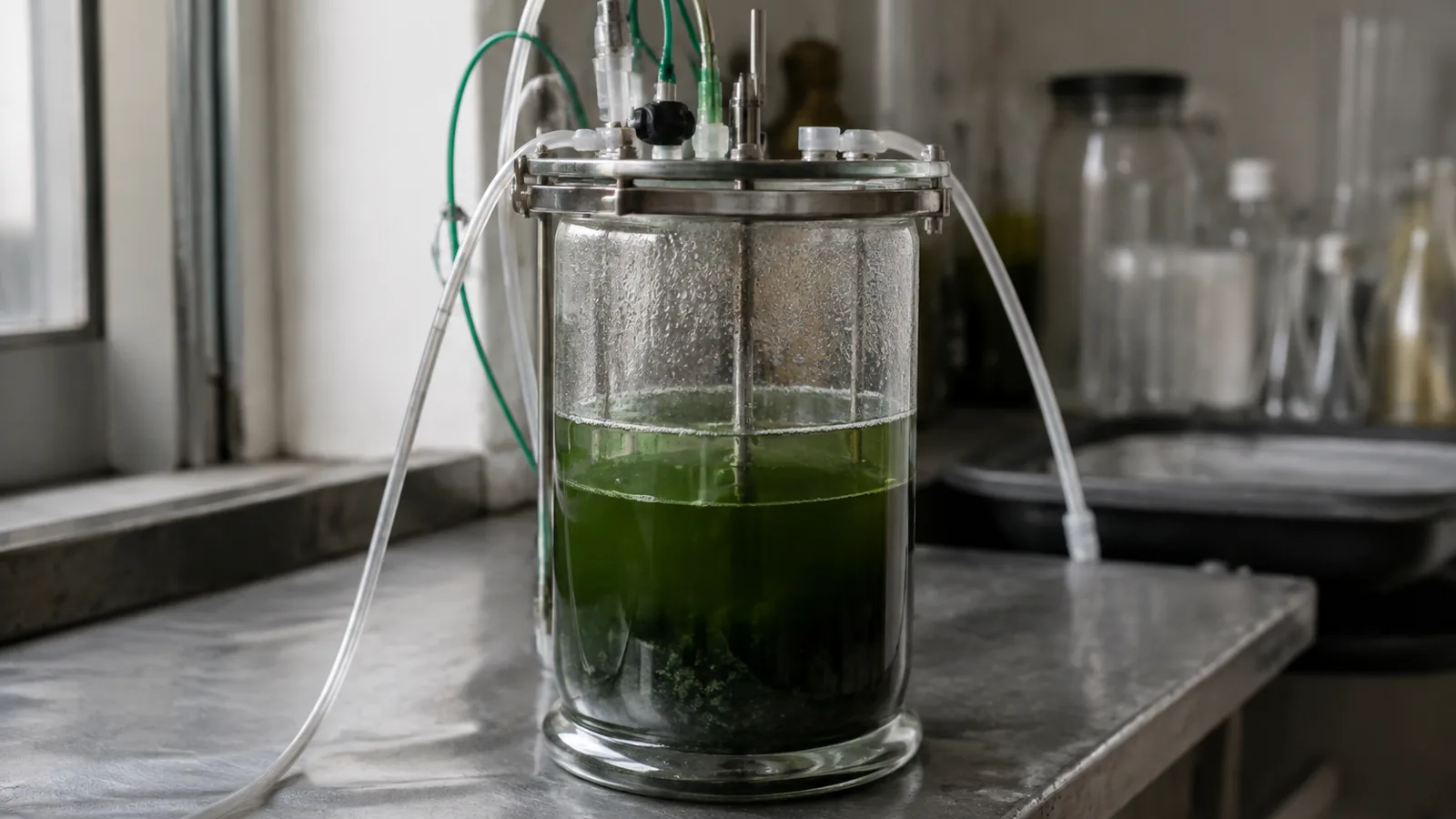
So the promise is worth something if it holds: a spirulina that makes the working form instead of the decoy. The method is the clever part. Tzachor’s team did not touch the organism’s genes. They changed its light. By tuning the wavelengths inside the photobioreactor, what the paper in Discover Food calls photonic management, they pushed the cyanobacterium’s metabolism toward biologically active, “unopposed” cobalamin rather than the analogue. On the chemistry, the result is legitimate and interesting.
Then you read what the study actually did. It measured a tank. Nobody swallowed the spirulina. The work in Discover Food was an engineering and life-cycle assessment of a cultivation system, weighing its energy inputs against its outputs, the composition of the biomass among them. The 1.64 microgram figure is an analytical reading of what came out of the reactor, the same category of measurement that flattered spirulina for decades and then collapsed the moment a human digestive tract got involved. The assay found active B12. No one has fed it to a person.
The gap between those two numbers, the one on the certificate of analysis and the one your bloodstream sees, is exactly what killed the original B12 claim. Only the second number counts, and only a human trial produces it. An “unopposed” active-B12 reading is a better place to start than the old pseudovitamin muddle. It is still a place to start. The experiment that would settle the question, feed the stuff to B12-deficient volunteers and watch their serum B12 and MMA move, is the one the announcement does not describe, because it has not been run.
There is a second sleight, and it lives in “per 100 grams.” Beef is something people eat in 100-gram portions. Dried spirulina is not. A typical serving is 3 to 5 grams stirred into a smoothie, and at 1.64 micrograms per 100 grams, five grams delivers roughly 0.08 micrograms. The adult daily requirement for B12 is 2.4 micrograms. To cover it from this spirulina you would have to eat on the order of 150 grams of dried powder a day, thirty-odd normal servings, which no one does and no one will. “Comparable to beef” is true only at a dose nobody consumes.
It helps to know who is telling the story and who paid for it. The cultivation platform the study evaluated was developed by VAXA Technologies, which grows spirulina in photobioreactors beside Iceland’s Hellisheiði geothermal plant and sells it. The researchers ran an engineering and life-cycle assessment of VAXA’s system and acknowledge the company’s cooperation, down to free access to information from the general manager of Vaxa Iceland. The money came from the European Union’s Horizon 2020 programme, through a project called NextGenProteins built to develop alternative proteins, plus two Icelandic public funds. A week after the study went public, VAXA said it was expanding its ÖRLÖ line with Icelandic Ultra Spirulina products carrying the active B12, and quoted its chief technology officer, Professor Isaac Berzin, calling the findings “a significant step forward.” None of that is disqualifying. It is the kind of thing a reader is entitled to know before “sustainable alternative to animal-source foods” does its work on them: a favorable assessment of a company’s system, funded by a program built to promote exactly this class of product, now selling the product on the strength of the paper.
And the finding is not new. The paper published on August 7, 2024. Reichman University’s release followed on August 20, 2024; VAXA’s own came eight days after that. What arrived in late August 2026 dressed as a discovery is that same two-year-old result on its second lap, stripped of the two years in which the confirming human study could have been done and was not.
VAXA has already put the product on the shelf. The one experiment that would tell a deficient vegan whether this spirulina finally does the job, the one that separates a better assay reading from a better supplement, is the one still waiting to be run.
Sources
- Discover Food – Tzachor et al., “Photonic management of Spirulina (Arthrospira platensis) in scalable photobioreactors to achieve biologically active unopposed vitamin B12” (2024)
- EurekAlert – Reichman University release on the spirulina B12 study, including funding and VAXA acknowledgment (Aug 20, 2024)
- PR Newswire – VAXA Technologies release announcing ÖRLÖ Icelandic Ultra Spirulina with active B12 (Aug 28, 2024)
- ScienceDaily – “Researchers unveil sustainable spirulina solution to vitamin B12 deficiency” (Aug 30, 2026)
- VeganHealth – Vitamin B12 in plant foods: spirulina’s pseudovitamin content and human-trial failures (Dagnelie 1991; Vegan Society)