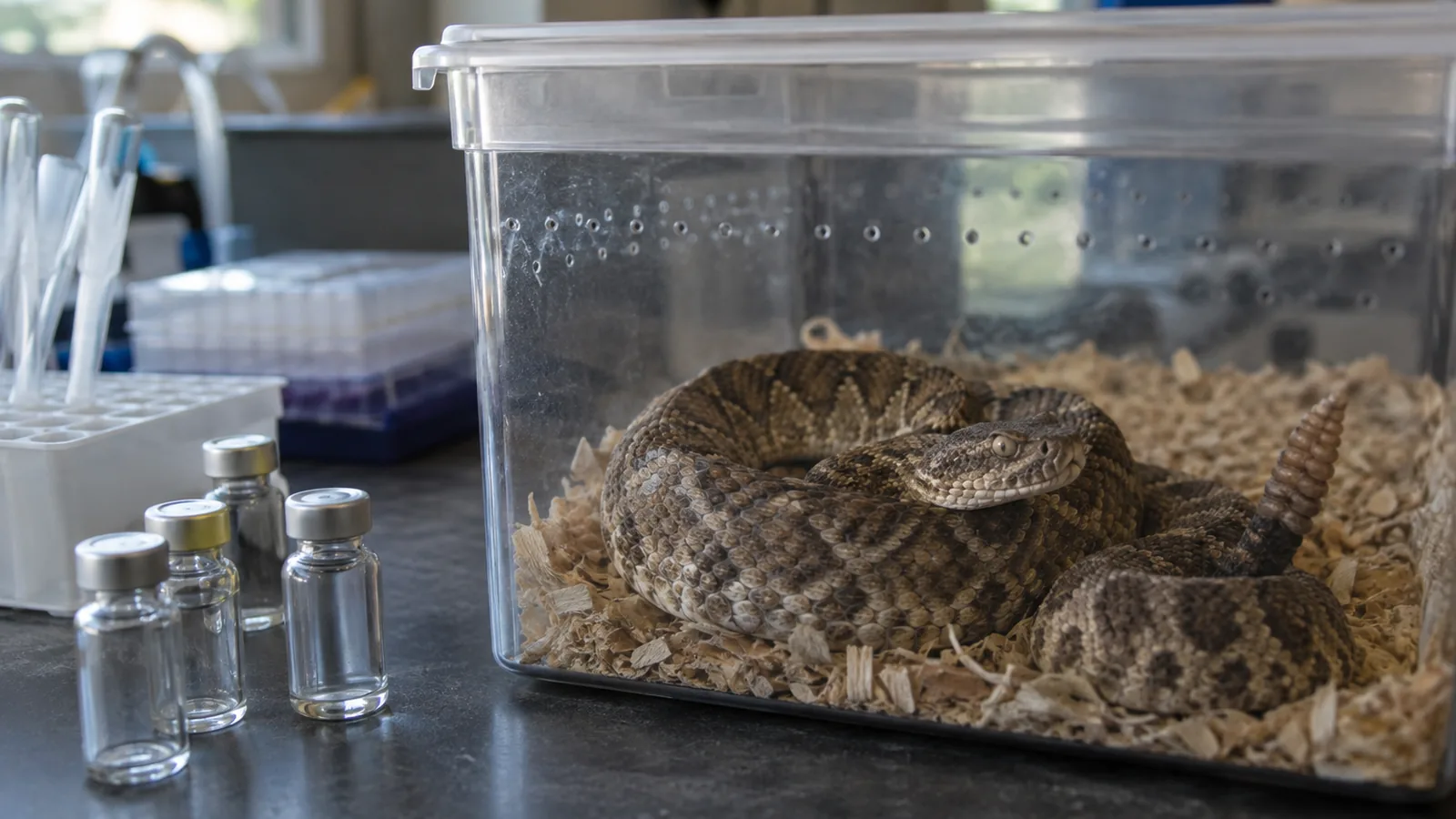
A rattlesnake can bite its own tongue and shrug it off. I didn’t know that until this week, and the moment I did, I couldn’t stop asking the obvious question: why doesn’t the venom kill the animal that brews it? A western diamondback carries enough hemorrhagic poison in its head to drop a grown man, its fangs sit millimeters from its own bloodstream, and somehow it just does not bleed to death. Something in that snake’s blood has been quietly holding the line against its own weapon the whole time. Biologists at the University of Maryland went looking for what, and they found an antidote evolution had already built, floating in the snake’s own serum.
The work, published in the Proceedings of the National Academy of Sciences by a team led by biologist Sean B. Carroll, is the kind of result that makes the whole century-old way we treat snakebite look clumsy. “Why rely on horse antibodies,” Carroll asked, “when nature has packaged an effective antidote right there in the snake?” That’s not a flourish. It’s the premise, and the lab data under it is startling.
Let me tell you what they actually did, because I came in braced for hype and left impressed by how careful it is. Rattlesnakes make a family of blood proteins descended from an ancient, unglamorous vertebrate glycoprotein called Fetuin-A, the same molecule drifting around in your blood and mine. Evolution copied that ancestor and spun off new versions: FETUA-1 through FETUA-5, and four of them, FETUA-2, 3, 4 and 5, exist only in the snakes. These four are toxin-blockers. They clamp onto the metalloproteinases, the venom enzymes that shred blood-vessel walls and cause the ugly, tissue-melting hemorrhage of a viper bite, and they switch them off.
But wait, why wouldn’t one protein do the job? Venom isn’t one poison. It’s a chemical orchestra, dozens of toxins playing at once. When the team tested the FETUA proteins one at a time against western diamondback venom, they mostly flopped. FETUA-3 alone did nothing, 0 of 5 mice. FETUA-2 alone was a coin toss, just 2 of 5 mice survived, and the survivors were sick. Then they combined them, and the picture flipped: FETUA-2 and FETUA-3 together gave complete protection against a lethal dose. Add FETUA-5 to the pair and the three together shut down the eastern diamondback too. The snake doesn’t defend itself with an antidote. It defends itself with a recipe, and you have to reassemble the whole recipe to get the benefit.
Then there’s the potency, which is where I sat up. Measured by weight in mice, the FETUA combination hit an ED50 of about 5.6 mg/kg against diamondback venom, which the authors put at about 10 times the potency of affinity-purified CroFab, the sheep-derived antivenom hospitals actually stock, and about 3 times the potency of the snake’s own whole serum. Ten to one against the commercial product, from proteins the animal grows for free.
Now sit with how we make the stuff we use now. Conventional antivenom is 19th-century technology in modern packaging: you inject a horse or a sheep with venom, again and again, then bleed the animal and purify the antibodies its immune system throws back. It’s expensive, it’s slow, and the product carries real risk to the patient, from allergic reactions to serum sickness, because you’re pouring another species’ antibodies into a human body, and even the modern sheep-derived version has put patients into acute respiratory distress. And it’s a business. In the United States the average snakebite treatment runs to about $31,343 a person, most of it the antivenom itself, and severe bites have produced six-figure hospital bills. The registry paper counting CroFab and Anavip vials across US envenomations was itself funded by BTG Specialty Pharmaceuticals, CroFab’s maker. A free protein the snake already builds doesn’t just embarrass that supply chain scientifically. It undercuts the price.
Here’s where I make myself slow down, because the result is preclinical and I won’t oversell it. Every one of these experiments used mice, BALB/c mice weighing 18 to 20 grams, with the venom and the FETUA proteins mixed together in a tube and incubated for half an hour before injection. That’s called preincubation, and it’s the friendliest possible test: the antidote meets the venom before either one meets the animal. It is not how a bite works. Nobody has yet tested whether these proteins can rescue you when they’re injected after the venom already has a head start in your tissue. The authors say so flatly, and they flag that the safety and pharmacokinetics in a living patient are simply unknown. The proteins won under the lab’s kindest conditions, which is exactly why the rescue-after-bite experiment is the next hard test, and the one I’ll be watching.
There’s a deeper honesty in the paper, too. These proteins block metalloproteinases, and only those. They do nothing to the venom’s phospholipase A2 toxins or its serine proteases, and in many vipers the PLA2 toxins do a big share of the killing. The team was blunt about it: shutting down the metalloproteinases won’t, by itself, be enough for every venom. You can watch the ceiling in their own data. Against the saw-scaled viper the cocktail helped but couldn’t fully protect, 3 of 5 mice survived; against the African puff adder it saved nothing at all, 0 of 5, even though it looked busy in the test tube. That gap isn’t academic. The snakes that fill the morgues aren’t American rattlesnakes. They’re the vipers and cobras of rural Africa and South Asia, where snakebite kills on the order of 100,000 people a year and maims hundreds of thousands more, a toll so badly counted that some researchers think the true number runs several times higher.
One more receipt. The co-inventors have patents pending on this work, with the University of Maryland as the assignee. I don’t hold that against them, that’s how a discovery gets funded and turned into something you can actually put in a vial. But it tells you where this is going. The antidote is free inside the snake. If it ever reaches a clinic, it will arrive with intellectual property bolted on, and the question of who can afford it will land hardest on exactly the poor, rural populations who need it most.
So what do I do with this? I file it under science that reorganizes how I think, not treatment I’d bet my life on tomorrow. If a diamondback got me in Arizona this year, I’d still want the sheep-derived antivenom in the ER, because that’s what has been tested in people and this hasn’t. But I’d watch the rescue experiments like a hawk, because the day a FETUA cocktail neutralizes a puff adder in a living animal injected after the bite, the whole moral and economic map of snakebite redraws itself. And I’d bet on the snake before I bet on the horse. Nature spent millions of years solving this inside the animal we’re all afraid of, and the hard part left is human, not biological: whether the antidote it grew for free reaches the clinic at a price the rural poor can pay. I’ll be watching for that as closely as I watch the rescue data.
Sources
- PNAS – Ukken, Carroll et al., “Nature’s antivenom: Combinations of conserved rattlesnake serum metalloproteinase inhibitors block the lethal action of viper venoms” (2026)
- PubMed Central – full text: FETUA methods, combinations, ED50, PLA2 limits, saw-scaled viper and puff adder results, funding and conflicts
- Phys.org – “Combined rattlesnake proteins prove 10 times more potent than current antivenom in lab tests”
- PubMed Central – “The Cost of Antivenom: A Cost Minimization Study using the North American Snakebite Registry”
- Journal of Medical Toxicology – CroFab and Anavip vial administration in US rattlesnake envenomations, funded by BTG Specialty Pharmaceuticals
- CHEST – CroFab-induced acute respiratory distress, a documented antivenom complication
- WHO – snakebite envenoming as a neglected tropical disease
- PLOS Neglected Tropical Diseases – systematic review of global snakebite morbidity and mortality
- ScienceDaily – “Scientists discover a powerful new antivenom hidden in rattlesnake blood”
- PubMed – study record for the rattlesnake serum inhibitor paper