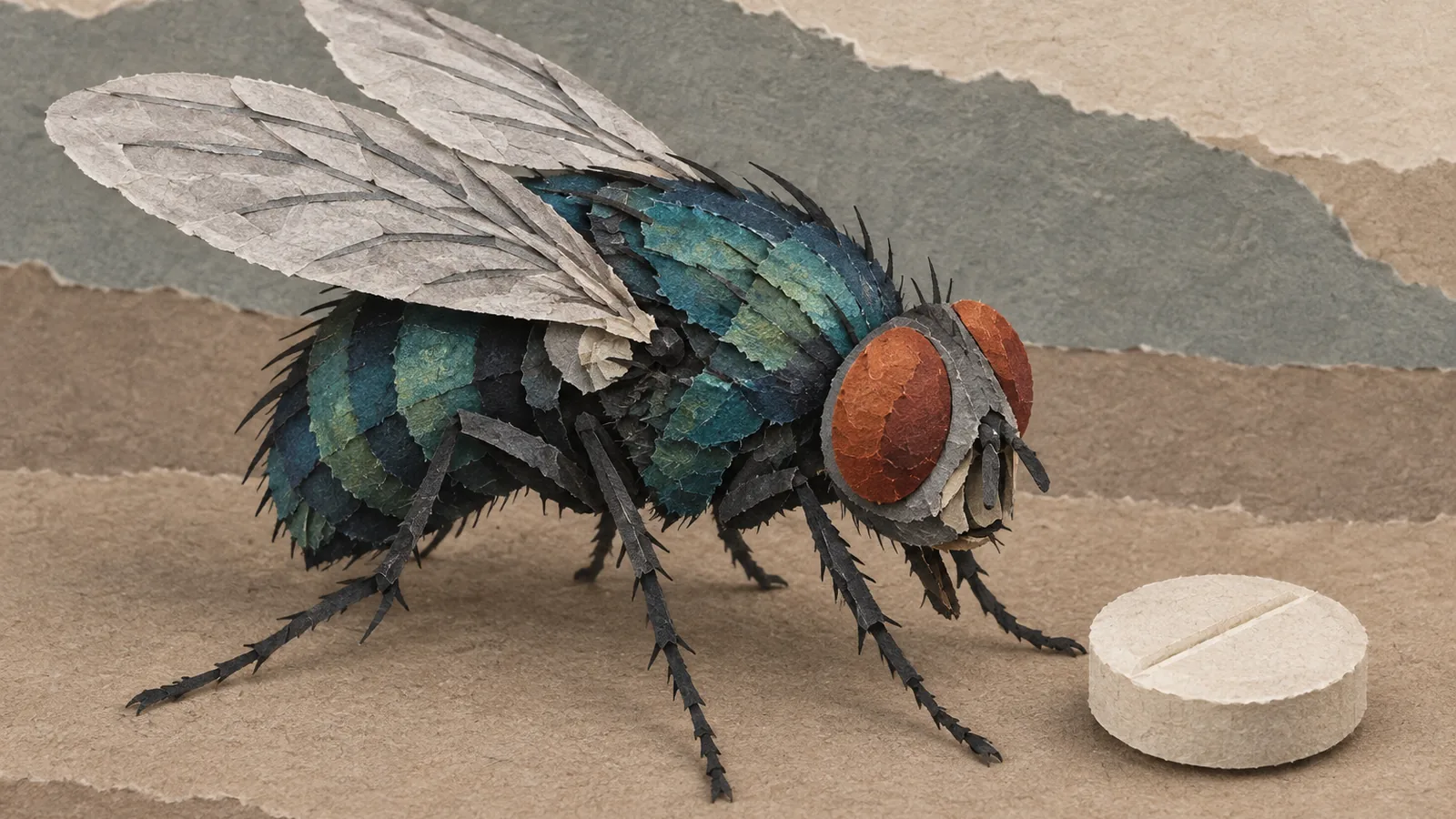
The United States beat the New World screwworm in 1966. Not managed it, not held it at arm’s length, eradicated it, in one of the great quiet victories of applied American biology. Sixty years later the parasite is back inside the southern border, and the emergency tool the FDA reached for this month is a flea pill approved in 2000. To understand how a country travels from total eradication to improvising with an over-the-counter pet tablet, start with the animal itself, because the screwworm is not an ordinary parasite.
Most flies that colonize a wound are janitors. They eat dead tissue and leave. The screwworm does the opposite. Its larvae consume only healthy, living flesh, burrowing like a screw into wood and tearing deeper into the host as they feed. A female mates once in her life, then lays her eggs at the edge of any open wound: a tick bite, a branding scar, the navel of a newborn calf. Left alone, an untreated infestation can kill a full-grown steer in under two weeks. It does not spare people.
That single mating is what doomed the fly the first time. USDA entomologists Edward Knipling and Raymond Bushland reasoned that if the female breeds only once, flooding the wild with sterilized males would starve the next generation before it arrived. Release enough sterile males, the females mate with them, the eggs never hatch, and the population collapses from the inside. It worked. By 1966 the screwworm was completely gone from the United States, and over the next four decades the same technique pushed the fly steadily south, out of Mexico and down through Central America, until by 2006 the continental population had been driven behind a living wall at the Darién Gap in Panama, where a facility releases 100 million sterile flies every week to keep South America’s screwworms from walking back north.
The United States stayed screwworm-free for the better part of sixty years. Then the barrier holding the fly at the Darién Gap was breached. On September 3, 2026, the FDA issued an Emergency Use Authorization for Capstar tablets and revised an earlier authorization for the generic version, clearing both to prevent and treat screwworm infestation in dogs and cats. “The FDA is addressing a previously unmet need and giving pet owners and veterinarians important tools to protect dogs and cats from NWS infestations,” said Timothy Schell, director of the agency’s Center for Veterinary Medicine. A “previously unmet need” is the bureaucratic way of admitting that six decades after eradication, the government had no authorized dog-or-cat treatment sitting on the shelf for the day the fly came back. So it reached for the closest thing it could find.
What it found was nitenpyram. The active ingredient is a neonicotinoid sold since 2000 under the brand name Capstar, the fast flea killer you give a dog to drop the adult fleas off it within hours. It was never built for anything more ambitious. It kills adult fleas and nothing else in the life cycle: no eggs, no larvae, no pupae. That is why it has always been sold as a knockdown, not a cure. The FDA’s own authorization language is honest about the limits if you slow down and read it. Nitenpyram kills most screwworm larvae within hours of the first dose. Owners must give a second dose six hours later. A veterinarian may still have to physically remove the surviving larvae from the wound. And the drug offers no protection at all against the next fly that lands. This is a 26-year-old over-the-counter flea tablet, made in 11.4 mg and 57 mg sizes dosed by weight, pressed into service as the nation’s frontline pet treatment for a flesh-eating parasite. It is, by the FDA’s own description, the first generic over-the-counter animal drug any U.S. agency has authorized against the screwworm. That is not the sound of preparedness. It is the sound of a system improvising.
The wall we stopped tending
The improvising is a fair measure of how badly the wall was neglected, because the barrier did not fall to some new super-fly. It fell because we stopped maintaining it. The northward breach began in 2023, and the causes on the record are mundane and damning in equal measure: interruptions in sterile-fly production during the COVID-19 disruptions, illegal cattle moving across borders faster than surveillance could track them, and the sheer difficulty of policing the jungle terrain where the flies are released. Once the population slipped the barrier, it did what it has always done. Since that breach the region has logged more than 185,000 animal cases and over 2,100 human cases. In August 2025 the first human case in the United States in years surfaced in Maryland, a traveler who carried the infection home from Central America. Then it stopped being an import. On June 3, 2026 the USDA confirmed the first domestic animal case of the current outbreak, a three-week-old beef calf in Zavala County, Texas, roughly fifty miles from the Mexican border, and by early September there were 48 confirmed cases across Texas and New Mexico in cattle, sheep, goats, and dogs. The pest we spent a generation walking out of this hemisphere walked back in through the southern border in a single summer.
The trade damage arrived faster than any treatment. Within days of the first Texas case Canada banned cattle that had been in Texas within the prior 21 days, and Mexico halted most U.S. livestock imports before the Douglas, Arizona port reopened to cattle on August 24, 2026 under a jointly negotiated protocol layering inspections and traceability on every animal. So it is worth seeing the emergency flea pill clearly, for what it is and what it is not. For the family whose dog picks up an infestation, an authorized on-label treatment beats the alternative, which until this month was nothing. But a short-acting tablet that has to be redosed and that leaves the animal open to the next fly is a bandage on the individual, not a defense of the country.
The real defense is the one Knipling and Bushland built and we let lapse: sterile flies, produced at industrial scale and released without a break. That is where the next chapter gets decided, and the thing to watch is the production line, not the pharmacy shelf. The USDA is releasing sterile flies in Texas now, Governor Greg Abbott has pledged to fast-track a domestic sterile-fly factory, and Mexico is converting a plant to turn out 60 to 100 million sterile flies a week. Whether this outbreak is contained or keeps spreading will not turn on how many Capstar tablets ship. It will turn on whether those factories reach full output before the fly pushes past the current Texas and New Mexico clusters, and whether the sterile releases run without the interruptions that opened the door in 2023. The screwworm was beaten once by patience and uninterrupted production. It will only be beaten again the same way, and an emergency flea pill is the receipt for what happens when the patience runs out.
Sources
- FDA – Emergency Use Authorization for drugs to prevent and treat New World Screwworm in dogs and cats (Sept 3, 2026)
- FDA – EUA for generic over-the-counter nitenpyram against New World Screwworm
- ASM – New World Screwworm: Rise, Fall and Resurgence
- Golden Goose Award – Knipling and Bushland and the sterile insect technique
- CBS News – FDA clears emergency use of nitenpyram for screwworm in pets
- USDA/HHS – first travel-associated U.S. human screwworm case (Aug 26, 2025)
- Swine Health Information Center – USDA confirms NWS detections in Texas and New Mexico, June 2026
- AZFamily – Douglas port of entry reopens to cattle after screwworm closure (Aug 24, 2026)
- Wikipedia – 2026 United States New World Screwworm outbreak