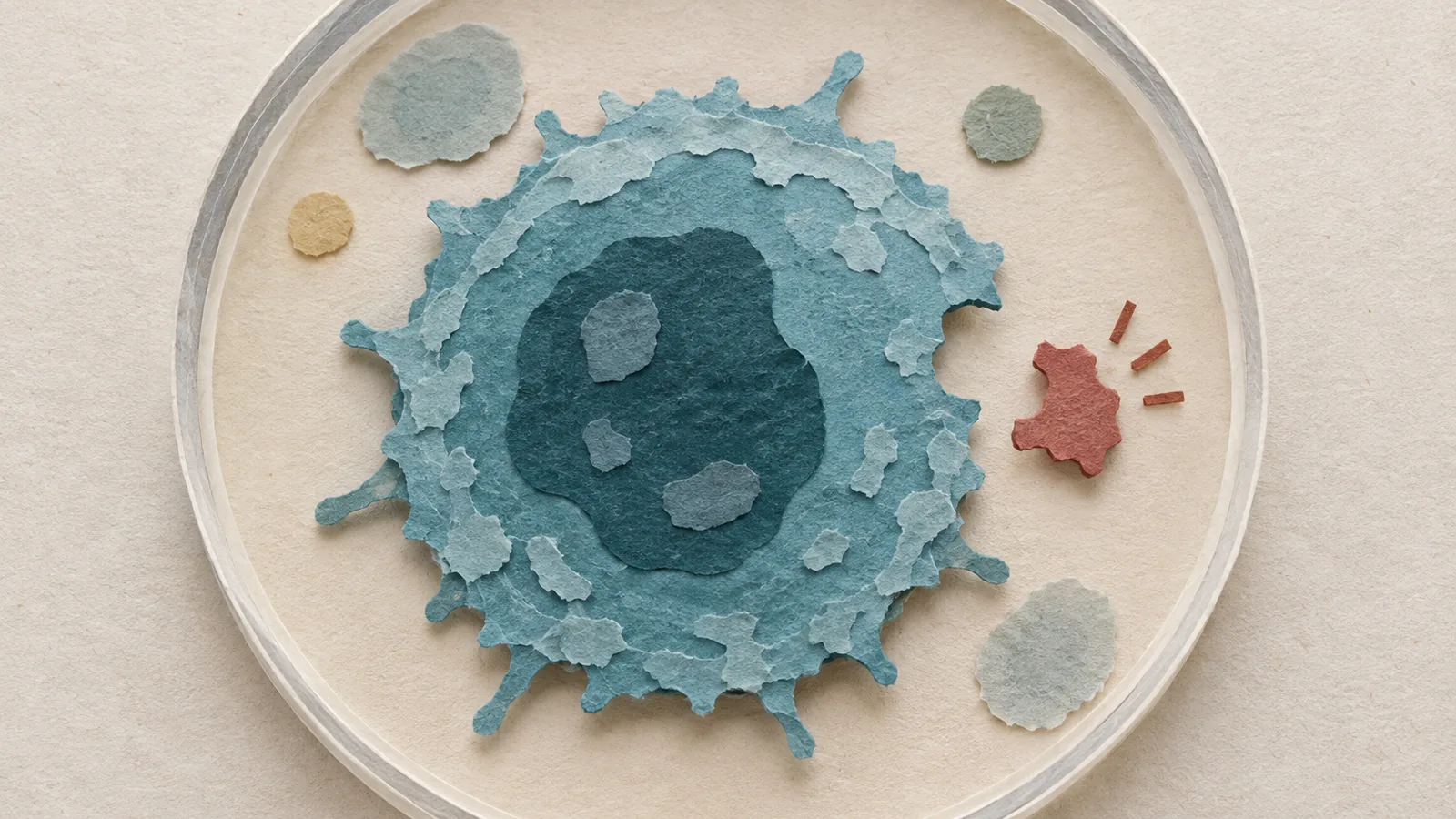
For most of my life I filed “broken gene” under bad news, full stop. A misspelling in the code, a function lost, and usually a person who pays for it. ANKRD11 is that kind of gene: break it in a developing embryo and you get KBG syndrome, oversized front teeth, short stature, and, in most affected kids, some degree of developmental delay. So a study that deliberately switched the same gene off inside immune cells and got a better fighter is not what I expected to be reading this week.
You are not building a better weapon. You are deleting the brake.
The paper landed in Nature Immunology on September 11. Zhou and colleagues shut ANKRD11 down specifically inside CD8 T cells, the assassins of your immune system, the ones that punch holes in infected and cancerous cells. Instead of a defect, they got a cell that held up better. Deleting the gene reprograms how those T cells differentiate, steering their fate away from the worn-out dead end and toward cells that keep working, and the reprogrammed cells did more in two of the hardest arenas immunology has: chronic hepatitis B, and cancer.
Here is why that combination made me sit up. Chronic HBV is not a rare problem. Roughly 240 million people carry it, and one reason it is so hard to clear has less to do with the virus being clever than with your own T cells quietly going dark. A 2024 Nature paper mapped one version of that in the liver: virus-specific CD8 T cells reach through the blood-vessel wall to grab infected liver cells, and the surrounding tissue pours prostaglandin E2 over them, spiking cAMP inside the T cell, tripping a kinase called Csk that shuts down the cell’s own trigger. The killer arrives at the scene, reaches for the alarm, and finds someone has cut the wire. Not exhausted, exactly. Switched off.
That is the backdrop against which “delete a gene and the cell fights again” gets interesting. And it sent me to the question I could not shake: why would breaking a chromatin gene make a tired T cell stronger, when breaking it in a brain makes a child struggle?
The answer, I think, is in what ANKRD11 does for a living. It is not a fighting gene, it is an editor. Broadly, its job is to pull histone-modifying machinery onto the DNA and tighten it, keeping certain genes wrapped up and quiet. In a developing neuron that curation is essential, which is why losing it derails development. But picture that same editor sitting inside a CD8 T cell that has been fighting a chronic enemy for months. If ANKRD11 is helping lock the chromatin into the give-up program, then removing it does not add anything new. It just takes the hand off the book and lets the cell read the pages it had been kept from: the path toward the durable, stem-like precursors that keep an immune response alive, instead of the dead-end effectors that burn out. You are not building a better weapon. You are deleting the brake.
This is a bench finding wearing very ambitious clothes. Zhou’s team is working at the bench, not in a clinic, and nobody has treated a patient on the strength of it. There is also a hard wall between this mechanism and a medicine: you cannot knock ANKRD11 out of a person, because a body-wide loss of it is KBG syndrome. The whole thing rests on doing the deletion only in T cells, which is a real trick, not a footnote. A beautiful mechanism and a therapy are separated by exactly that gap.
What makes me think the direction is not a fluke is that ANKRD11 is not alone. Over the last two years, labs coming from wildly different angles have found brakes on struggling CD8 T cells and pulled them. One team showed that simple dietary restriction reprograms CD8 T cell fate and improves the response to immunotherapy. Another found that ablating a factor called Satb1 redirects exhausted subsets back toward antitumor work. A third restored pancreatic-tumor immunity by targeting a lipid enzyme, DGAT1. Different models, different levers, and I would not pretend they share one mechanism. But a pattern is surfacing under them: the exhausted T cell is not empty, it is held. ANKRD11 is one more finger on the clamp, and a chromatin-level one at that.
My conclusion is not a cure headline. I would push back on anyone selling this as hope for a hepatitis B patient this year. What I read it as is a map of the brake, and the experiment I am actually waiting for is the one that mimics the effect with a molecule instead of a gene deletion, because that is the line between elegant biology and something that ever reaches a human vein. I am glad the search has turned from “how do we build a stronger T cell” to “what keeps switching the good ones off,” because in chronic HBV and in cancer, that switch is a lot of why the disease wins. But until someone shows me that molecule, I will treat this as a gorgeous map and nothing I would stake a patient on yet.
Sources
- Nature Immunology – Zhou et al., ANKRD11 deficiency reprograms CD8+ T cell differentiation to enhance immunity in chronic infection and cancer (2026)
- Nature – A liver immune rheostat regulates CD8 T cell immunity in chronic HBV infection (2024)
- WHO – Hepatitis B fact sheet (240 million living with chronic HBV, 2024)
- GeneReviews (NCBI Bookshelf) – ANKRD11-Related KBG Syndrome: gene function and clinical features
- Nature Metabolism – Dietary restriction reprograms CD8+ T cell fate to enhance anti-tumour immunity and immunotherapy responses (2025)
- Frontiers in Immunology – Ablating Satb1 reprograms the differentiation trajectory of exhausted CD8+ T subsets to enhance antitumor immunity (2026)
- Nature Communications – Targeting DGAT1 reprograms lipid landscape and restores CD8+ T cell immunity in pancreatic cancer (2026)