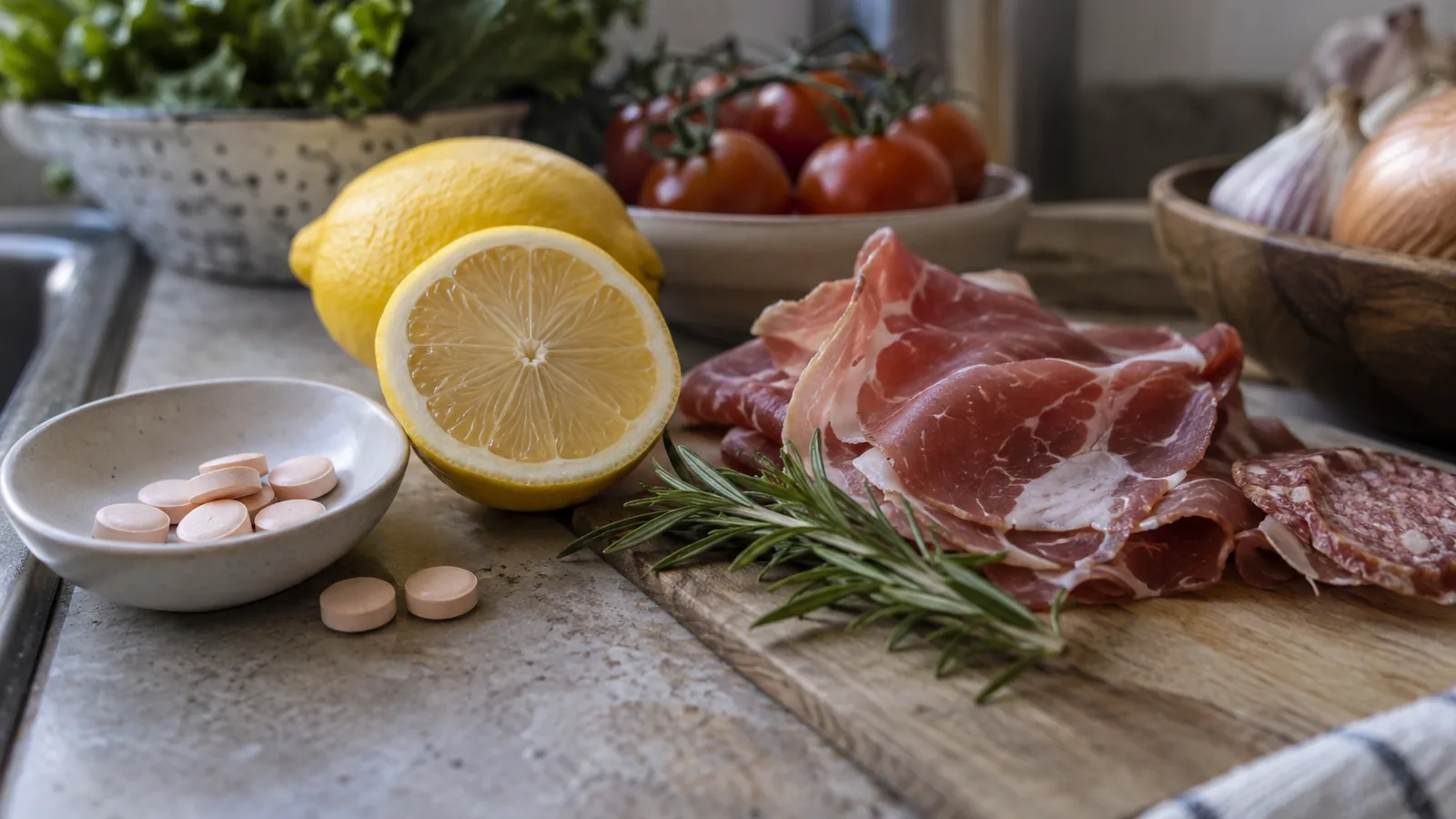
I have spent years telling people not to fear vitamin C on an ingredient label. Ascorbic acid is just vitamin C. Citric acid is what makes a lemon a lemon. Rosemary extract is, well, rosemary. These are the “clean” preservatives, the ones I would point to and say: relax, that one’s fine. So when I saw all three sitting on a list of eight preservatives linked to higher blood pressure in a study of more than a hundred thousand people, my first reaction was not fear. It was confusion. How does vitamin C end up on a heart-risk list?
So I went digging. The answer turned out to say less about vitamin C than about how these chemicals get onto your plate in the first place, and who signed off on them.
The study is NutriNet-Santé, a French cohort that has been following volunteers since 2009, and the new analysis in the European Heart Journal tracked 112,395 adults, mean age 42, nearly four in five of them women. These are not people who filled out one survey and vanished. Every six months they wrote down everything they ate and drank across a three-day window, and the researchers followed them for an average of seven to eight years. Here is the number that stopped me: within the first two years, 99.5 percent of them had eaten at least one industrial preservative. Not most people. Essentially all of them. Preservatives are not an edge case of the modern diet; they are baked into it.
| Measure | Value |
|---|---|
| of the cohort | 99.5% |
The team split the additives into two families by what they do in the food. Non-antioxidant preservatives are the ones that stop mold and bacteria. Antioxidant preservatives keep fat from going rancid and stop cut apple from browning.
Then they compared the heaviest users of each family to the lightest. The people eating the most non-antioxidant preservatives had a 29 percent higher rate of new high blood pressure and a 16 percent higher rate of cardiovascular disease, the heart attacks, strokes, and angina that hypertension eventually pays out. The antioxidant family, the “good guys” with vitamin C among them, carried a 22 percent higher rate of high blood pressure. Eight additives came up tied to hypertension by name: potassium sorbate (E202), potassium metabisulphite (E224), sodium nitrite (E250), ascorbic acid (E300), sodium ascorbate (E301), sodium erythorbate (E316), citric acid (E330), and rosemary extract (E392). Ascorbic acid was the one also tied to cardiovascular disease on its own.
| Measure | Value |
|---|---|
| Non-antioxidant, hypertension | 29 |
| Antioxidant, hypertension | 22 |
| Non-antioxidant, CVD | 16 |
Which sent me back to my question, because I could not let it go. Why would ascorbic acid, a molecule I actively recommend people get more of, land on a blood-pressure list?
You have to think about what an additive on a food diary actually is. When you eat citric acid or ascorbic acid, it is almost never because you squeezed a lemon or bit into a bell pepper. It is because you ate something built in a factory that needed those compounds to survive a supply chain. The additive is not really the exposure. It is a fingerprint. A high ascorbic-acid intake is a tidy chemical marker for a diet that pours in from packages, and packaged food carries a lot of other passengers: sodium, refined starch, emulsifiers, the industrial texture of a thing engineered to sit on a shelf for a year. The vitamin C is not the suspect. It is the tan line that tells you where the person has been.
That cuts both ways, and it is the honest limit of the study. The researchers say so plainly: this is an observational design, which finds statistical associations, not proof that a preservative reached into an artery and did damage. They adjusted for the obvious confounders, but the one I kept circling is salt. Sodium nitrite carries sodium. Sodium ascorbate and sodium erythorbate carry it in the name. So is this a preservative story, or a hiding-in-plain-sight salt story riding under a chemical label? The team accounted for other risk factors and I think the association holds; I am less sure it belongs to the chemistry rather than to the whole processed package the chemistry rides in on. That is not a dodge. It is the open question the study leaves on the table.
The confounding worry cuts one way. The specific chemicals cut the other, and not all of these are innocent UPF markers. Sodium nitrite is the compound that gives cured meat its pink, and in the gut it can help form nitrosamines, a class of compounds long flagged as carcinogens. That is not a new or fringe worry. The sulfite in potassium metabisulphite is a well-known irritant that plenty of people already react to. These are working chemicals, and the establishment’s answer for decades has been that each one, tested alone, at the dose in a single food, is fine. This study did not test them alone. It watched what happens when a real person eats the real mixture, every day, for years. That is the exposure that actually exists, and almost nobody has been measuring it that way.
The biology is the smaller problem here. The bigger one is who decided these were safe to begin with. In the United States, a large share of food chemicals reached the market through the GRAS pathway, “generally recognized as safe,” a 1958 rule with a later addition that lets a manufacturer assemble its own panel of experts, declare an ingredient safe, and start using it. The FDA strongly encourages a company to file a notice, but it does not require one, so an ingredient can be self-affirmed and put in your food without the agency or the public ever being told. The company that profits from the additive gets to certify the additive. On March 10, 2025, HHS Secretary Robert F. Kennedy Jr. directed the FDA to explore rulemaking to eliminate that self-affirmed loophole, which he said had let new chemicals “often with unknown safety data” enter the food supply “without notification to the FDA or the public.” For once the populist instinct and the epidemiology point the same way: the French team, working from the data side, called for a re-evaluation of these additives “by the authorities in charge, such as the EFSA in Europe and the FDA in the USA.”
Sit with that. A 112,000-person cohort and a peer-reviewed cardiology journal are asking regulators to go back and re-check compounds those same regulators, or the companies they were supposed to be policing, waved through decades ago. Even JAMA ran the finding in its own news pages, the establishment quietly conceding what skeptics of the processed-food complex have said for years: nobody was watching the combination. The “safe” list was never the product of a long, human, real-diet study of the kind that would earn the word. It was the product of a paperwork standard built for industry convenience.
I am not going to tell you ascorbic acid is bad for you, because that is not what the evidence says and I would be lying to make a cleaner story. What I took from this is different. The lesson is not to fear the E-number. It is that E-numbers cluster, and where they cluster densely is a package, not a plate. So here is my decision, the one I have already made: I am not scanning labels for ascorbic acid, and I am not waiting on a rulemaking that may take years to finish. I am going to keep buying the food that does not need a preservative to survive the trip home, and when 99.5 percent of a cohort is eating the same class of chemicals, I am going to put the burden of proof on the people selling it, not on me.
Sources
- European Heart Journal – Hasenböhler, Touvier et al., preservative additives, hypertension, and CVD in the NutriNet-Santé study (2026)
- European Society of Cardiology – press release on the NutriNet-Santé preservative findings (2026)
- American College of Cardiology – Journal Scan summary of the NutriNet-Santé analysis (2026)
- ScienceDaily – coverage of the eight preservatives linked to blood pressure and heart disease (2026-09-20)
- JAMA Medical News – “Some Common Food Additives Linked to Hypertension and CVD” (2026)
- ClinicalTrials.gov – NutriNet-Santé cohort record (NCT03335644)
- HHS – Secretary Kennedy directs FDA to explore eliminating the self-affirmed GRAS pathway (2025)