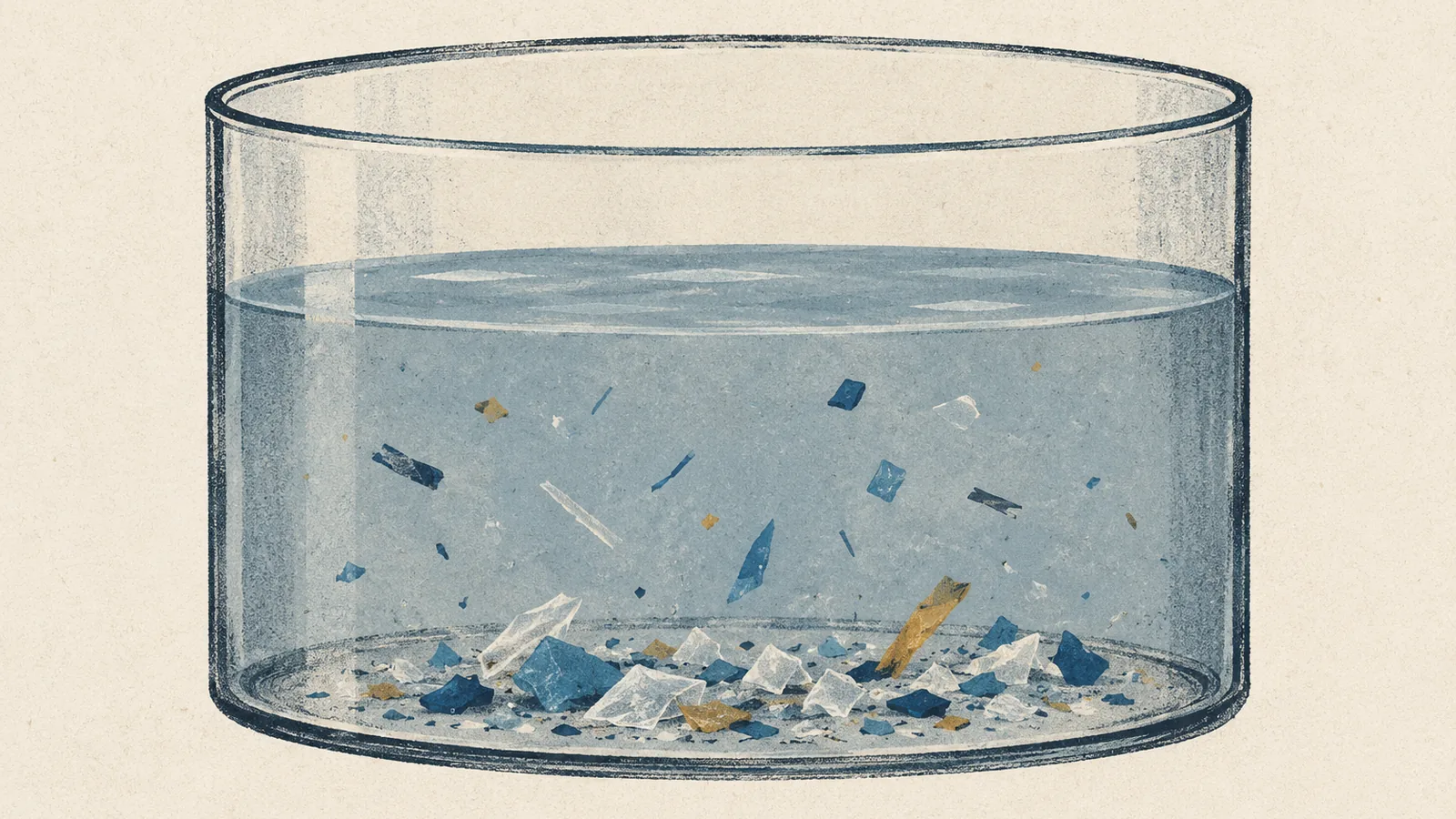
For years I kept plastic in two mental bins: the additives that leach out, which worried me, and the polymer itself, which I filed as chemically dead. So a new Columbia paper left me with a slightly uncomfortable question. Why did I ever assume the polymer just sat there? In lab tests published in Nature on October 14, microscopic particles of six of the most common commodity plastics generated hydroxyl radicals at their surfaces just by sitting in water, with no sunlight, no catalyst and no heat. And across those six plastics, the ones that made more radicals ruptured more red blood cells.
The team, led by Naixin Qian and Wei Min, tested polypropylene, polyethylene, polystyrene, PVC, PET (the water-bottle plastic) and PMMA, better known as acrylic, and every one of them produced radicals where plastic met water. Qian didn’t soften what that means in Columbia’s announcement: hydroxyl radicals are “textbook examples of the kinds of molecules that can damage animal and human tissue.” They are the most aggressive of the reactive oxygen species, the oxidizers your cells spend a small fortune in antioxidant enzymes mopping up. Min told the Los Angeles Times that they “tend to damage nearby materials and molecules,” and warned that if they reach DNA, “most likely (it will) cause mutation.”
How you catch a radical in the act
Radicals are hard to prove because they vanish almost as fast as they form, so the team came at them two independent ways. Electron spin resonance with a chemical trap called DMPO grabbed the radicals long enough to fingerprint them, while a fluorescent probe that lights up around hydroxyl radicals glowed right on the surfaces of polystyrene particles under a confocal microscope, according to News-Medical’s summary of the paper.
Then came a test so simple it’s almost rude. Polystyrene particles stirred in water destroyed nearly 90 percent of a dye, methyl orange, over 10 days, and when the researchers swapped the water for methanol, ethanol, acetonitrile or DMF, the dye survived, per a detailed technical writeup. The plastic needed water to turn reactive.
| Measure | Share |
|---|---|
| nearly this share of methyl orange after 10 days stirred with polystyrene in water | 90 percent |
Time-lapse imaging put the output at roughly 0.1 to 1 nanomolar per minute, held for hours. The authors call that a lower bound.
sustained for hours
- Lower bound
- 0.1
- Upper bound
- 1
Wait, why would water do this?
This is where I stopped reading and just sat with it, because water and plastic famously don’t get along. Plastic is hydrophobic. It repels water, and that turns out to be the whole trick.
When water presses against a water-hating surface, the molecules at the boundary can’t form their usual full set of hydrogen bonds, so some are left with a dangling arm reaching out at nothing. Hydroxide ions, the OH⁻ always drifting around in water, get pushed into that strained layer, where they hold their electrons far more loosely. Simulations from Teresa Head-Gordon’s lab at UC Berkeley put a number on it: pulling an electron off hydroxide in bulk water costs about 207 kcal/mol, which is why it essentially never happens on its own, but at a negatively charged plastic boundary the computed cost drops below 100. Lose that electron and hydroxide becomes a hydroxyl radical.
What convinced me is that the bench data follow the theory. The more a plastic made water bead up on it, the more radicals it produced, with a correlation of 0.93 across the six plastics. When the team coated particles with a surfactant, Triton X-100, the plastic’s negative surface charge was neutralized and radical output fell in step, a correlation of −0.99 across four surfactant concentrations.
“Water is a key active player here, rather than just a spectator,” Min said. I’d put it more bluntly. Water is the reagent, and the plastic is the workbench.
The worst offenders are the plastics in your kitchen
Polyethylene and polypropylene, the two polyolefins, were the most reactive of the six, while the more water-friendly PET and PMMA were the least. Polypropylene is the plastic in most baby bottles and takeout tubs, and we already know those bottles shed: a 2020 Nature Food study from Trinity College Dublin found polypropylene bottles released up to 16 million particles per liter of 70°C water during formula prep, with hotter water releasing more, and estimated bottle-fed infants swallow an average of 1.6 million particles a day.
Nobody has measured radicals in a bottle of formula, and the bottle study tested no other polymers. But put the two papers side by side and you get heavy shedding from a plastic that, in this lab work, turns water reactive more readily than almost anything else tested. Because the reaction happens at surfaces, it also scales with surface area. “As plastic fragments into smaller and smaller particles, its surface area increases enormously,” Min said.
The same Columbia group estimated in 2024 that a liter of bottled water carries about 240,000 detectable plastic fragments, mostly nanoplastics, 10 to 100 times more than earlier counts. Your blood is largely water, and the researchers suggest particles that reach it could stay chemically active there.
What it did to cells
The team exposed red blood cells from mice to each plastic, and the cells deformed and burst. Polystyrene left some as helmet-shaped fragments called schistocytes, the shredded cells a pathologist associates with mechanical or oxidative injury. Across the six plastics, the more radical activity a material showed, the more cells it ruptured (r = 0.75). The plastics also pushed the protein lysozyme to clump, a looser association (r = 0.68), and adding caffeine, a radical scavenger, or the Triton coating suppressed that clumping almost completely. These were short lab exposures, and the authors themselves say they didn’t establish that the radicals directly caused the cell damage.
That’s the honest gap, and it sits on top of human evidence that has been piling up without a mechanism. In 2024, Raffaele Marfella’s team reported in the New England Journal of Medicine on 304 patients who had carotid surgery. Of the 257 followed, 58.4 percent had polyethylene lodged in their artery plaque, and over a mean 33.7 months those patients had a heart attack, stroke or died at a rate of 20 percent, against 7.5 percent for patients with no plastic detected, a hazard ratio of 4.53 (95% CI 2.00 to 10.27). Separately, researchers who exposed placental tissue from 40 healthy pregnancies to polystyrene microplastics watched superoxide and hydrogen peroxide climb while the tissue’s antioxidant enzymes, superoxide dismutase and catalase, fell. Neither study proves this particular chemistry is running inside people, but oxidative stress keeps turning up wherever plastic goes, and now there’s a plausible physical route for it.
| Group | Value (percent) |
|---|---|
| Plastic detected in plaque | 20 |
| No plastic detected | 7.5 |
For half a century the worry about plastic was what leached out of it, while the polymer surface was treated as the chemically quiet part, the reason we were comfortable wrapping food and water in it. This paper shows the interface between plastic and the most ordinary liquid on Earth doing aggressive chemistry. Matthew Campen of the University of New Mexico called it “a foundational study about the chemistry of plastics interacting with the most common chemical, water,” and cautioned against leaping to health conclusions. Stanford’s Tracey Woodruff went the other way: “We know enough that people should be taking actions to reduce their exposures,” she told the Times, because “if we wait to reduce exposures, we could also be causing more harm.” I’m with Woodruff. The burden of proof sat with the worried for decades, and that was always backwards.
What we still don’t know is whether this survives the real world. The team used fresh commercial powders, not sun-weathered particles fished out of a river, and aging changes surface chemistry. Radical production hasn’t been measured in natural water or in a living body. And the surfactant result raises a question I can’t stop turning over: blood is full of proteins and fats that coat particles, so do they blunt the reaction the way Triton did, or not?
That’s the experiment the federal government now has money for. On April 2, Health Secretary Robert F. Kennedy Jr. launched STOP, a “$144 million national program [to] measure, understand and to remove microplastics from the human body,” and EPA Administrator Lee Zeldin said the agency is “designating both microplastics and pharmaceuticals as priority contaminant groups.” A mechanism like this one is exactly what that money should chase into living tissue, because right now there are still no federal drinking-water limits for microplastics.
I’m not waiting for that study to change my kitchen. The polypropylene takeout tubs are off leftover duty, and I won’t pour hot water into a plastic bottle again, mine or a baby’s.
Sources
- Nature: Qian, Min and colleagues, microplastic–water interface study (2026)
- Columbia Climate School: Microplastics Are Chemically Active, and Could Cause Biological Harm (2026)
- Bioengineer.org: technical summary of the Nature microplastics study (2026)
- News-Medical: Scientists discover water-triggered reactions that may explain microplastic harm (2026)
- Los Angeles Times via The Spokesman-Review: New research shows how microplastics and water interactions could lead to cell damage (2026)
- Healio: microplastics in carotid plaque tied to heart attack, stroke and death (2024)
- Frontiers in Endocrinology: Polystyrene microplastics on human placental explants induce cytotoxicity and oxidative stress (2024)
- News-Medical: Nature Food study on microplastic release from polypropylene baby bottles (2020)
- KATV: HHS Secretary Kennedy announces STOP microplastics program (2026)
- Nature World News: Microplastics produce cell-damaging hydroxyl radicals in plain water (2026)