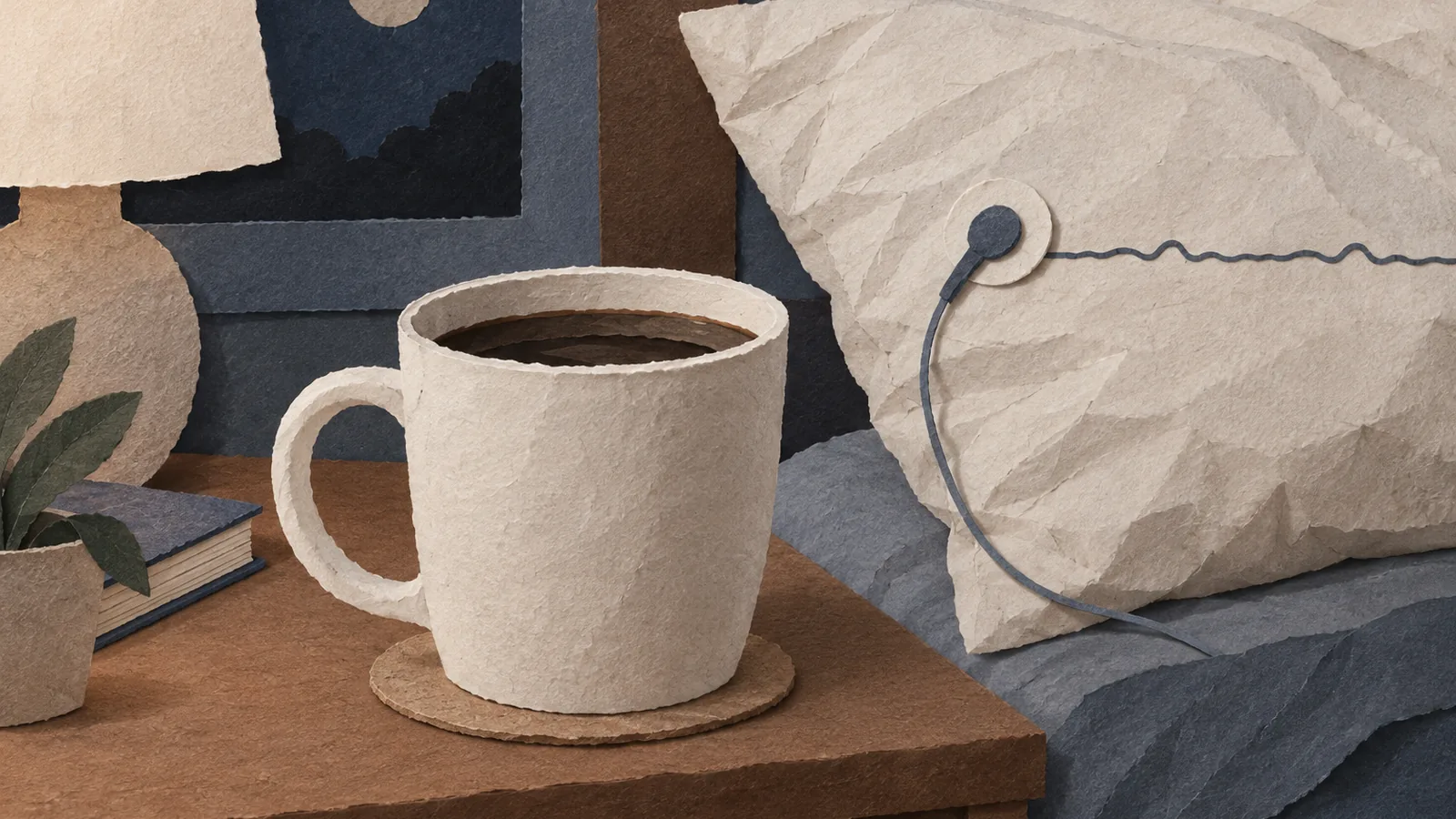
I used to think a good night’s sleep was something I could feel. Wake up clear-headed, you slept well. Wake up groggy, you didn’t. That was my whole test, and a review out of Wroclaw Medical University just told me the test is broken.
The claim sounds almost backwards: caffeine can make your sleep worse without ever keeping you awake. You drop off on schedule. You stay down your full eight hours. You wake up and tell your coworkers you slept great. And on the electrode readout, your brain never fully went under.
A quick honest note on what this is. The paper, by Prof. Donata Kurpas and James Chmiel in Nutrients and written up by ScienceDaily on September 22, is a narrative review, not a fresh trial. Kurpas and Chmiel are pulling together decades of sleep-lab work, not dropping new data. But the thing they point at is neither new nor contested, which is why it should bother you: the gap between how sleep feels and what sleep does has sat in the EEG record for thirty years, mostly ignored because feeling rested is so convincing. The subjective sense of a good night, the authors write, does not always match what shows up in the neurophysiological recordings.
What gets cut is slow-wave activity, the deep, low-frequency delta waves that mark the most restorative stretch of the night. This is when your body does its physical repair and the day’s memories get filed into long-term storage. Caffeine thins it. In one of the cleaner placebo-controlled experiments, Hans-Peter Landolt showed that caffeine reduced low-frequency delta activity in the human sleep EEG and ate into the deepest stage of non-REM sleep while total time in bed held steady. The lights were off and the sleeper was down for the count, and the deepest stretch still never arrived at full strength.
So why does that even happen? A stimulant and a night of sleep should not be able to share a body. The answer is a molecule called adenosine, and once it clicked for me the whole thing rearranged.
All day, while you are awake and burning fuel, your cells leave a byproduct behind: adenosine. It pours into the spaces between your neurons and settles onto receptors there, and the longer you are up the more of it piles on. That rising tide is your sleep pressure, the heavy-lidded weight you feel by 10 p.m. Adenosine is your brain keeping an honest count of how long it has been running. Caffeine’s trick is that it is shaped just enough like adenosine to slot into those same A1 and A2A receptors as an antagonist without switching them on. It does not clear the adenosine out. It parks in the doorway so the tiredness signal cannot get through, and you feel alert because your brain has been blinded to its own fatigue.
And the blindfold does not lift the second you fall asleep. Caffeine has a half-life of roughly five to six hours, so a good share of a late-morning or afternoon dose is still circulating at bedtime, still sitting on those receptors, still keeping the deep-sleep machinery from running at full depth. Push the coffee later, or metabolize it slowly, and the drug is still on the job while you sleep. Your brain files its report as “rested.” Your delta waves file a very different one.
This is where it stops being abstract. A 2023 systematic review and meta-analysis in Sleep Medicine Reviews pooled 24 studies and put numbers on the damage: caffeine cut total sleep time by about 45 minutes and knocked sleep efficiency down 7 percent. When the researchers looked at deep sleep specifically, the N3 and N4 stages, they found about 11.4 fewer minutes of it. That is not sleep you lost to lying awake; it went missing from inside a night that felt complete.
The timing is the part you can act on. To fully avoid a measurable hit to total sleep, the same analysis calculated, a standard coffee should be your last one at least 8.8 hours before bed, and a pre-workout scoop, with its much bigger dose, at least 13.2 hours out. If you go to bed at 11, that puts the honest coffee cutoff around 2 in the afternoon. The 3 p.m. pick-me-up is not early. It is the problem.
| Measure | Value |
|---|---|
| Standard coffee | 8.8 |
| Pre-workout scoop | 13.2 |
Now the asterisk, and it is not a small one: none of these numbers are the same for everyone. How fast you clear caffeine is written largely in your liver, in a gene called CYP1A2, and how hard the receptor answers is shaped by variants in ADORA2A. Some people really are fast metabolizers who can drink espresso after dinner and still sink into deep sleep. Others are slow burners whose noon coffee is still doing quiet work at midnight. Age, stress, and how habituated you are pull on the same lever, and older adults’ sleep may be more sensitive to caffeine than younger adults’. There is no universal caffeine curfew, which is exactly why “I sleep fine on coffee” is such a treacherous thing to trust. Fine is a feeling. It is not a measurement.
What none of this tells me is the part I most want answered: what the nightly shaving-off of deep sleep actually costs a person over years, in memory, in immune repair, in the slow ledger of brain health. The review maps what caffeine does to a single night. It cannot yet hand you the compounded bill. That study, the long one that follows real people and their real coffee across decades, still has to be done.
But I do not need that study to change one thing. I am not quitting coffee, and I am not going to treat the morning cup as a sin. What I am doing is moving my hard stop to early afternoon and treating the deep, dreamless bottom of the night as something I have to protect on purpose, not something I can assume I am getting. I would rather earn the delta waves than keep taking my brain’s word for it.
Sources
- ScienceDaily – “Coffee doesn’t have to keep you awake to disrupt your sleep” (Sept. 22, 2026)
- Nutrients – Kurpas D., Chmiel J., narrative review of caffeine and sleep neurophysiology (2026), doi:10.3390/nu18081220
- Neuropsychopharmacology – Landolt et al., “Caffeine reduces low-frequency delta activity in the human sleep EEG” (1995)
- Sleep Medicine Reviews – Gardiner et al., “The effect of caffeine on subsequent sleep: A systematic review and meta-analysis” (2023)
- Sleep Medicine Reviews – Clark & Landolt, “Coffee, caffeine, and sleep: A systematic review of epidemiological studies and randomized controlled trials” (2017)
- British Journal of Pharmacology – Jacobson et al., “Adenosine A2A receptor antagonists: from caffeine to selective non-xanthines” (2022)
- Pharmacy Times – coverage of the 8.8-hour pre-bed caffeine cutoff finding