I’d always filed growth hormone under overnight maintenance. You fall asleep, the brain goes dark, and the body gets on with patching muscle and bone. So I didn’t expect to end this week on a much weirder question: what if the hormone your sleep releases is also helping to end it?
Sleep drives growth hormone release, and growth hormone feeds back to regulate wakefulness.
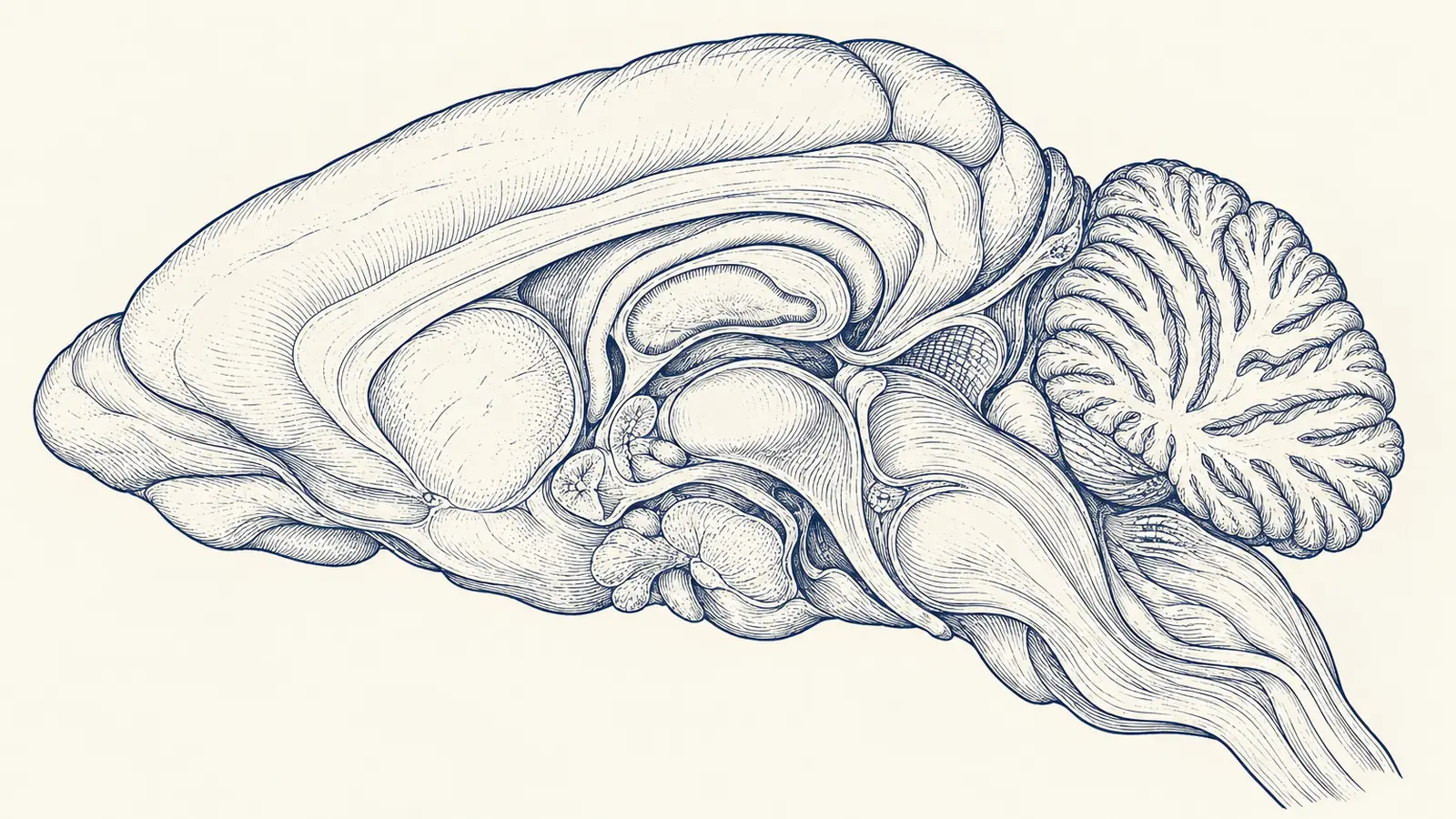
In mice, that’s roughly what Yang Dan’s lab at UC Berkeley found. Growth hormone released during sleep acts back on the locus coeruleus, a small brainstem cluster that runs alertness, and makes its neurons more excitable, which promotes wakefulness. The authors describe it as a negative feedback pathway in “Neuroendocrine circuit for sleep-dependent growth hormone release,” published in Cell. Co-author Daniel Silverman boiled it down to one line: “Sleep drives growth hormone release, and growth hormone feeds back to regulate wakefulness.”
You’re probably not seeing that version. ScienceDaily is running the work under a headline announcing that scientists have discovered how deep sleep “builds muscle, burns fat, and boosts the brain”, even though the paper went online in June 2025 and its findings are about neurons, hormone levels and wakefulness. Muscle and fat turn up only in Berkeley’s own release, as background on what growth hormone does in general, the reason anyone cares about the hormone, and never as something these mice demonstrated.
What the mice did show is stranger than the headline, and I’d rather have it.
A hormone that talks back to the brainstem
Wait, why would a hormone whose job is supposedly out in the muscles and liver end up tuning the brain’s alarm system? According to the Berkeley release, growth hormone builds up gradually during sleep, and the locus coeruleus responds to it. As those neurons grow more excitable, the animal moves toward waking. I find that loop genuinely lovely to think about, because it means part of what ends a stretch of sleep may be chemistry the sleep itself produced.
It isn’t a straight line, though. The same release notes that Silverman published a study earlier in 2025 showing that an overexcited locus coeruleus paradoxically promotes sleepiness instead. Push this system too far and it flips. Anyone promising to tune it with a pill is out ahead of the evidence.
The upstream half of the circuit has its own surprise. Two kinds of hypothalamic neurons control how much growth hormone the pituitary lets out: GHRH neurons step on the gas and somatostatin neurons step on the brake. Physiologists have known that push-pull for decades, but Xinlu Ding, the postdoc who led the work, put the difference in one sentence: “We’re actually directly recording neural activity in mice to see what’s going on.” Doing that turned up two separate brakes. Somatostatin neurons in the arcuate nucleus hold growth hormone down by inhibiting the GHRH neurons beside them, while a second population in the periventricular region acts through the median eminence, the gateway where hypothalamic signals reach the pituitary’s blood supply.
In non-REM sleep the pattern goes the way you’d guess, with somatostatin falling, GHRH rising moderately, and growth hormone flowing. REM sleep is the one I had to read twice: growth hormone release coincides with strong bursts of both GHRH and somatostatin activity, the brake surging right alongside the gas while the hormone still gets out. Why the brake doesn’t win is the question I’d most like answered next, and none of this cell-by-cell choreography has been shown in human sleep.
What we do have in people is the other half of the picture, and the press materials skip it. In 2000, Eve Van Cauter’s group at the University of Chicago pooled sleep-lab recordings from 149 healthy men aged 16 to 83. Slow-wave sleep, the deepest stage, made up 18.9 percent of the night in men aged 16 to 25 and just 3.4 percent in men aged 36 to 50. Over that same stretch from early adulthood to midlife, growth hormone secretion dropped by 372 micrograms per decade, before sliding more slowly, by 43 micrograms per decade, into later life. The study was correlational and included only men, but the drop was steep, and it hit in midlife rather than old age.
Three years earlier, the same group tried pushing deep sleep up instead of watching it fall. Eight healthy young men took bedtime doses of gamma-hydroxybutyrate (2.5, 3.0 or 3.5 grams, against placebo), a drug that deepens slow-wave sleep, and the deepest stage expanded mainly in the first 2 hours after sleep onset. The authors reported a doubling of growth hormone secretion, driven by a bigger, longer first pulse after falling asleep and correlated with the extra deep sleep. Because it was a drug study, it can’t cleanly separate an effect of deeper sleep from a direct effect of the drug, and it’s a compound nobody should experiment with at home.
Neither human study proves the mouse feedback loop exists in people. Together they show that in humans, deep sleep and growth hormone move together, and that deep sleep thins out decades before anyone calls you old. The Berkeley circuit offers a candidate explanation for how a sleeping brain lets the hormone out, though whether people run on the same wiring is untested.
From a mouse circuit to a gene-therapy pitch
I’m fine with basic neuroscience staying basic. What bothers me is how quickly the promotion outruns it. Berkeley’s release already reaches toward diabetes and “degenerative diseases like Parkinson’s and Alzheimer’s.” Silverman mentions that “there are some experimental gene therapies where you target a specific cell type” and calls the circuit “a novel handle to try to dial back the excitability of the locus coeruleus.” None of those diseases appears in the paper’s findings, and no person was enrolled. A year later, the work is being sold to the public as a muscle-and-fat discovery it never was, and that framing skips over the hormone-and-wakefulness loop the mice actually showed.
None of these studies tested a bedtime routine, so this is my bet, not their finding: I’m keeping the same lights-out time every night, weekends included, to protect the first couple of hours after I fall asleep, when deep sleep and that first growth hormone pulse rose together in the gamma-hydroxybutyrate experiment, and I won’t buy anything sold as a sleep-time growth hormone booster.
Sources
- Cell: Ding et al., “Neuroendocrine circuit for sleep-dependent growth hormone release” (2025)
- UC Berkeley News: “Sleep strengthens muscle and bone by boosting growth hormone levels” (September 8, 2025)
- JAMA: Van Cauter, Leproult and Plat, slow-wave sleep and growth hormone across age in 149 men (2000)
- Journal of Clinical Investigation: Van Cauter et al., gamma-hydroxybutyrate, slow-wave sleep and growth hormone (1997)
- ScienceDaily: “Scientists discover how deep sleep builds muscle, burns fat, and boosts the brain” (2026)