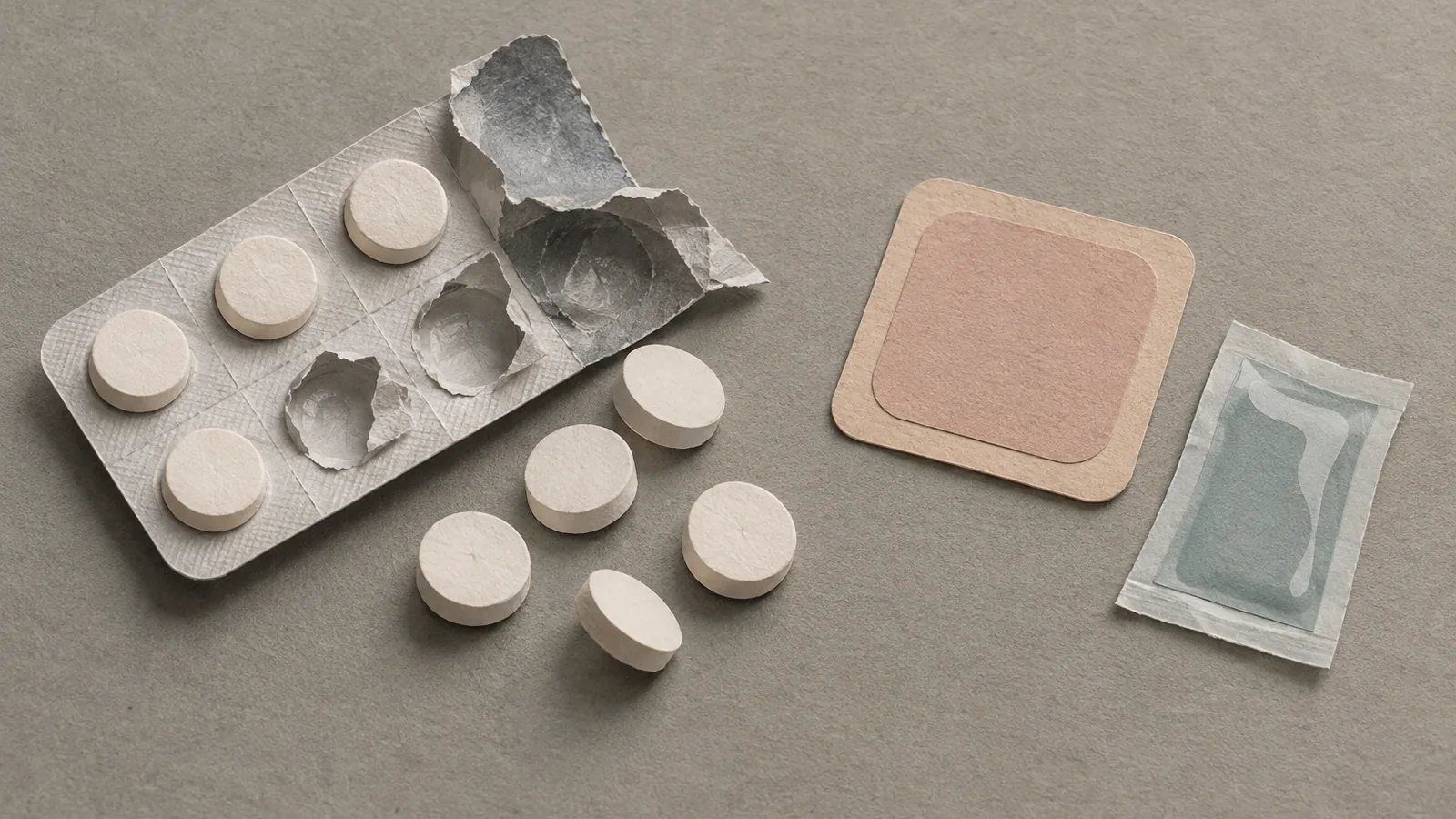
For more than twenty years, a black box sat at the top of the estrogen prescriptions written for menopause in America, the regulatory equivalent of a skull and crossbones, and the FDA has now moved to take it off. The warning went on in the early 2000s, after the Women’s Health Initiative halted a large trial and announced that hormone therapy raised the risk of clots, strokes, and breast cancer. The message that reached the exam room was blunter than the science: hormones are dangerous. A generation of women heard it, and either went without treatment or accepted the risk on faith.
This week a Danish registry drew the line the warning never contained. The pill raised the risk. The patch did not.
The Women’s Health Initiative found harm, and that much was never in doubt. But it tested one thing: oral conjugated equine estrogen paired with a synthetic progestin, given to women who were on average more than a decade past menopause, at doses higher than many prescribers now start with. One drug, one route, one population, one result, generalized into a warning that covered every estrogen product on the shelf, including the ones that work nothing like a pill.
The registry that just clarified this is not small. Researchers led by Julie Berggreen matched Danish women aged 50 to 69 who suffered a first blood clot, ischemic stroke, or heart attack between 2003 and 2021 against women the same age who did not, then read the prescription records: 9,807 clot cases, 18,460 stroke cases, and 11,974 heart-attack cases, each set against roughly five matched controls. They sorted the risk not by whether a woman took hormones, but by how.
Current use of any oral hormone therapy carried a higher rate of venous thromboembolism, the clots that form in the legs and travel to the lungs, and it did so regardless of dose or duration. Stroke and heart attack were fussier: those risks surfaced only with high-dose oral therapy taken for more than a year. Transdermal therapy, the patches and gels and sprays that send estrogen through the skin, showed no general increase in any of the three. Vaginal estrogen, the local low-dose kind, was associated with a lower stroke risk, not a higher one.
The absolute numbers are worth holding onto, because a rate ratio without a denominator is how people get frightened for no reason. Among women taking nothing, venous clots occurred at about 15.8 per 10,000 person-years. The excess from oral therapy worked out to roughly one additional clot per 1,055 women each year, one extra stroke per 1,642, one extra heart attack per 3,846. Countable and small, and all of it concentrated in the version of the drug that goes through the stomach.
There is a mechanism, and it is not mysterious. Swallow estrogen and it passes through the liver before it reaches the rest of the body, and the liver answers by raising the clotting factors that make blood more likely to thicken. Send the same hormone through the skin and it skips that first pass, leaving the clotting machinery largely alone. This is why specialists have argued for years that the real questions in menopausal hormone therapy are dose, route, and age, not a yes-or-no on hormones.
Which is the uncomfortable part of the timeline. When an umbrella review in PLoS Medicine gathered the trial evidence in 2021, it confirmed the signal the black box was built on, a stroke risk ratio of 1.17 with a confidence interval of 1.05 to 1.29 and a venous clot risk ratio of 1.60 whose interval ran from 0.99 to 2.58, wide enough to graze the line where an effect disappears. Then it stated plainly what it could not do: it could not separate the effects by type, dose, formulation, or route, because the underlying studies had blurred them together. The limitation was named in the literature. The warning label was not rewritten to match it.
None of this makes oral estrogen a scandal. This is an observational study, and it carries a specific hazard: as Robert Storey, a University of Sheffield cardiologist who reviewed the findings and declared no financial stake in them, noted, a woman with quietly developing heart disease might stay on treatment longer precisely because her symptoms went unrecognized, which would make the drug look guiltier than it is. The high-dose cardiovascular signal, in particular, remains an association, not a verdict. What the study does show is a route-stratified pattern, oral carrying the clot risk and transdermal clear of it, consistent with a separate Swedish national analysis that tied oral combined therapy and the synthetic steroid tibolone to heart disease while the transdermal route sat clear.
So the correction here is not that hormone therapy is safe and the establishment invented a threat. The threat existed. It was never uniform, the route that avoided most of it was on the market the entire time, and the institutions that shape what a patient hears flattened a solvable question into a warning that answered it wrong. In the U.S., the oral products the trials had indicted stayed the common way women were started, while the patch that carried little of the clot risk was the road less prescribed.
The FDA convened a panel in July of 2025, and months later moved to pull the boxed warning it had defended for two decades, on the reasoning that not all of these products are the same drug and never had been. It is the correct call. It arrived a generation, and a great many unwritten prescriptions, after the evidence first asked for it.
Sources
- Medical Xpress – coverage of Berggreen et al., Danish nationwide nested case-control study, The BMJ (23 Sept 2026)
- MedPage Today – Menopausal Hormone Therapy Thrombotic Risk Varies by Dose, Route of Administration (2026)
- PLoS Medicine – Zhang et al., umbrella review of menopausal hormone therapy and women’s health (2021)
- Journal of Clinical Endocrinology & Metabolism – MHT and cardiovascular disease: the role of formulation, dose, and route of delivery (2021)
- Research and Practice in Thrombosis and Haemostasis – The crux of menopausal hormone therapy: dose, route, and age (2023)
- Science Media Centre – expert reaction (Prof. Robert Storey) to the Danish hormone-therapy study (2026)
- HealthDay – Tibolone, oral estrogen-progestin therapy linked to heart disease (Swedish national analysis)
- Menopause & Midlife Medicine – FDA boxed warning on menopausal hormone therapy: history and removal