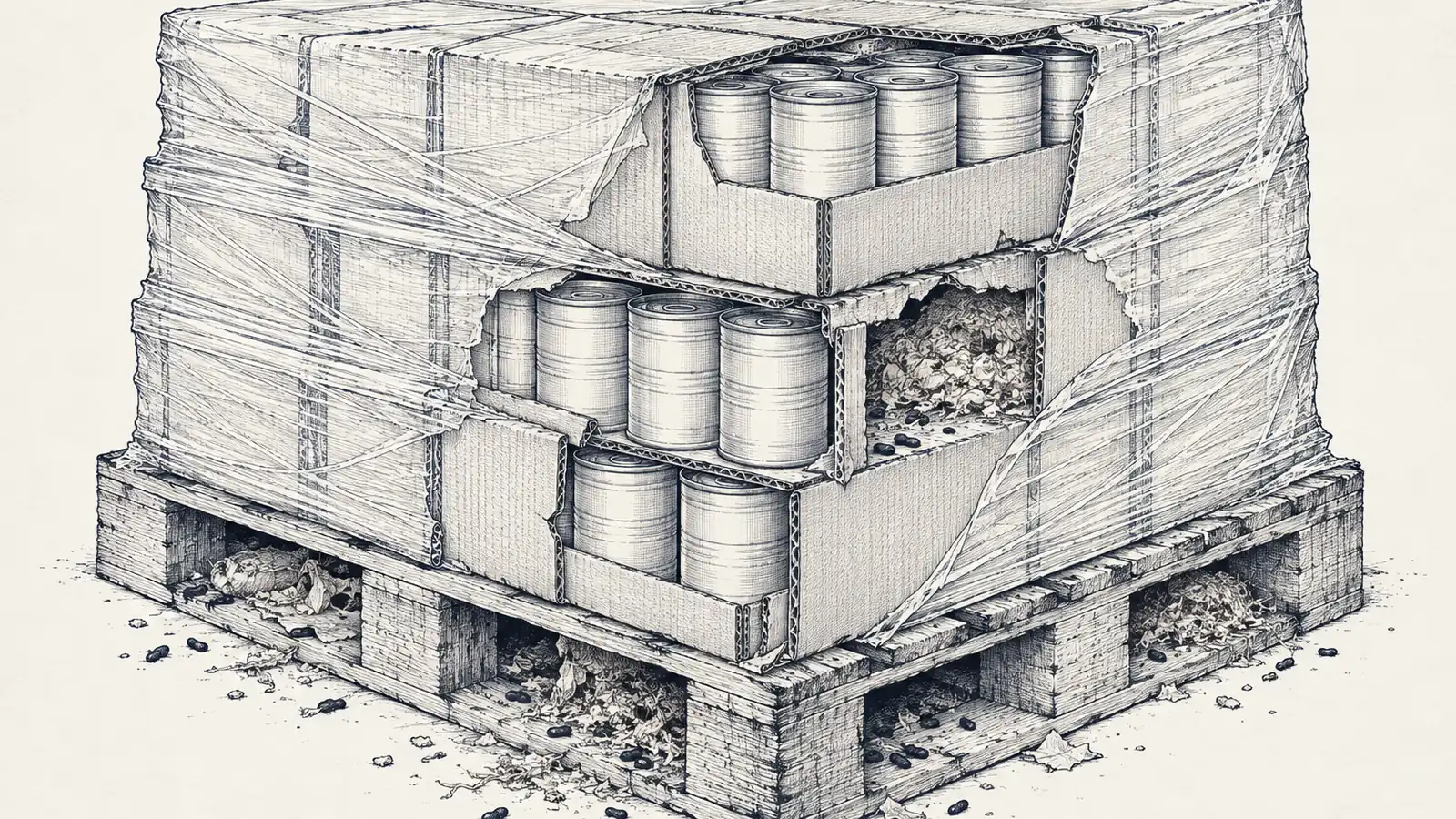
The government’s investigators started walking a North Minneapolis warehouse on November 17, 2025, and by the time they finished a month later they had a tally that reads less like an inspection report than a field guide: 9 live rodents, 17 dead ones in various states of decay, 8 live birds, 1 dead bird, and 5 live worms. That is 26 rodents in all, sharing the building with rice, cat food, over-the-counter drugs, and, according to the government’s complaint, infant formula.
The owner, Bassam Abu Samrah, had seen inspectors before. He had seen a great many of them. The FDA had been through Gold Star Distribution six times, five of them before this visit, and the Minnesota Department of Agriculture had inspected the building 26 more times between 2013 and 2025, its reports telling the same story on a loop: live and dead rodents, gnaw marks, chewed packaging, droppings, nesting material. Laboratory work on the 2025 samples confirmed rodent urine, urea, excreta, hairs, and gnaw holes in the product packaging. Thirty-two inspections across more than a decade. The rodents never left.
On September 21, 2026, a judge in the U.S. District Court for the District of Minnesota entered a consent decree barring Gold Star and Abu Samrah from receiving, holding, or shipping any FDA-regulated product until the agency certifies in writing that the warehouse is fit to use, which requires the company to hire an independent sanitation expert, eliminate the pests, renovate the building to keep them out, and destroy every regulated product under FDA supervision. There is no fine. There is no criminal charge. And it is not an isolated result: nine days earlier the same federal government had closed out a far larger infant-formula case in much the same way.
Elizabeth Miller, the FDA’s associate commissioner for inspections and investigations, framed the order as a warning shot. “When a company repeatedly ignores serious, ongoing violations that put trust at risk, the FDA will act,” she said. By the agency’s own count the company had ignored them through 32 inspections and more than a decade, while rodent urine turned up in the packaging of products meant for infants. The action, when it finally came, was an order to clean up.
Bill Marler, the plaintiffs’ food-safety attorney who has spent three decades suing companies over exactly this kind of contamination, put the incentive plainly: “a civil check is a line item and a criminal charge is personal.” A cleanup order, by his reading, asks the operator to promise to do what the law already required, and to hold the keys while he does it. Abu Samrah keeps the business and can reopen the day the FDA signs off.
What makes the Gold Star file worth more than a shudder is the company it keeps. On September 14, nine days before the Minnesota decree, the Justice Department announced that Abbott Laboratories would pay nearly $385 million to resolve civil allegations tied to contaminated powder infant formula from its plants in Sturgis, Michigan and Casa Grande, Arizona. Sturgis is the plant at the center of the 2022 cronobacter outbreak that federal accounts linked to infant illness and at least one death, and whose shutdown helped touch off the national formula shortage.
Abbott’s prosecutors had drafted more than a check. According to reporting on the closed criminal probe, Justice Department lawyers had weighed a misdemeanor charge under the Food, Drug, and Cosmetic Act, a second count for misleading the government, and charges against at least one individual at the company. Department leadership closed the investigation instead. A spokesman called criminal charges “heavy-handed” and said this Justice Department “does not believe in regulation by prosecution.” The civil settlement, like Gold Star’s decree, carries no finding of liability. When the government most aligned with cleaning up the food supply had a formula maker and a drafted indictment in front of it, it reached for the checkbook and called the alternative excessive.
So here are the two ends of the infant-formula supply chain in a single month. At one end, a multinational pays nearly $385 million, closes its criminal file, and admits nothing. At the other, a warehouse operator pays $0 and answers more than a decade of rodents with a pledge to tidy up. Marler’s summary is hard to improve on: the two cases “sit at opposite ends of the industry and reach the same place.” Nobody was charged.
The FDA says it acts when trust is at risk. The record it just closed shows what acting looks like: a building full of dead rodents and live birds, infant formula on the shelves, 32 inspections behind it, and a court order telling the man who owned the place to clean it up before he opens the doors again.
Sources
- FDA – Federal Court Enters Consent Decree Against Gold Star Distribution, Inc. (2026-09-23)
- U.S. Department of Justice – Abbott agrees to pay over $384M to settle contaminated infant formula allegations (2026-09-14)
- Food Safety Magazine – how the Abbott criminal probe was closed, and the “regulation by prosecution” line
- Marler Blog – accountability analysis: 26 state inspections since 2013, no charges