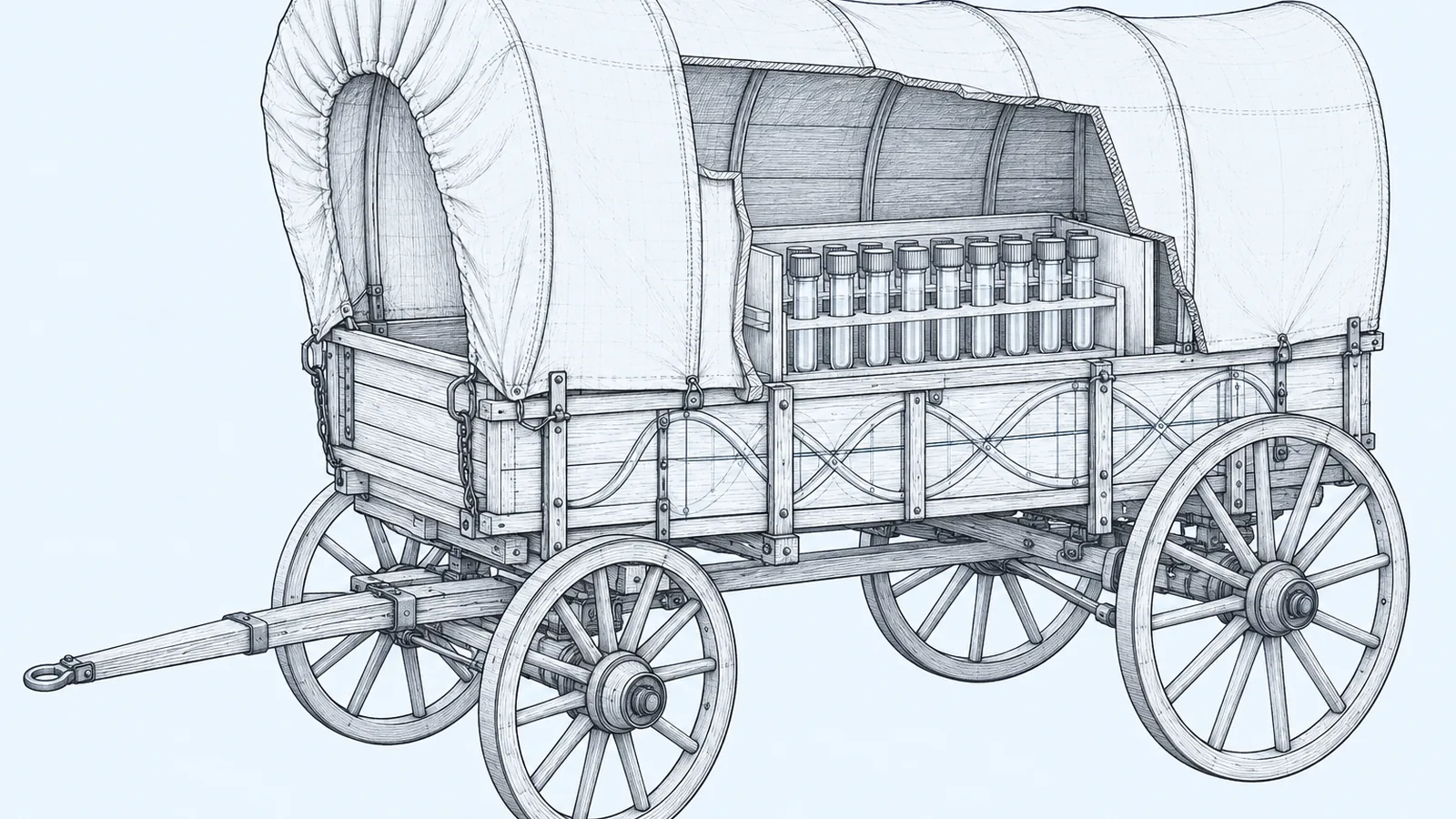
Sometime in the early 1800s, as families loaded wagons and pushed west out of the Carolina and Virginia backcountry into the hills that would become Tennessee, Alabama and Georgia, at least one of them carried something no one could see or name: a single misspelled letter in a gene called EGFR. It asked nothing of them. It rode along through the generations, mostly silent, passed down at kitchen tables and christenings, until this month a database of saliva tubes finally gave it a name and a number.
The letter is a variant called germline EGFR T790M, and a team at the Dana-Farber Cancer Institute has now written what one journal fittingly called a biography of an inherited lung cancer risk gene. Reporting in Science in September, Jaclyn LoPiccolo, Pasi Jänne and Alexander Gusev mined the genetic and health records of more than 3.3 million people to answer two questions at once: how dangerous this inherited variant is, and how it came to be concentrated in the American South.
The danger is not subtle. Across the whole dataset, carriers were about 25 times as likely to develop lung cancer as people without the variant, an odds ratio of 25.18 with a p-value of 1.9 times 10 to the minus 24, which in this line of work is the statistical equivalent of a signal flare. Among people who never smoked, the group in which lung cancer is supposed to be a rare misfortune, carriers were more than 60 times as likely to get it. Smokers who carried it ran roughly 10 times the risk. Gusev, who does statistical genetics at Dana-Farber, called it “one of the strongest, if not the strongest, cancer risk-increasing mutations that has ever been found.” Coming from a field that hedges reflexively, that is close to a shout.
| Group | Value (× baseline) |
|---|---|
| Never-smokers | 60 |
| Smokers | 10 |
The variant is rare, which is the only reason it took a dataset this size to catch. Nationally it turns up in about one American in 15,850. But rarity is a matter of geography. In the Southeast it runs as common as one in roughly 2,000, and people with Southern U.S. ancestry are 6 times more likely to carry it than people from anywhere else.
The carriers turned out to share a single stretch of chromosome, the genetic signature of descent from one common ancestor who lived in the early 19th century. The variant itself is older, traceable to British and Irish settlers, but it became common in the region only after a founder event and a genetic bottleneck in Southern Appalachia about two centuries ago. From there it followed the wagon roads west out of the colonial Southeast, and, beginning in the early 1900s, started turning up in non-European populations as well. A mutation with a migration history. The families who carry it have handed it down for the better part of ten generations, and until now not one of them knew.
Which raises the question of who found it, and how. This did not come out of a hospital tumor registry or a cancer center’s family-history clinic. It came out of 23andMe, the direct-to-consumer company that mails people plastic tubes to spit in, drawing on more than 10 million consented research participants to surface 641 carriers. The national biobanks built and funded to catch exactly this kind of inherited risk turned up almost nothing: the U.K. Biobank found 2, the NIH’s All of Us program 19. A database of mail-order saliva kits found the gene they were built to find.
That scale is also where the caution lives. The phenotypes here are largely self-reported, assembled from what customers tell a consumer-genomics company rather than confirmed against pathology, and the finding points, conveniently, toward exactly the kind of genetic testing the company sells. The odds ratio is far too large to be an artifact of loose self-report, so the association holds. What it invites is a leap the data has not yet earned.
LoPiccolo framed the takeaway carefully. The findings, she said, raise the possibility that screening could someday be guided by inherited genetic risk and not smoking history alone. The operative words are possibility and could. Lung-cancer screening in this country is built almost entirely around smoking history and age, so a never-smoking 40-year-old in Knoxville with this variant fits no existing guideline and would, under today’s rules, be sent home. The study makes a strong case that such a person carries extraordinary risk. It does not show that scanning them changes what happens next. No trial has followed carriers through a screening program to see whether early detection saves their lives, and inherited EGFR-driven lung cancer was already known from smaller familial studies before this dataset put a number on it. What is new is the scale and the map, not a plan for the people the map identifies.
For now the gene has its biography, ten generations deep and dated to a wagon road out of Appalachia. What it does not have, for the roughly one-in-15,850 Americans and one-in-2,000 Southeasterners who carry it, is a screening guideline anywhere in the country that knows what to do with them.
Sources
- Nature Medicine – “Biography of an inherited lung cancer risk gene” (28 September 2026)
- The ASCO Post – “Germline EGFR T790M Associated With Significant Lung Cancer Risk” (September 2026)
- 23andMe Research – “A Powerful Inherited Lung Cancer Risk Variant and Its Colonial American Roots”
- Medical Xpress – “Rare inherited EGFR mutation linked to dramatically increased lung cancer risk” (September 2026)
- Science – LoPiccolo J, Jänne PA, Gusev A, et al., germline EGFR T790M and inherited lung cancer risk (2026)