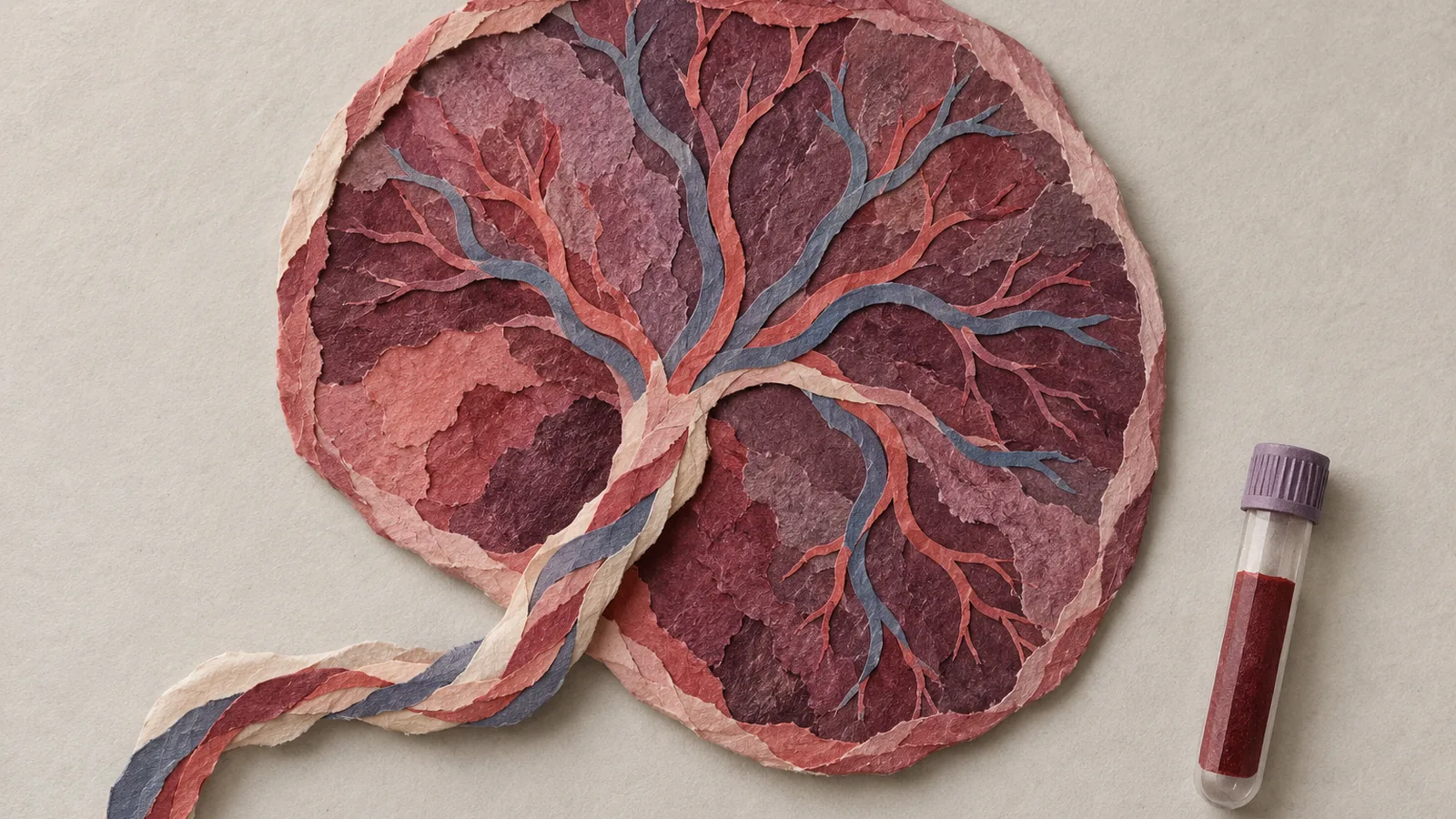
For years I filed ADHD under “brain” and left it there. A wiring problem, a dopamine problem, something you manage with a prescription and a seating chart. It never once occurred to me to look earlier, at the organ we treat as medical garbage: the placenta, the thing that gets weighed, glanced at, and dropped in a bin the second the baby is out. A new analysis out of University of Iowa Health Care says the first trace of a child’s ADHD may have been sitting in that organ, readable on a maternal blood test months before birth.
Serena Gumusoglu and her colleagues went back to banked maternal blood samples and tracked one protein, placental growth factor (PlGF), across all three trimesters, then linked each pregnancy to the child’s later health records. In the pregnancies that produced a child eventually diagnosed with ADHD, PlGF did something odd in the third trimester. It stayed flat when it was supposed to climb.
Each standard-deviation drop in third-trimester PlGF came with 2.6 times higher odds of a later ADHD diagnosis. I read that line twice. Not the first trimester, not the second, where the two groups looked the same. The signal lived entirely in the home stretch, the exact window when the fetal brain grows faster than it ever will again.
So what is this protein, and why would it have any say over a kid’s attention a decade later? PlGF belongs to the same family as VEGF, the signal that tells blood vessels to grow. The placenta uses it to build out its plumbing, the dense vascular bed that pours oxygen and nutrients into the fetus, and levels normally rise through pregnancy and surge late, because late is when demand peaks. Obstetricians already know this protein from the other direction: a low PlGF reading is an established warning sign for preeclampsia, and it is already used in preeclampsia risk assessment. The marker isn’t exotic.
But why would the protein that builds the placenta’s blood supply reach into the brain? That is the question I kept circling. The idea the researchers are chasing is that if PlGF never makes its third-trimester surge, the placenta’s capacity to deliver may stop scaling up at the moment the brain needs it most. The organ built to feed a sprint idles instead. And the placenta is not a passive pipe: there is growing evidence it talks to the developing brain through hormones, immune signals, and its own supply of serotonin, a conversation researchers now call the placenta-brain axis. A flat PlGF curve may be the readable trace of that conversation going quiet.
What makes it hard to wave off is what the Iowa team did next. The easy dismissal is that low PlGF just flags sick pregnancies, and sick pregnancies already carry higher ADHD risk. Preeclampsia, fetal growth restriction, and early preterm birth all tie to both low PlGF and to neurodevelopmental trouble. So the researchers accounted for them, and the association held. They also tracked a second placental protein, endothelin-1, as a control, and it showed no difference between the groups. This was not a generic unhealthy-placenta effect. It tracked one protein, in one window.
I’m not going to oversell you a lead as a verdict. This is 176 pregnancies from a single medical center, read backward through stored samples and chart diagnoses, which makes it small, retrospective, and unable to prove that low PlGF causes anything. The authors say so themselves. ADHD pulled from health records rather than a uniform diagnostic workup is a softer endpoint than the clean odds ratio makes it sound. One cohort, one lab, one protein is where you start looking, not where you stop. Gumusoglu’s next step is a Klingenstein-funded run of mouse experiments to test whether dialing PlGF down actually bends offspring neurodevelopment, which is the honest way to chase cause when you can’t randomize a pregnancy.
The exposure wars are what get under my skin. The public fight over where ADHD and autism come from has fixated almost entirely on what the mother took or breathed: the acetaminophen panic that gets declared settled in one review and reopened by the next, the studies tying late-pregnancy air pollution to attention problems. We interrogate every exposure that crosses the mother’s lips and keep landing on noisy, contested answers. And the whole time, the organ that filtered every one of those exposures, the tissue standing between her bloodstream and the fetus, gets delivered, weighed, and thrown out before anyone reads what it recorded. A system built to prescribe a stimulant and move on would grow exactly this blind spot.
I’m not going to tell you to march into your OB and demand a PlGF trajectory off one small study. It isn’t a screening test, and a single low number is not a verdict on your child. But I am done thinking of the placenta as disposable. If this holds up, the organ we throw away was keeping a record of the whole pregnancy, and I want it read before it hits the bin, not shrugged off as “just the preeclampsia marker” and forgotten.
Sources
- JAMA Psychiatry: Gumusoglu et al., placental growth factor trajectories and child ADHD (2026)
- PubMed: Gumusoglu et al., PlGF trajectories and child ADHD (2026)
- News-Medical: Placental health in late pregnancy linked to childhood ADHD (University of Iowa, 2026)
- PMC: The role of the placenta-brain axis in psychoneuroimmune programming
- PMC: Neurodevelopmental Outcomes of Prenatal Preeclampsia Exposure
- International Journal of Environmental Research and Public Health: fetal exposure to late-pregnancy air pollution and ADHD-risk behavior (2022)
- Brown University Psychopharmacology Update: acetaminophen use in pregnancy not linked to childhood disorders (2024)