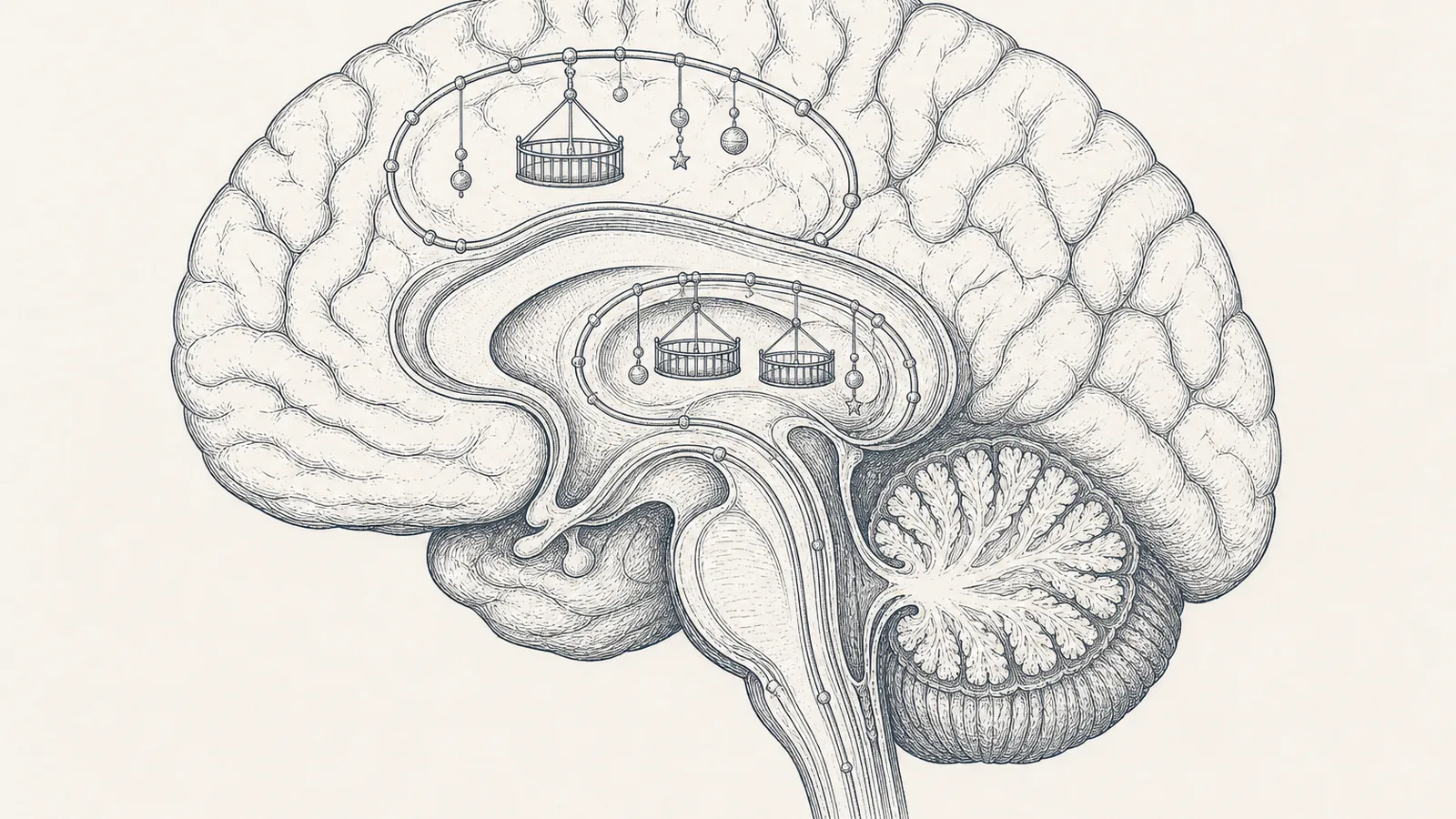
For most of my life “mommy brain” was a punchline. The forgotten keys, the word that won’t come, the sentence that trails off mid-thought, all of it something to laugh about at a baby shower and never take seriously, because nobody serious took it seriously. So here is what I did not expect to be reading this week: hard imaging evidence that pregnancy remodels the brain so specifically that a second pregnancy targets a different set of circuits than the first, and that the brain changes tied to maternal depression show up months earlier the second time around, during the pregnancy itself rather than after the birth.
That second finding is the one a mother could actually use, so let me not bury it. But start with the strangeness of the first.
The study landed in Nature Communications, out of the Pregnancy Brain Lab at Amsterdam UMC. Milou Straathof, Elseline Hoekzema and their colleagues did something almost nobody in this field has the patience for: they scanned the same women before and after each pregnancy, then lined those brains up against first-time mothers and women who had never given birth. In total, 110 women. 30 going through their second pregnancy, 40 through their first, 40 as never-pregnant controls.
And the pattern that came out got under my skin. During a first pregnancy, the biggest changes hit the brain’s Default Mode Network, the self-referential hub that lights up when you think about yourself, imagine another person’s mind, turn something over inside your own head. That fits everything Hoekzema’s lab has spent a decade building, ever since her group showed that pregnancy shrinks gray matter in social-cognition regions so consistently you could look at a scan and guess whether a woman had carried a child. The brain was retooling the exact machinery a mother uses to read and bond with a baby.
The second pregnancy did not just run that tape again. The Default Mode Network still shifted, but more quietly. This time the loudest changes moved into the networks that handle attention and sensory processing, the circuits that sort visual and auditory signals and decide what you snap your focus toward. Straathof’s read is almost funny in how practical it is: these processes can be beneficial when you’re caring for more than one child, tracking the one climbing the bookshelf and the one who just went suspiciously quiet in the next room.
Wait, why would the brain know to change there the second time and not just repeat itself? That is the question I could not put down, and the honest answer is that nobody has the full mechanism yet. But you can see the logic the researchers are reaching for. Read it as adaptation and it almost tells its own story: the first pregnancy reshapes the social-bonding hardware, and the second, facing a genuinely different job, tunes the systems that would help you divide attention across two moving targets. That is interpretation, not proven biology, and Straathof is careful to hold it as a hypothesis. What the scans do show plainly is that the gray-matter loss underneath all of this does not look like damage. The team frames it as neuroplasticity, the same sculpting-away that reorganizes an adolescent brain into an adult one. The tissue is not degenerating. It is being pruned into something more specialized. That reframing alone should have retired the “mommy brain” joke years ago.
Then comes the turn that matters for real people. When the team looked at how these structural changes lined up with peripartum depression, the mood disorder that can arrive during pregnancy or after birth, they found associations in both first and second pregnancies. But the timing shifted. For first-time mothers, the link between brain changes and depression showed up mainly after the baby arrived. For second-time mothers, it showed up during the pregnancy itself. Amsterdam UMC calls this the first evidence that the changes in a woman’s cerebral cortex during pregnancy are related to depression at all. Not a treatment, not a diagnosis. A signpost, pointing at when a second-time mother might be most vulnerable, which is precisely the thing our maternity care system is terrible at anticipating.
And I want you to hold the size of this study while you hold its promise, because the two temper each other. It is observational, not a trial. The key second-pregnancy group is 30 women. For ethical reasons the scans bracket each pregnancy rather than running through it, so the sharpest window of change is inferred, not watched live, and the team is upfront that they still do not know how a mother’s age folds in. An association between a brain change and a depressive episode is a lead worth chasing, not a mechanism nailed down. But a small, careful study pointing a flashlight at the right months is still worth more than the decades we spent pointing nowhere.
Because sit with what this line of work is correcting. The maternal brain has been long understudied in neuroscience and medicine, waved off as hormones and forgetfulness, when it turns out to be one of the most dramatic remodeling events an adult body goes through. Every pregnancy, this study argues, leaves its own distinct fingerprint. Not a generic “baby happened to this woman” blur, but a specific, legible mark that differs from the one before it.
So this is my conclusion. I spent years half-believing the joke that a pregnant woman’s brain gets foggier and lesser, and this is one more reason to throw that out entirely and treat the emotional weather of a second pregnancy as a real neurological event with its own clock. If I were carrying a second child, I would not wait for the postpartum checkup to start watching my own mind. I would treat the pregnancy itself as the window, and I would say so to my doctor early, before anyone thought to ask me how I was doing.
Sources
- Nature Communications – Straathof, Hoekzema et al., “The effects of a second pregnancy on women’s brain structure and function” (2026)
- Amsterdam UMC – “Changes in the brain of women during a second pregnancy”
- ScienceAlert – “Second Pregnancy Does Something Unique to The Brain, Study Reveals”
- ScienceDaily – “Second pregnancy changes the brain in surprising new ways”
- Annual Review of Neuroscience – “The Maternal Brain in Context: Systemic Physiological Changes Across Pregnancy” (2026)