When Marat Fudim, a heart-failure cardiologist at Duke, took the stage at the Heart Rhythm Society’s congress in Chicago this April, the device he was there to discuss already owned one of the odder results in recent cardiology. In the company’s randomized trial, patients who got the implant improved by 46.4 points on the standard heart-failure quality-of-life questionnaire, while patients who didn’t improved by 5.7, a gap of 40.7 points. Every one of those patients knew which arm they were in, and the blood marker that tracks strain on a failing heart showed no significant difference between them.
| Group | Value (points) |
|---|---|
| Implant plus drugs | 46.4 |
| Drugs alone | 5.7 |
may reflect, at least in part, a substantial placebo effect
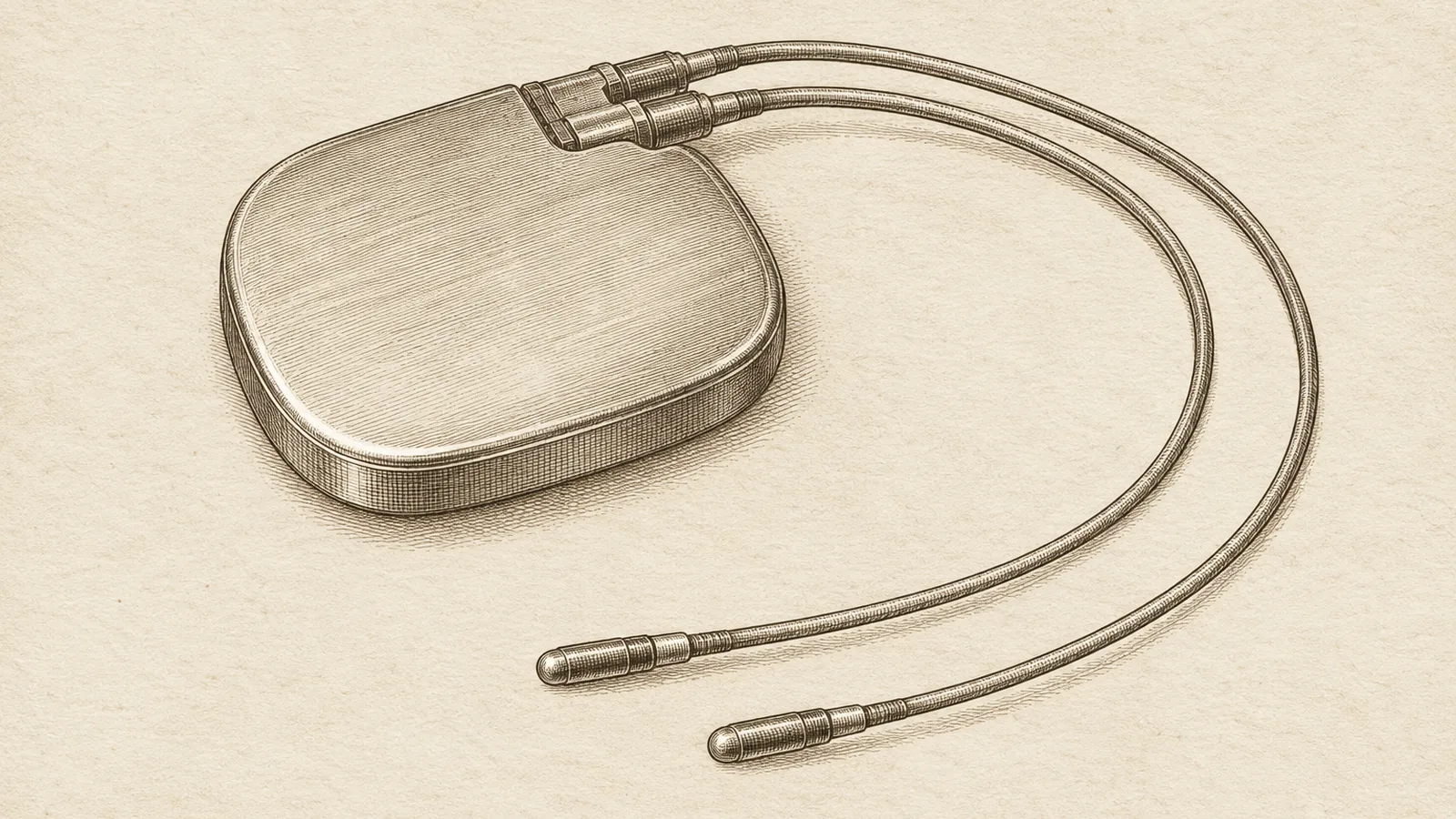
The device, made by the Swiss-based Berlin Heals, does almost none of the things heart implants usually do. It does not pace, shock or pump. It runs a low direct current, measured in millionths of an amp, through the heart muscle by way of a lead and a patch placed on the heart. Fudim presented early results from the company’s newest study, and the company’s announcement reported gains in ejection fraction, walking distance, quality of life and symptom class without printing a single number. The trial’s disclosure statement records that Fudim takes consulting fees from Berlin Heals. By October the device had reached the Heart Failure Society of America meeting in Phoenix, where MedPage Today described early studies as almost “too good to be true.” That hedge is the most accurate thing anyone has said about cardiac microcurrent so far, and the reason has more to do with how the trials were built than with the electricity.
Ten patients, then seventy
The first study had ten patients with non-ischemic dilated cardiomyopathy and class III symptoms, each implanted through a five- or six-centimeter cut between the ribs. According to a 2026 review in Heart Failure Reviews, their ejection fraction rose from 32% to 42% over six months, and their six-minute walk went from about 210 meters to more than 400. Seven of the ten were followed for two more years in a Berlin Heals-funded extension in ESC Heart Failure, which reported that the gains held after the device was switched off and that one patient needed it switched back on. Ten patients and no control arm is the kind of result that gets a company to pay for a randomized trial.
Berlin Heals paid for one. C-MIC II, published in the European Journal of Heart Failure, enrolled 94 patients and randomized 70 between January 2021 and May 2024 at nine sites, all in Eastern Europe. Half got the device on top of standard drug therapy and half got the drugs alone, and 65 made it into the analysis. The primary endpoint was the change in ejection fraction at six months: the device arm gained 6.6 percentage points and the control arm 1.5, a difference of 5.1. A core lab read the echocardiograms blinded, with a caveat the authors put in writing, that “the C‑MIC lead may have been visible on some images, potentially revealing group allocation.” Even with that leak, it’s the most believable number in the paper.
The secondary endpoints are where the results start to sound too good. On the Kansas City Cardiomyopathy Questionnaire, the device group improved by 46.4 points and the control group by 5.7. Six-minute walk distance rose 165 meters with the device and 20 without it, and 81% of device patients moved up at least one NYHA symptom class, against 13% of controls. Device patients went home with a surgical scar and a generator under the skin, while controls went home with neither. Nobody in the control arm had a sham procedure, and the staff running the walk tests and grading symptom class knew who had what.
The measures least exposed to that kind of expectation told a smaller story. NT-proBNP ended about 7.5% lower in the device group, which the authors did not report as a significant decline. Peak oxygen uptake on exercise testing, which still depends partly on how hard a patient pushes, came out 2.03 mL/kg/min better with the device, at a p-value of 0.056, just outside the line. Changes in heart size showed no significant difference between the groups. The questionnaire scores moved. The blood marker did not.
The C-MIC II authors noticed. In their discussion they write that the questionnaire results “may reflect, at least in part, a substantial placebo effect.”
A stop the protocol never planned
The C-MIC II protocol had no provision for stopping early because the treatment was working. On October 12, 2023, after looking at 48 patients with at least four months of follow-up, the independent data monitoring committee recommended stopping anyway. Sixty patients had been randomized by then. Enrollment kept going while the sponsor consulted its German Notified Body, which held discussions in May 2024 and did not oppose the recommendation, and the trial formally closed on June 6, 2024, at 70.
The surgery was not trivial. Implantation took an average of 2.4 hours skin to skin, and patients stayed a median of five days. Serious adverse events struck 5 of the 32 device patients analyzed, or 15.6%, including two hemothoraxes, meaning blood collecting in the chest cavity; in the control arm, 1 of 33 had one. All-cause hospitalizations split the same way. No one died in either arm. The company’s press release, which called C-MIC II a “Landmark Trial,” reported “no device-related serious adverse events,” a sentence that is accurate under the trial’s classification and that a patient deciding about chest surgery would probably like to see unpacked.
| Measure | Part | Whole |
|---|---|---|
| device patients with a serious adverse event | 5 | 32 |
Who wrote the evidence
Berlin Heals funded C-MIC II, and four of its authors are company employees. According to the paper’s disclosures, Fudim and Jesus Rame take consulting fees from Berlin Heals, and Stefan Anker lists personal fees from Berlin Heals and nine other companies. The 2026 review that summarizes the field for clinicians lists two Berlin Heals employees among its authors, carries the same three consultants, credits editorial support from MediCog LLC and acknowledges a grant from Germany’s federal research ministry. The device’s backers have, in effect, written the review of their own evidence.
The earliest mechanistic paper does the same thing more plainly. In 2021, Rame and Johannes Müller published a hypothesis in Bioelectricity that the current improves pumping by driving fluid out of swollen heart muscle. Müller’s listed affiliation was the Department of Bioelectricity and Medical Research at Berlin Heals, and the disclosure statement reads, “No competing financial interests exist.” The review reports no test of the edema theory in patients. The other proposed mechanism, calmer scar-forming cells, rests on rat cells and hypertensive rats.
Cardiology has paid for this lesson before. Early open-label trials of renal denervation for resistant hypertension reported blood-pressure drops of 20 to 25 mmHg. Then SYMPLICITY HTN-3 randomized 535 patients and gave the control group a sham procedure, and pressure fell 14 mmHg with the real thing and 11.7 with the fake, a difference that was not significant. The American College of Cardiology’s summary says the result highlights “the utility of sham controls in device-based trials, a practice that is not commonly followed.”
None of this means the idea is dead. A drug-free electrical therapy that could nudge a failing heart toward repair is worth wanting, and a 5.1-point gain in ejection fraction from a core lab gives it something to stand on. But every patient treated so far has had non-ischemic disease, the review concedes that effects in ischemic heart failure “remains unknown,” the battery runs about eight to twelve months, and the system can’t yet be implanted alongside the defibrillators and resynchronization devices that many heart-failure patients already carry. The review’s authors call their own findings “hypothesis-generating.”
The company’s next trial, CMIC-IV, is double-blind and sham-controlled, enrolling ischemic and non-ischemic patients with ejection fractions between 20% and 40%, mostly at Western European centers, and Berlin Heals says it will help “significantly de-risk the FDA IDE pivotal trial”. It’s the first study that can tell whether the 40-point questionnaire edge survives when patients don’t know what’s inside them. Until then the device remains, in the company’s own words, “investigational and not approved for commercial use in any jurisdiction.” Berlin Heals says 52 patients have received it across three studies, and every one of them knew they had it.
Sources
- European Journal of Heart Failure: C-MIC II open-label randomized controlled trial (2025)
- Heart Failure Reviews: Fudim et al., cardiac microcurrent therapy in heart failure, mechanistic rationale and early clinical evidence (2026)
- ESC Heart Failure: Kosevic et al., two-year outcomes of a cardiac microcurrent device, first-in-human pilot (2025)
- American College of Cardiology: SYMPLICITY HTN-3 trial summary
- Bioelectricity: Rame and Müller, myocardial edema and cardiac electrical microcurrent in heart failure (2021)
- MedPage Today: Cardiac Microcurrent Therapy Raises Eyebrows in Heart Failure, HFSA 2026
- Berlin Heals press release: CMIC-III less invasive study results at Heart Rhythm 2026
- Berlin Heals press release: “Landmark Trial” announcement for C-MIC II (2025)