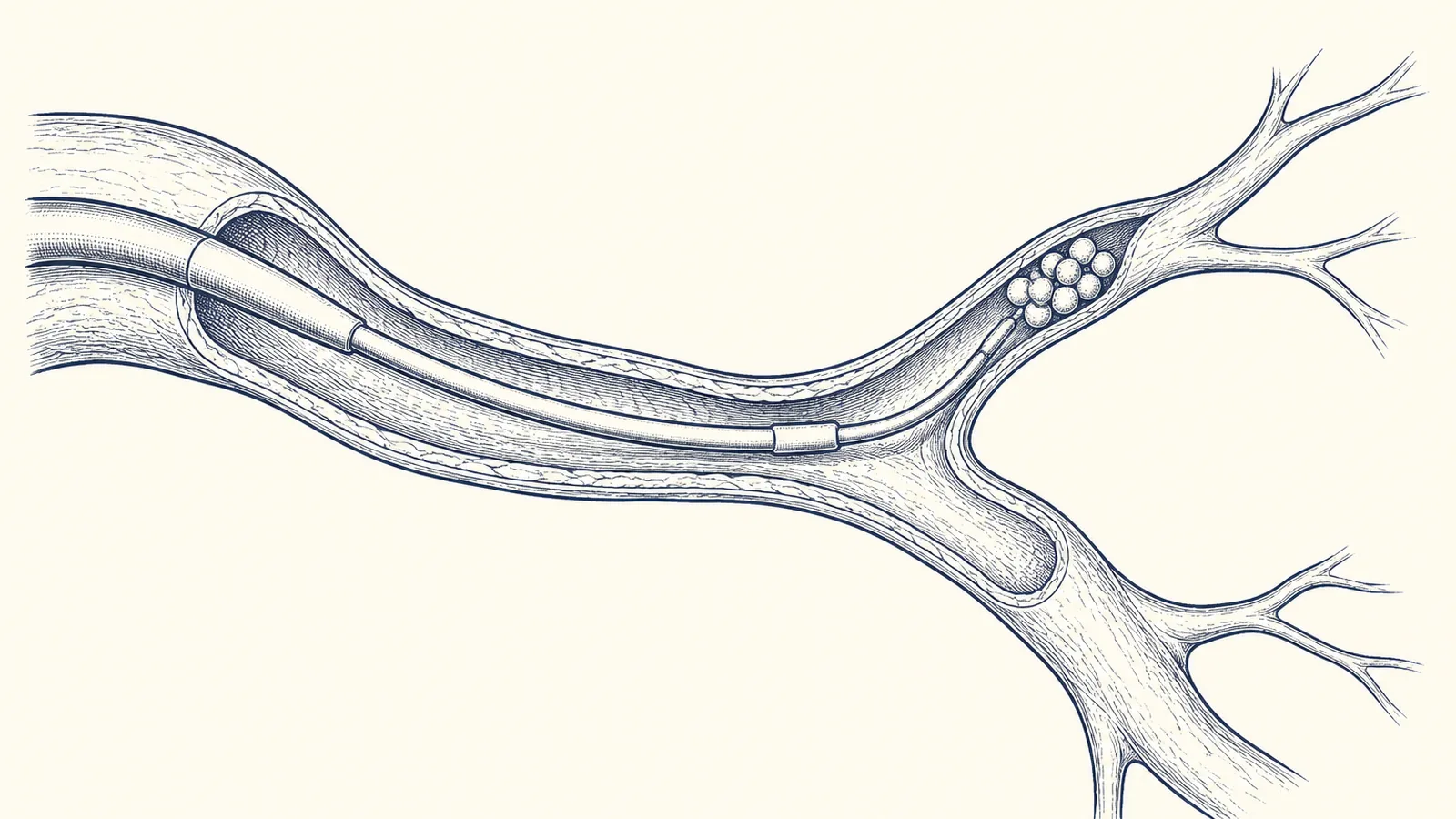
The first time I read that doctors thread a catheter into the arteries around an arthritic knee and plug some of them on purpose, I was a little alarmed. Since when does cutting off blood make a sore joint feel better? Then I read the results out of Berlin, where median pain in 194 patients fell from 7 to 3 on a 10-point scale and stayed there for a year, and the lead investigator suggested the procedure might change the course of the disease. Then I read the fine print. Nobody in the study got a fake version of the procedure, and a Dutch trial that did use a sham, and followed its patients for a year, concluded the benefit was mainly placebo.
the pain reduction observed in patients treated with GAE is mainly due to a placebo effect
The procedure is called genicular artery embolization, or GAE, and its logic turns out to be about the joint’s lining, not its cartilage. An arthritic knee gets inflamed around the edges, and that inflamed tissue sprouts abnormal new blood vessels that keep the inflammation fed. GAE sends tiny particles into the small arteries supplying the knee to block those vessels and ease the inflammation without touching the joint itself. The Berlin version uses gelatin microspheres engineered to dissolve within hours, which is the detail that made me sit up: the beads choke off the fragile overgrowth just long enough, then break down so normal flow can come back.
A year of relief, measured one way
The study, led by interventional radiologist Florian Nima Fleckenstein at Charité – Universitätsmedizin Berlin, appeared in Radiology on June 16 and is getting a second round of coverage this month. Its patients, median age 69, had all failed at least three months of physical therapy, anti-inflammatory drugs, and joint injections, the point where the next conversation is usually about a new knee. Five radiologists performed 239 procedures between July and November 2024, with 45 people having both knees done, and all 239 were technically successful. Median pain started at 7, dropped to 4 by six weeks and sat at 3 at six and twelve months. The KOOS knee questionnaire, scored out of 100, moved the same way, with pain going from 44 to 65, quality of life from 19 to 40, and sports and recreation from 15 to 36. At a year, 80% of participants had improved by at least 2 points on the pain scale, the threshold for a change patients can feel.
| Measure | Share |
|---|---|
| of Berlin participants at one year | 80% |
Fleckenstein called GAE “a meaningful new option between injections and joint replacement,” and in the RSNA release he went further, saying that with resorbable microspheres it “may be the first procedure that alters the course of the disease, slowing its progression.”
Nothing in the paper measured the course of the disease. The authors included no imaging-based endpoints or objective functional tests, and the study did not demonstrate that GAE prevents cartilage deterioration or reverses existing joint damage, or that it keeps anyone away from a knee replacement. What it measured was how patients said they felt. That matters enormously to someone living with a bad knee, and it’s also the outcome most easily moved by the thing the study left out, which is a group that got a fake procedure.
The sham patients got better too
This procedure has already been tested against a fake, and the longest-running test is Dutch. At Erasmus MC in Rotterdam, Tijmen van Zadelhoff’s team randomized 58 people with mild-to-moderate knee arthritis, 29 to embolization and 29 to a sham in which catheter maneuvering was simulated. At four months, KOOS pain had improved 21.4 points with the real procedure and 18.4 with the sham, a difference that wasn’t statistically significant. The team kept following those patients, and in April they reported the one-year results in European Radiology. The embolization arm went from 44.44 to 65.61 on KOOS pain, the sham arm from 42.34 to 58.15, and the 7.46-point gap between them at one year again fell short of significance. MRI found no meaningful change in synovitis, the joint-lining inflammation the whole procedure is designed to quiet, in either group.
I stared at those numbers for a while, because Rotterdam’s embolization arm traveled from 44 to 66 over a year, almost exactly the 44 to 65 that Berlin reported. These are different patients at different hospitals, and Rotterdam used non-dissolving Embozene microspheres, so its sham arm can’t tell you how much of Berlin’s gain was placebo. What it does show is that a carefully staged fake procedure took a comparable group of knees from 42 to 58. The Erasmus MC team put its own conclusion bluntly: “the pain reduction observed in patients treated with GAE is mainly due to a placebo effect.”
The other two sham trials, gathered with Rotterdam’s in a 2025 systematic review, split. In Australia, Landers and colleagues blocked the arteries of 59 patients with an antibiotic suspension and saw KOOS pain improve 24.1 points versus 22.2 with a sham at twelve months; only a subgroup of 17 whose genicular arteries were all fully blocked beat the controls, and that was on sports and quality-of-life scores, not pain. In the United States, Bagla’s team ran the one clearly positive trial. On a visual pain scale measured in millimeters, where patients started around 81, pain fell 50.8 with embolization and 0.5 with the sham at one month. It used absorbable particles, the closest cousin to Berlin’s beads, but it enrolled 21 patients, 7 of them in the sham arm, and non-responders could cross over to the real procedure after that first month.
When the field pools what it has, the advantage keeps thinning. A September review of 22 studies found no statistically significant advantage over sham procedures when it combined three randomized trials, and a June analysis of 45 studies and 2,205 patients saw improvement but rated the certainty of the evidence low or very low. The most impressive randomized number in the literature, 72.7% improvement versus 24.2% at a year in 50 patients, came from comparing GAE plus standard care against standard care alone, with no sham arm to separate the particles from the experience of having a procedure.
So why would a procedure with no particles help so many people? I don’t think the patients are imagining their relief. Arthritis pain swings from week to week, and people tend to enroll in trials when it’s at its worst, so some improvement shows up on its own as pain drifts back toward its usual level. On top of that comes the expectation built by lying in an angiography suite while specialists work on your knee, which is a much louder signal than a pill. None of these trials pinned down which of those forces did the work, but any of them can move a self-reported pain score, and only a sham arm can subtract them out.
Berlin also lost people along the way. By one year, 154 of the 194 patients were still in follow-up. The other 40 have unknown outcomes, so the durability claim rests on the 79% who stayed.
The beads have a stock ticker
According to its maker, the beads are Nexsphere-F, from South Korea’s NEXTBIOMEDICAL (KOSDAQ: 389650). The company’s July press release announced that Radiology had published clinical results for Nexsphere-F, described the 7-to-3 drop as “a 57% reduction,” said the company “believes this is the largest prospective, single-center observational study to date” of its kind, and called the paper “strong international recognition of Nexsphere-F’s clinical value and differentiation.” The product carries a European CE mark. Neither the RSNA release nor the company’s announcement says who paid for the Charité study.
In the United States, the FDA’s Breakthrough Device designation for the beads was announced in January 2025, and the company holds FDA and CMS IDE approvals for its pivotal trial, RESORB (NCT06872567), which began enrolling in October 2025 and plans about 126 patients at more than 10 U.S. centers. It randomizes patients to Nexsphere-F embolization or a corticosteroid injection. Beating a steroid shot would show the procedure outperforms a shot, but it can’t show the beads outperform the experience of having a procedure, and Rotterdam has just shown how large that experience can be.
The safety record is the strongest thing in the Berlin paper: no moderate or severe complications across 239 procedures, and mild ones in 6.7%, mostly skin discoloration that cleared within a day. The authors argue that rapidly resorbable beads may overcome limitations of existing agents, including off-label use, antimicrobial resistance from the antibiotic option, and particles landing in the wrong tissue. Those are proposed advantages, not outcomes this study measured, and 194 patients over one year is a good start on safety rather than the last word on it.
The Society of Interventional Radiology’s 2026 position statement supports offering GAE to carefully selected patients whose symptoms persist despite conservative treatment, especially people who can’t have a knee replacement or want to put one off, with trained operators and trials continuing. The SIR represents the specialists who perform the procedure, and it is endorsing its use outside trials in the same year its longest-running sham-controlled trial called the effect mainly placebo. I think that’s too permissive.
If my knee were stuck at a 7 after physical therapy and injections, I would sign up for a sham-controlled trial of these dissolving beads, and I would not pay for Nexsphere-F embolization outside one until a sham-controlled study of that product, followed for at least a year, finds the gap Rotterdam couldn’t.
Sources
- Radiology – Fleckenstein et al., genicular artery embolization with rapidly resorbable gelatin-based microspheres (2026)
- RSNA press release on the Charité GAE study (June 2026)
- AuntMinnie – GAE benefits may just be placebo effect (April 2026)
- Systematic review of sham-controlled GAE trials (2025)
- ScienceDaily – New knee arthritis treatment delivers lasting pain relief without surgery (October 2026)
- AuntMinnie – GAE effective for knee pain up to 12 months
- Clinical Radiology – randomized trial of GAE plus standard care versus standard care (2026)
- Journal of Vascular and Interventional Radiology – SIR position statement on GAE (2026)
- NEXTBIOMEDICAL press release via BioSpace – Nexsphere-F study published in Radiology (July 2026)
- Endovascular Today – NEXTBIOMEDICAL begins pivotal RESORB trial of Nexsphere-F (October 2025)