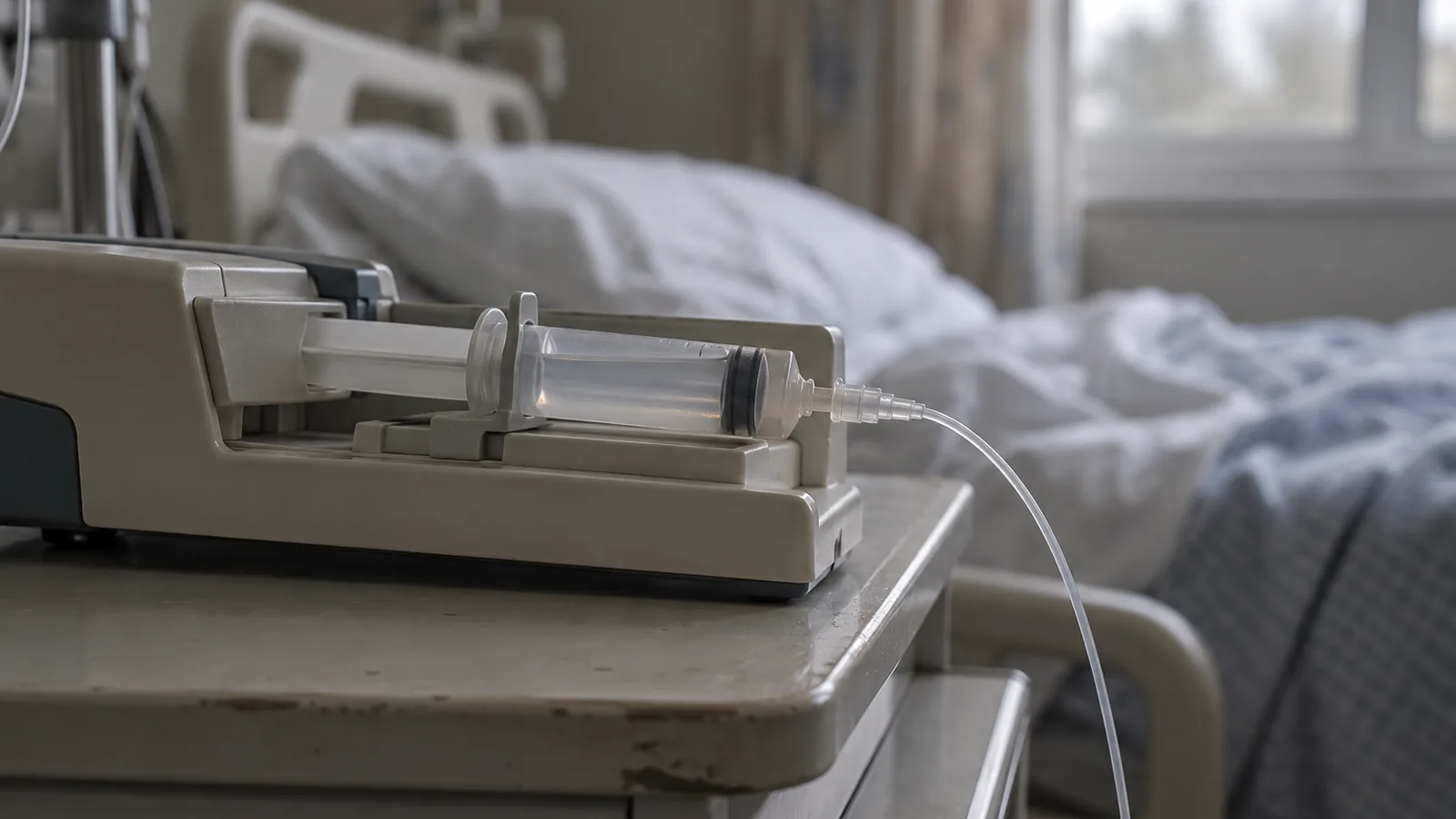
In 2012, Janet Hardy, a professor of palliative care at Mater Adult Hospital in South Brisbane, published a trial that should have settled a question palliative medicine is still asking. Her group gave 185 patients with uncontrolled cancer pain either subcutaneous ketamine or a placebo infusion over 3 to 5 days. Both went on top of the opioids and standard adjuvant drugs the patients were already taking, and the trial was double-blind, so neither patients nor staff knew who got which. The result was flat: pain responded in 31 percent of patients on ketamine and 27 percent on placebo, a gap the statistics could not tell apart from chance. Patients on ketamine had nearly twice the rate of adverse events worse than baseline, and significantly more of them dropped out because of toxicity.
cautiously consider time-limited, individualized trials of ketamine
A cost-effectiveness analysis from the same trial, with Hardy among its authors, added the rest of the bill: worse quality of life on ketamine, higher costs, and a conclusion that the drug was neither effective nor cost-effective. Supportive-care research rarely produces a negative this clean.
This September, a rapid systematic review in Annals of Palliative Medicine gathered 13 studies of palliative ketamine in people with advanced cancer. Four open-label pilots reported promising benefits for cancer pain in outpatients. Seven more studies, a mix of pilot trials, retrospective chart reviews and one mechanistic trial, reported improvements in refractory pain near the end of life. Open-label pilots tend to find what they’re looking for, since everyone in the room knows the patient is getting the interesting new drug. Then the review reaches Hardy’s work, calls it the only adequately powered randomized controlled trial in the set, and reports that it found no analgesic benefit and greater toxicity. The pilots found a signal. The trial built to confirm it did not.
This matters because cancer pain is common and badly handled. Earlier this month the oncologist Angus Dalgleish sat down with John Campbell on YouTube to go through cancer’s early warning signs, on the sound premise that the disease is far more treatable when it’s caught early. That conversation stops at diagnosis, and the record on what happens to the pain afterward is poor. A 2012 review in the Journal of the Advanced Practitioner in Oncology collected the numbers. Pain was reported by 64 percent of patients with advanced disease and 59 percent of those on anticancer therapy. A separate analysis found nearly one in two cancer patients undertreated for pain, and a prospective study of 3,123 outpatients found 33 percent receiving inadequate analgesic prescriptions, with no improvement between the first visit and follow-up.
The worst version of that pain is the pain crisis, and a 2026 meta-analysis in the Journal of Nursing Scholarship, pooling seven studies and 1,865 patients, put its incidence at 37 percent.
| Measure | Share |
|---|---|
| pooled incidence among cancer patients | 37 percent |
The same analysis then looked at who was most at risk. Bone metastasis carried an odds ratio of 3.91 and chemoradiotherapy 3.23, roughly what an oncologist would guess, but the strongest associations in the paper were emotional: 10.99 for severe anxiety and 6.54 for mild depression, while social support was modestly protective. These are associations, and they don’t prove that anxiety causes a pain crisis, since the most frightened patients may simply be the ones with the worst disease. The authors still drew the practical conclusion themselves and called for routine psychological assessment to be built into oncology nursing, so that pain crises are caught before they happen.
| Group | Value (odds ratio) |
|---|---|
| Severe anxiety | 10.99 |
| Mild depression | 6.54 |
| Bone metastasis | 3.91 |
| Chemoradiotherapy | 3.23 |
Set that next to the placebo arm of Hardy’s trial. More than a quarter of patients whose cancer pain had not been controlled improved on an infusion that held no ketamine, while a research team watched them closely. Something other than the drug moved that pain: the regimen they were already on, the attention, the passage of a bad week. The trial wasn’t designed to say which, and the field has shown less curiosity about that response than about the next compound that might beat it.
That next compound usually arrives as a weak positive trial. In an open-label trial of virtual-reality headsets for 100 patients having a thyroid needle biopsy for suspected cancer, the headset group reported less pain only after the analysis adjusted for baseline pain and two covariates that had not been prespecified. Those two were chosen because the groups turned out to be unbalanced at the start. Unadjusted, the difference was not significant, and even the adjusted effect was smaller than the minimum effect the trial had been powered to detect. To their credit, the authors said so in their own abstract.
The cheap, low-risk interventions in this year’s literature are no miracle either, but their wins are modest and sized honestly. A single-blind randomized crossover study of acupoint application in bladder-cancer patients receiving bladder instillations after surgery reduced voiding frequency, urgency and painful urination compared with instillation alone, and it improved physical functioning. Pain scores trended down without reaching significance. A systematic review of exergaming, meaning video games that get patients moving, covered 19 cohorts and reported favorable findings for mobility, balance and fatigue. No serious intervention-related adverse events turned up among the studies that reported safety, though the authors flag that reporting was incomplete and that the effect on pain was inconsistent. Neither study treats cancer pain in the strict sense, and neither should be sold as doing so. They point the same way as the pain-crisis data, toward function, mood and the daily texture of care, and away from another molecule.
The authors of the 2026 review laid out the pilots, the chart reviews and Hardy’s negative trial, then concluded that palliative care clinicians should “cautiously consider time-limited, individualized trials of ketamine” for patients with heavy symptom burden, pending more rigorous research. Hardy did the rigorous research in 2012. For fourteen years it has been cited as a reason for caution, and in palliative medicine that has turned out to be different from a reason to stop.
Sources
- Tometich et al., palliative ketamine for pain and depression in advanced cancer, Annals of Palliative Medicine (2026)
- OncLive, Adjunctive Ketamine Does Not Relieve Cancer Pain (Hardy et al., 2012)
- McCaffrey et al., cost-effectiveness of subcutaneous ketamine in chronic cancer pain (2015)
- Wang et al., incidence and predictors of pain crisis in cancer patients, Journal of Nursing Scholarship (2026)
- Viale, Improvement Needed: Cancer Pain Management in 2012
- Karadeniz et al., virtual reality during thyroid fine-needle biopsy, Journal of Medical Internet Research (2026)
- Shi et al., acupoint application after bladder-cancer surgery, Pain Research & Management (2026)
- Han et al., exergaming for adults with cancer, Frontiers in Oncology (2026)
- Dr. John Campbell with Prof. Angus Dalgleish, Pain and cancer (2026)