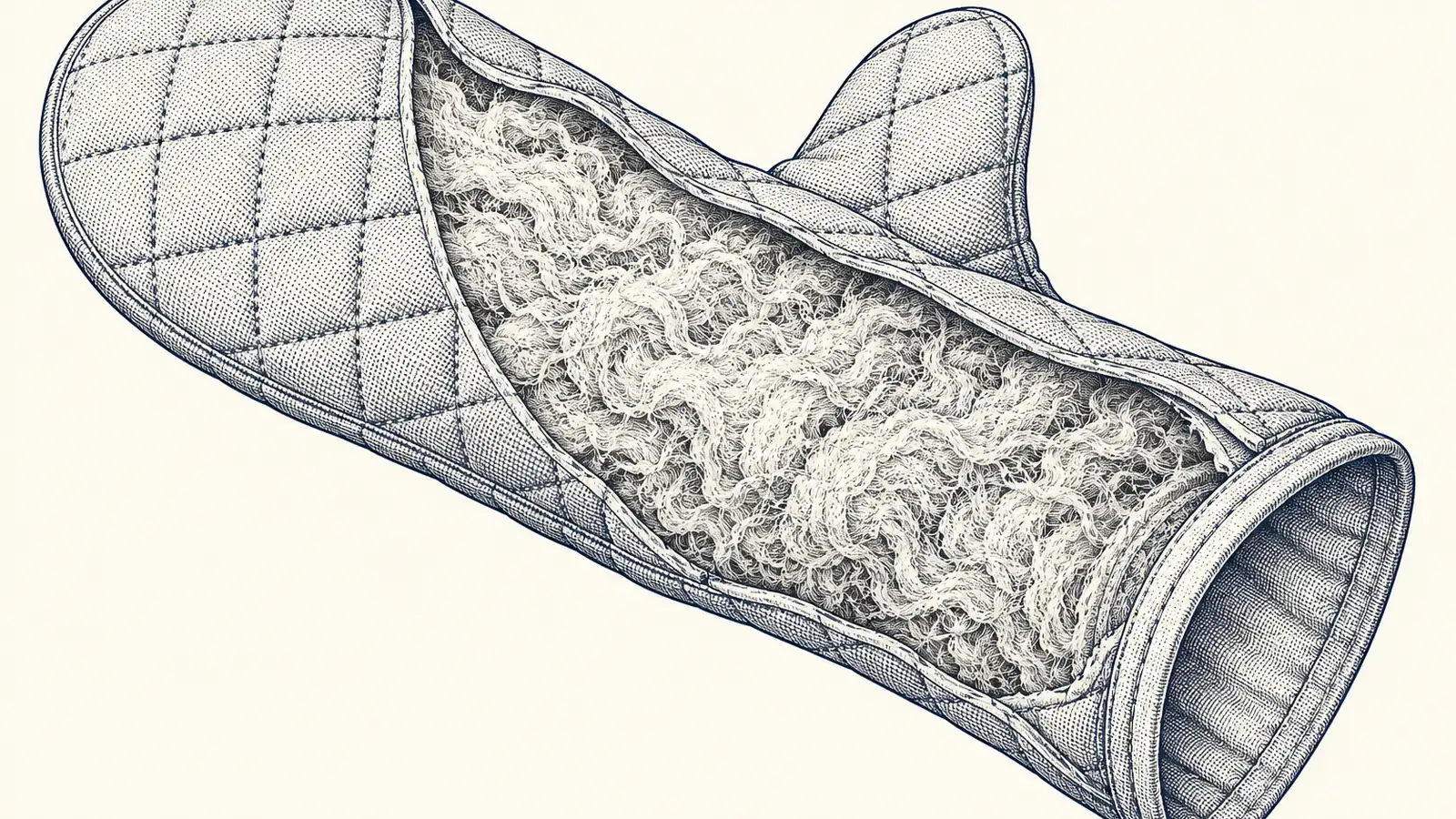
I have never once wondered what’s packed inside an oven glove, and I suspect you haven’t either. Who checks the stuffing of a fourteen-euro kitchen accessory? In November 2025, a private citizen did, or at least asked the question out loud: they flagged a listing for “heat-resistant oven gloves for indoor and outdoor use” and wondered online whether the things could contain asbestos.
Two Italian mineralogists decided to find out. Alessandro Gualtieri of the University of Modena and Reggio Emilia and Alessandro Cavallo of the University of Milan-Bicocca bought the gloves in December 2025, in two independent purchases two weeks apart, from a listing on one of the five largest e-commerce retailers in the world (they don’t name it). Each pair cost about 14 euros. The label said “Made in China,” declared no asbestos and carried no CE marking. They cut fragments from both gloves of a pair and ran them through X-ray powder diffraction and electron microscopy with chemical analysis. The answer, set out in their letter published October 14 in Environmental Health, was chrysotile asbestos at 89 percent by weight, with calcite and dolomite making up the rest. When handled, the gloves tended to shed dust.
| Measure | Share |
|---|---|
| of the glove material, by weight | 89 percent |
This is one product, bought twice, and the authors don’t pretend it’s a survey. They do warn, in the full text, that it “may be just the tip of the iceberg.” Having read the rest of the record, I think they’re being polite.
Why anyone would put asbestos in a glove
Chrysotile ended up in that glove for the same reason it went into brake pads and boiler lagging for a century: it doesn’t burn. It can sit on a hot tray and shrug. What the Italians received is essentially an old industrial heat glove, sold to home cooks with nothing on the listing to say so.
So why does flexing a glove matter? Here’s where I had to stop and ask the obvious question, because it turns out the danger is mostly about shape. The fibres the authors measured met the counting criteria used for regulated, respirable fibres: at least 5 micrometres long, under 3 micrometres wide, and at least three times longer than wide. Something that thin can ride the air past your nose and throat into the deep lung. Your lungs keep a cleanup crew there, the macrophages, which wrap around debris and break it down. A short fibre gets swallowed. A long one is too long for the cell to close around, and the macrophage gets stuck mid-gulp, pouring out inflammatory signals. A 2010 review in Particle and Fibre Toxicology by Ken Donaldson and colleagues lays out the leading hypothesis for what follows: long fibres that drain toward the lining of the chest wall, the parietal pleura, get caught at its tiny exit openings because they’re too long to pass through, and that retention site is where pleural mesothelioma appears to begin, often decades later.
Nobody has measured how much fibre a cook would actually breathe from these gloves; dust in the hand isn’t a dose in the lung. But think about what an oven glove does all day. You grab it, squeeze it, crumple it against a roasting pan and hang it by the stove, close to face height. I can’t think of many household objects that flex their own stuffing more often.
The pattern around this glove is hard to wave away. In November 2025, Australia, where asbestos is banned, recalled imported children’s coloured sand after tremolite asbestos turned up, and WA Health told families to stop using it, clean with wet cloths while wearing gloves and a P2 or N95 mask, and double-bag everything. In January 2026, Britain’s Hobbycraft recalled its Giant Box of Craft because the coloured sand vials “may contain trace asbestos fibres,” and Somerset Council ordered its maintained schools to take immediate action if the kit was on site.
The US has been here too. In a 2020 study in Environmental Health Insights, with testing commissioned by the Environmental Working Group, tremolite turned up in 3 of 21 talc-based cosmetics, two eyeshadow palettes and a toy makeup kit, all bought from a large online retailer. The toy kit was marketed to children.
Each time, the product landed in a country that had already banned or restricted asbestos, carried there by a supply chain that ends at a front door. Gualtieri and Cavallo name the mechanism precisely: “digital platforms obscure responsibility, dilute accountability, and complicate regulatory intervention.” The marketplace takes its cut while the seller is a storefront name and a warehouse on another continent.
A treaty that can’t even agree to a label
A national ban only reaches as far as that nation’s border enforcement. By the authors’ count, just 74 of 195 countries ban every form of asbestos, chrysotile included, and the remaining 62 percent still permit what they call “safe or controlled” chrysotile use. The US Geological Survey estimates worldwide consumption of asbestos fibre at about 930,000 tons in 2025 and expects continued demand in Asia for asbestos cement pipe and roofing.
The international machinery meant to track that trade is stuck. Chrysotile still isn’t on Annex III of the UN’s Rotterdam Convention, and listing it wouldn’t ban anything. Exporters would simply have to tell importing countries what they’re shipping and get their consent first. At the April–May 2025 conference, consensus failed again and the decision was pushed to the next one, which the authors attribute to “political opposition by a small group of parties.” Under a consensus rule, a few exporting states can block a disclosure requirement for everyone else, and importing countries are left with their own customs checks and whatever the seller chooses to write on the listing.
Where Washington is helping, and where it isn’t
In March 2024 the EPA banned ongoing uses of chrysotile. The cost of waiting that long was already on paper. The CDC counted 45,221 deaths with malignant mesothelioma on the death certificate from 1999 to 2015, with annual deaths climbing from 2,479 to 2,597, and warned that “new asbestos-containing products continue to be manufactured in or imported” into the country.
The Trump administration deserves credit for one thing. Executive Order 14324 suspended duty-free de minimis treatment for all countries on August 29, 2025, so goods valued at $800 or less, the cheap parcels that used to pour in with minimal paperwork, now have to be filed under a proper entry type. That’s a sovereignty win at the border. Still, a customs entry is paperwork. It doesn’t put a glove under an electron microscope, and it can only repeat what the shipper knows or admits.
Meanwhile the same administration’s EPA reopened the ban. On June 16, 2025, the agency told the Fifth Circuit it would reconsider parts of the 2024 chrysotile rule, including whether permanent workplace controls could stand in for outright prohibition in certain uses and how workplace protections apply to asbestos sheet gaskets in chemical production. It estimated about 30 months for the rulemaking, putting a final rule around mid-December 2027, with the current rule in effect until then. By USGS’s estimate, the entire US consumed 50 tons of asbestos fibre in 2025, all from stockpiles and all for the chlor-alkali industry. Renegotiating a ban on a known human carcinogen for that sliver of industry, while the same fibre turns up in kitchen gloves sold to Americans’ neighbors abroad, gets the priorities backwards. Health populism holds the line on the carcinogen and makes the lobby prove its case, not the other way round.
The authors’ remedy starts with listing chrysotile under Rotterdam and building an international framework for online sales: mandatory disclosure of asbestos content, harmonized product identification, cross-border enforcement, restrictions on shipping into countries that ban asbestos, and platform accountability. That last item carries the most weight. Europe already wrote a rule requiring hazard-label information on distance-sale listings, and the authors note its application date has been pushed back to January 1, 2028. Until the platform collecting the fee answers for what it lists, the system’s real safety check is a curious stranger emailing two mineralogists.
I wouldn’t buy a heat-resistant glove from any listing that can’t tell me what the fibre is; I’d pay a little more for plain silicone from a seller with a name and an address.
Sources
- Environmental Health: Gualtieri and Cavallo letter (2026)
- PubMed Central: full text of the Gualtieri and Cavallo letter (2026)
- CDC MMWR: Malignant Mesothelioma Mortality, United States, 1999–2015 (2017)
- Particle and Fibre Toxicology: Donaldson et al., long-fibre retention in the parietal pleura (2010)
- USGS: Mineral Commodity Summaries 2026, Asbestos
- Federal Register: EPA Asbestos Part 1, chrysotile final rule (2024)
- National Law Review: EPA to reconsider the Asbestos Part 1 rule (2025)
- KPMG: CBP implements executive order suspending de minimis treatment (2025)
- Environmental Health Insights: asbestos in talc-based cosmetics (2020)
- WA Health: public health advice after recall of children’s sand products (2025)
- Somerset Council: Hobbycraft Giant Box of Craft recall (2026)