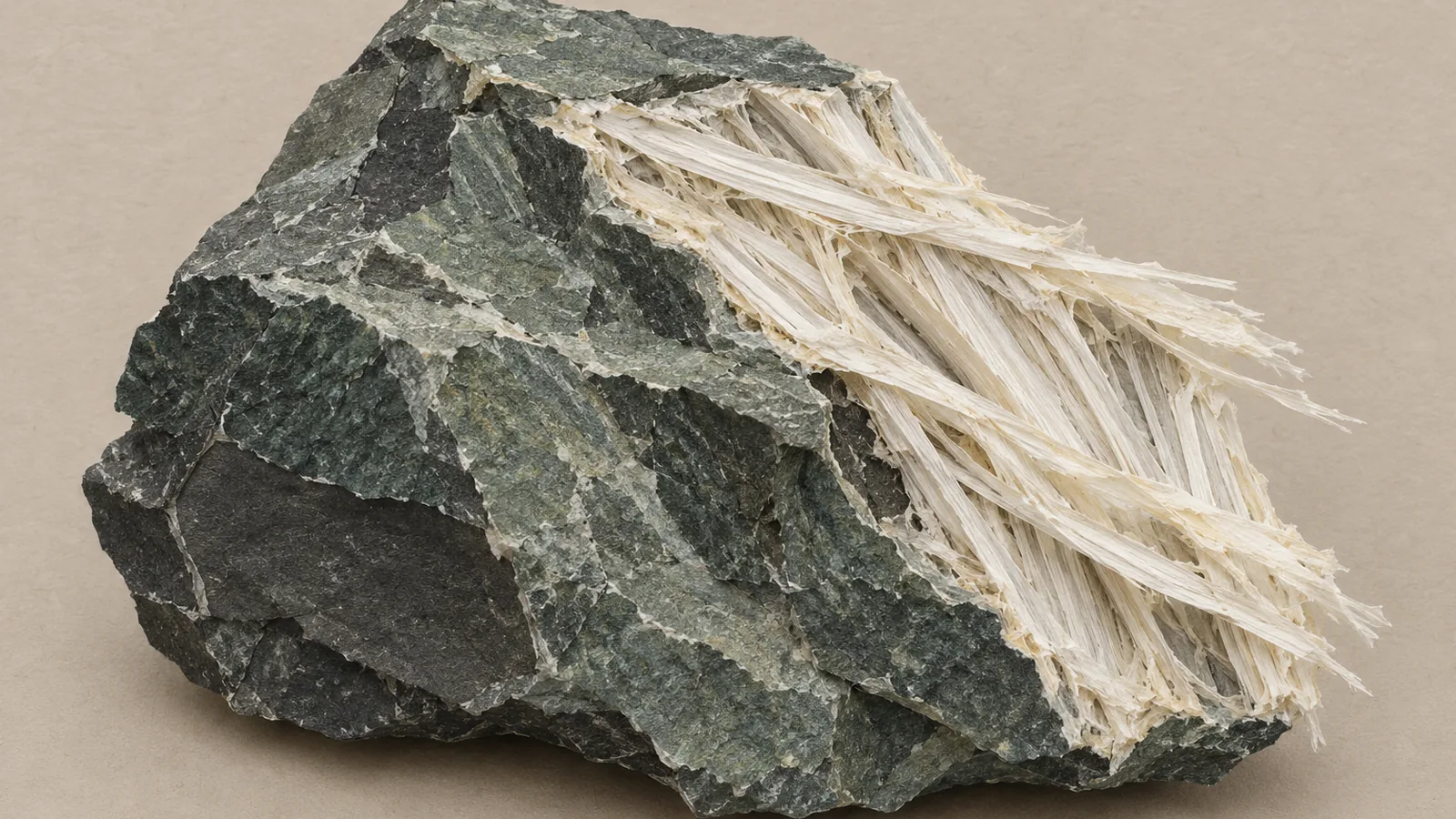
I had asbestos filed right next to leaded gasoline, a twentieth-century villain that got caught and hauled away. Then I learned that China mined an estimated 250,000 tons of it in 2025. I also learned that in one eastern Chinese city, where the main asbestos trade was spinning the fiber by hand, nearly everyone in the most heavily exposed group was a woman. Wait, this is still going on?
It is, and it sits inside a puzzle that a team at Zhejiang Cancer Hospital wants solved. China has done the two things that should bend a lung cancer curve. Adult smoking prevalence fell to 23.2 percent in 2024, almost five points below 2010, according to a national China CDC survey of nearly 200,000 people. Fine-particle pollution dropped 54 percent between 2013 and 2023, to a national average of 30 micrograms per cubic meter, by the Ministry of Ecology and Environment’s own count. Yet the country logged about 1.06 million new lung cancers in 2022. Age-standardized incidence, which strips out the effect of an aging population, rose between 2016 and 2022, per the latest national cancer statistics review. With about 733,300 deaths that year, lung cancer is also China’s deadliest cancer.
I’ll admit my first instinct was to call that a contradiction, and it’s messier than one. Lung cancer takes decades to surface, so a tumor diagnosed in 2022 mostly reflects what someone breathed long before the air cleaned up. The trend does show that the curve hasn’t bent yet, and the Zhejiang group argues that one of the inputs has barely been counted.
Their review, published October 13 in Environmental Health, comes from corresponding author Tianhui Chen’s cancer-prevention department, with co-authors including Kari Hemminki of the German Cancer Research Center. It argues that asbestos-related lung cancer in China is being systematically missed. Chrysotile is still in use, legacy asbestos materials are everywhere, and exposure reaches past traditional asbestos workers through household and environmental routes. The authors blame the undercount on “non-specific clinical presentation, incomplete exposure documentation, and limitations in surveillance systems,” and they call a comprehensive ban “an important long-term strategy.” Because it’s a narrative review built from existing evidence, it puts no number on asbestos’s share of China’s lung cancer. Its job is to point at a hole in the ledger, and the evidence beneath it holds up well when you take it one study at a time.
The fiber China never stopped using
Start with supply. The U.S. Geological Survey’s 2026 asbestos summary estimates Chinese mine output at about 250,000 tons in each of 2024 and 2025. World consumption is roughly 930,000 tons, most of it going into cement pipe, roofing sheets and other building materials in Asia. A Fujian Cancer Hospital team writing in Frontiers in Public Health calls China “the world’s second-largest asbestos producer and leading consumer” and notes that it “has yet to adopt a comprehensive national ban.”
The rules inside the factories are loose too. A 2026 PLoS One analysis led by Duo An of Xi’an Jiaotong University puts China’s eight-hour exposure limit at 0.8 fibers per cubic centimeter (0.8 f/cc). The developed countries it compared set their limits between 0.01 and 0.1 f/cc, so China’s ceiling is 8 to 80 times looser. The same paper reports that the number of asbestos-related enterprises kept climbing until at least 2019.
The Fujian group’s analysis of Global Burden of Disease modeling attributes 29,020 Chinese cancer deaths in 2021 to on-the-job asbestos exposure, and lung cancer accounts for 89.7 percent of them. Age-standardized rates climbed until about 2010, fell until 2018, and have since been “rebounding modestly, particularly among females.” These numbers are modeled estimates, not counted deaths. They also cover workplace exposure only, which leaves out the household and environmental exposure the Zhejiang review worries about.
| Measure | Share |
|---|---|
| of cancer deaths attributed to occupational asbestos in China, 2021 | 89.7 percent |
Miners without a single mesothelioma
Asbestos has a signature tumor, mesothelioma, a cancer of the lining around the lung. You’d expect it to work like a smoke alarm: expose a population heavily and the cases pile up and announce themselves. Two things muffle that alarm in China. Some scientists think chrysotile, the curly serpentine fiber, is less potent at causing mesothelioma than the needle-straight amphiboles, as CDC toxicology training material notes, though the same page says both types cause mesothelioma and lung cancer. And nobody can count a cancer that was never diagnosed and recorded.
At China’s largest chrysotile mine, in Qinghai, researchers followed 1,539 men for 26 years. Measured against national death rates for Chinese men, lung cancer deaths ran at 4.69 times the expected rate (95% CI 3.61 to 6.09). Smokers with the heaviest cumulative exposure reached 18.69 times expected (12.10 to 28.87), a dose-response gradient the authors say implies “a causal link,” at least for smokers. The nonsmoker figure, 1.46 (0.50 to 4.30), rests on just three deaths and isn’t statistically significant. Because 84.6 percent of the men smoked, the cohort can’t say much about asbestos acting alone, and the authors describe smoking as an effect modifier. They found zero mesotheliomas and note that some may have been misdiagnosed as lung cancer.
| Result | Value (SMR) | Lower bound | Upper bound |
|---|---|---|---|
| All miners | 4.69 | 3.61 | 6.09 |
| Heaviest-exposed smokers | 18.69 | 12.10 | 28.87 |
| Nonsmokers | 1.46 | 0.50 | 4.30 |
What happens inside the lung is so mechanical that I read the passage three times. A macrophage, the immune system’s cleanup cell, tries to swallow a fiber too long to fit inside it. When it fails, it spills its contents into the air sacs, a process the CDC calls “frustrated phagocytosis,” which can release hydrogen peroxide and superoxide radicals onto the surrounding tissue. Then I reached the line about cell division and had to put it down. Long fibers “interfere physically with the mitotic spindle,” the scaffolding a dividing cell uses to pull its chromosomes apart, and they cause chromosomal damage, “especially deletions.” So how does an inert mineral thread wreck a genome without any chemistry at all? It only has to be in the way when the cell splits.
The women at the spinning wheels
The most unsettling numbers come from an unnamed asbestos-processing city in eastern China, where hand-spinning chrysotile was the main local industry. Researchers writing in Frontiers in Oncology linked death certificates and family interviews for 2,964 residents who died in 2005 and 2006. Women made up 92.9 percent of the most heavily exposed group, because women were considered better suited to asbestos textile work. Among women, lung cancer’s share of deaths climbed with exposure: the standardized proportionate mortality ratios were 1.42, 1.66 and 2.01 from low to high. Not one mesothelioma death was recorded, which the authors put down to an “incomplete registry system of death causes and low diagnostic technology.”
| Group | Value (SPMR) |
|---|---|
| Low exposure | 1.42 |
| Medium exposure | 1.66 |
| High exposure | 2.01 |
One city can’t explain the 401,900 new lung cancers diagnosed in Chinese women in 2022, per the national statistics, and I won’t pretend it does. But there’s a pattern here worth chasing. The modeled occupational burden is ticking back up, particularly among women. The review argues that exposure histories go unrecorded. Put those together and you have a carcinogen whose signature tumor rarely reaches the death records, falling on women whose work with the fiber may never make it into a chart.
It would be easy to file this as somebody else’s problem, but Washington just showed how fragile its own protections are. EPA’s 2024 chrysotile ban already gives some manufacturers up to 12 years to phase the fiber out, per Environmental Health News. On June 16, 2025, the Trump EPA asked the Fifth Circuit to pause the lawsuit over that rule so it could spend roughly 30 months reconsidering it. Industry petitioners led by the Texas Chemistry Council were in that same court trying to overturn it. An administration that campaigned on making Americans healthier moved to reopen the ban, which handed the companies suing over it a second chance. After public pushback, the agency dropped the plan within weeks, and the industry challenge carried on anyway. Environmental Health News puts asbestos-related deaths at an estimated 40,000 Americans a year, and any proposal to loosen the rule should have to answer for that number in public.
The Zhejiang review can’t tell you how much of China’s lung cancer comes from asbestos, and its authors don’t claim to. What it shows is a system built not to notice. The exposure limits are loose, the records are patchy, and the fiber’s damage usually shows up as an ordinary lung tumor with nothing on file about where it came from. I’ve stopped treating “never smoked” as the end of a lung history. If I had ever spun fiber, relined brakes or torn out old cement roofing, I would write it into my medical history in exactly those words, without waiting for anyone to ask.
Sources
- Environmental Health – Huang, Gu, Chen et al., “Asbestos exposure: a potential driver of rising lung cancer incidence in China” (2026)
- Frontiers in Public Health – Chen et al., burden of cancer attributable to occupational asbestos in China, 1990–2021 (2026)
- PLoS One – Wang et al., cancer mortality in Chinese chrysotile miners: exposure-response relationships (2013)
- Frontiers in Oncology – Jiang et al., respiratory disease and lung cancer mortality among female chrysotile workers in eastern China (2022)
- PLoS One – An et al., disease burden of asbestos-related diseases in China, 1990–2023 (2026)
- Chinese Journal of Cancer Research – Cao, Qin, Liu, Chen, cancer statistics in China, 2022 data (2025)
- U.S. Geological Survey – Mineral Commodity Summaries 2026: Asbestos
- China Daily – national survey: adult smoking rate falls to 23.2 percent (2025)
- Gov.cn / Xinhua – Ministry of Ecology and Environment: PM2.5 down 54 percent, 2013–2023 (2024)
- CDC/ATSDR – How does asbestos induce pathogenic changes?
- National Law Review – EPA to reconsider asbestos Part 1 risk management rule (2025)
- Environmental Health News – Trump administration abandons plan to weaken asbestos ban (2025)