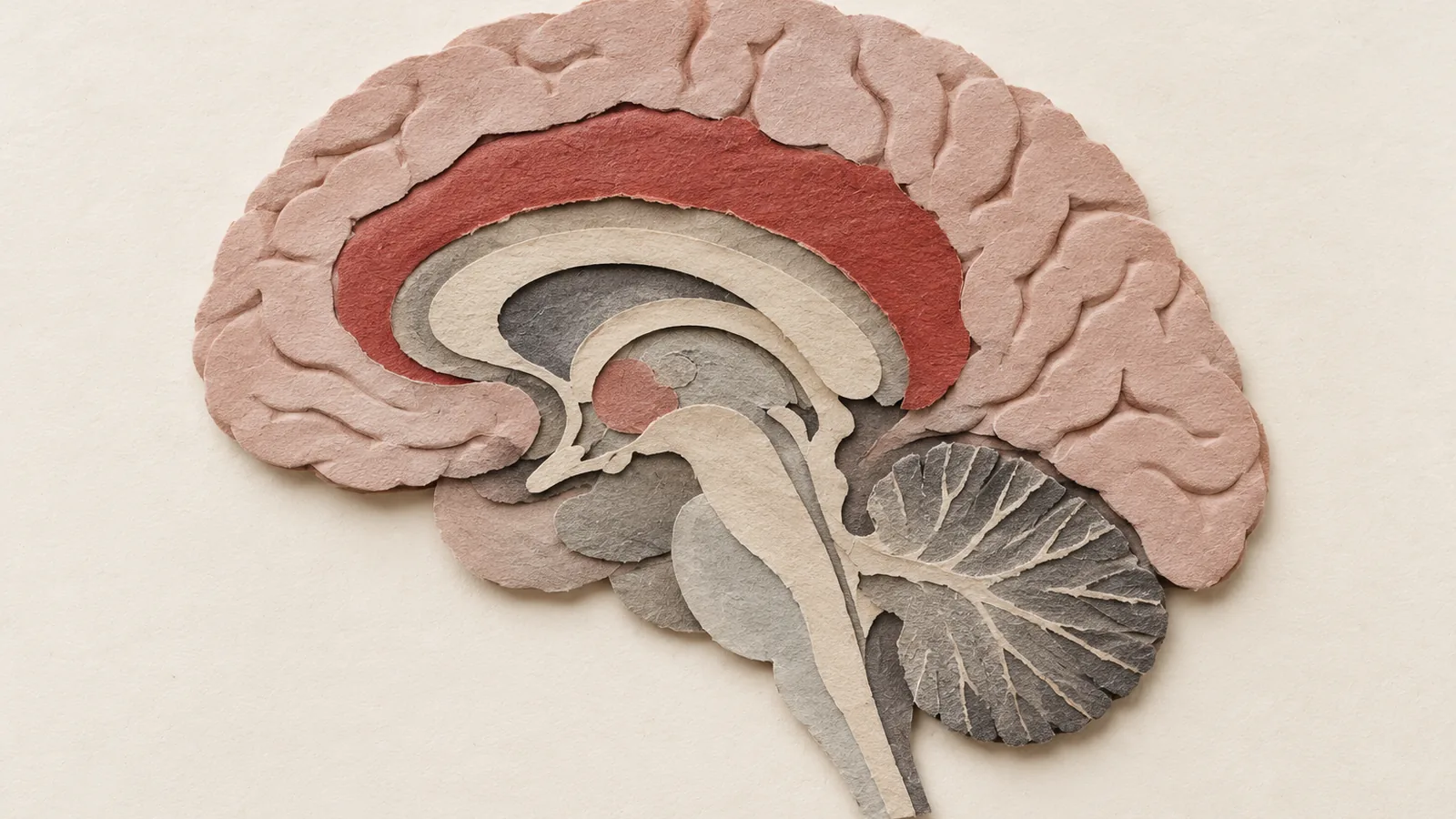
You know the move. Someone with a bad back reaches for the car door and braces before the twinge arrives, shoulders set and breath held, already living through a pain that hasn’t happened yet. A burn on the stove is an event. A chronic back is a resident. I’d always put that difference down to temperament, and a brain-imaging study out of UC San Diego suggests I was being lazy about the biology.
Low back pain is the leading cause of disability worldwide by the World Health Organization’s count, touching more than half a billion people, according to UC San Diego’s release. In a paper published October 5 in the British Journal of Anaesthesia, a team led by Fadel Zeidan measured brain blood flow in 114 people whose low back pain had lasted more than 12 weeks. They provoked each person’s pain the way a clinician would, with a leg raise, and as a comparison they put a painful but harmless dose of heat on the calf. The heat did what heat always does in these experiments: it quieted a brain system called the default mode network. The leg raise did the opposite and turned the network up.
“In every pain study, when you’re experiencing pain, the DMN deactivates,” Zeidan said in the release, which ScienceDaily carried. With a movement-triggered flare in chronic pain, he said, it “turns on instead.”
Why would the self network care about your spine?
The default mode network is often called the brain’s “self network,” a spread of regions that hums along while you daydream, replay an awkward conversation, or worry about next year. A sharp physical threat normally pulls you out of that inward mode, because your attention snaps to the hand on the stove. So wait: why would a back flare push people further in?
A second finding hints at it. The patients with more severe chronic pain showed stronger functional connectivity between the default mode network and the primary somatosensory cortex, the strip of brain that maps sensation from the body. That’s a measure of how closely activity in the two regions rises and falls together, not proof that anything got physically rewired. The researchers read it as the body’s map and the self’s narrative running in sync. In their telling, quoted by News-Medical, the moment-to-moment experience of a flare is “contaminated not only by the feeling of pain,” but by “past experiences like embarrassment about not being able to participate” in normal life, and by “fear of movement when trying to avoid the pain.” When I read that, I thought of the person at the car door. The scans themselves can’t confirm it, though. This is an observational study, and it shows the network rising alongside movement-evoked pain and tracking severity. It can’t say what thoughts filled that network, and it can’t show that the network makes back pain chronic or that quieting it would help.
Two plainer findings keep the whole thing anchored in the body. Worse pain during the leg raise went with more activity in sensory and motor regions, and heart rate climbed with the intensity of the flare. I like that second detail a lot, because patients with chronic back pain spend years being told their pain is subjective, and here it shows up on an ordinary pulse reading.
The idea that chronic back pain bends this network isn’t new. In 2008, Marwan Baliki, A. Vania Apkarian and colleagues at Northwestern scanned 15 chronic back pain patients and 15 healthy controls while they tracked a moving bar on a screen. The patients performed just as well, but their default mode network didn’t deactivate normally. The paper’s title put it bluntly: “Chronic Pain Hurts the Brain.” What that small study couldn’t capture was a flare. The new one provokes pain the way life does, by moving, in a much larger group, and lets each patient serve as their own control against heat.
The researchers draw a pointed conclusion from this. They suggest standard treatments such as opiates often fail for movement-triggered pain because it runs through different brain networks than acute pain does. “Current pain medicine is fixated on ridding patients of their pain symptoms, but that’s not the source of chronic pain,” Zeidan said in the release. That’s a hypothesis built on scans, not a drug trial. But the drug trials have been heading the same way for years.
In the 2023 OPAL trial, published in The Lancet, 347 people with acute low back or neck pain got either an oxycodone-naloxone course or placebo, with both groups receiving guideline care. The opioid group had no better pain relief at six weeks. By a year, pain scores slightly favored placebo, and one in five opioid patients was at risk of misuse, against one in ten on placebo. That trial looked at acute pain, so it says nothing direct about this brain network or about chronic backs. Still, the drug class sold for decades as the serious answer to a bad back failed to beat a dummy pill and doubled the share of patients at risk of misuse. The University of Sydney team behind it now says first-line care should rely on “reassurance and advice to stay active, and simple analgesics like non-steroidal anti-inflammatory drugs if necessary.”
Compare that with a treatment that goes after what the pain means to the patient. In a 2022 JAMA Psychiatry trial led by Yoni Ashar, 151 adults with back pain lasting at least six months and rated at least 4 out of 10 were randomized to pain reprocessing therapy, which teaches people to treat their pain as a non-dangerous brain signal, or to placebo or no treatment. Afterward, 66 percent of the therapy group were pain-free or nearly so, versus 20 percent on placebo and 10 percent with no treatment, and most kept their relief at one year. It’s a separate trial with its own patients and it can’t prove the default-mode story. But it’s an intervention aimed squarely at the self-and-meaning side of pain, and it produced numbers the opioid trials never have.
| Group | Value (percent) |
|---|---|
| Pain reprocessing therapy | 66 |
| Placebo | 20 |
| No treatment | 10 |
Zeidan’s lab has a mechanistic thread of its own. In a 2022 study in Pain, 40 healthy, pain-free volunteers who took four 20-minute mindfulness sessions got relief from lab-induced pain, and the people who got the most relief showed the most decoupling between the thalamus, a sensory relay, and the precuneus, a default mode hub. Those were healthy volunteers under a heat probe rather than back patients, so it’s a clue about mechanism, not a clinical result. The lab is now running imaging-based trials of mindfulness meditation and psychedelics, including psilocybin, in chronic pain, and the release calls the early findings promising but preliminary. “They’re not a silver bullet,” Zeidan said; “you’re not necessarily getting rid of the pain, but you’re changing the relationship.”
The study was funded by the NIH’s National Center for Complementary and Integrative Health and UC San Diego’s Sanford Institute for Empathy and Compassion, and the authors reported no conflicts of interest.
What stays with me is that bracing at the car door. It isn’t weakness or temperament. It may be the brain’s self network doing exactly what this study caught it doing: folding a flare into everything that person has learned to fear about moving. If my back went chronic tomorrow, I’d turn down the opioid script, sign up for a pain-reprocessing or mindfulness program, and keep getting in and out of that car every day, because that’s where the evidence points.
Sources
- British Journal of Anaesthesia: Gianola, Zeidan et al., “Brain mechanisms supporting movement-evoked chronic low back pain” (2026)
- UC San Diego release via Newswise: researchers discover why chronic low back pain feels personal (2026)
- ScienceDaily: Scientists discover why chronic back pain feels so personal (2026)
- News-Medical: Targeting the brain’s Default Mode Network may help better manage chronic low back pain (2026)
- News-Medical: Psychological treatment provides potent and durable relief for chronic back pain (2021)
- The Hospitalist: summary of the OPAL trial of opioids for acute back and neck pain, Lancet (2023)
- University of Sydney: Opioids no more effective than placebo for acute back and neck pain (2023)
- Journal of Neuroscience: Baliki, Apkarian et al., “Beyond Feeling: Chronic Pain Hurts the Brain, Disrupting the Default-Mode Network Dynamics” (2008)
- Pain: Riegner, Zeidan et al., mindfulness meditation-induced pain relief and thalamic-default mode network decoupling (2022)