In 2011, Stephanie Studenski and her colleagues pooled nine cohorts of community-dwelling adults, 34,485 people aged 65 and over, and asked whether a stopwatch could tell you who would still be alive years later. It could. In their JAMA analysis, each extra 0.1 meters per second of walking speed came with a hazard ratio for death of 0.88. Gait speed plus age and sex predicted survival about as well as models that also knew each person’s chronic conditions, blood pressure, BMI and hospital history. Geriatricians have argued ever since that walking belongs beside blood pressure as a vital sign. That argument has always had a democratic edge, because the test needs nothing more than a hallway and a clock.
A paper published November 6 in Nature Medicine pushes the idea much further, and in doing so it changes who holds the measuring tape. A Weizmann Institute of Science team recorded 30 seconds of treadmill walking from each of 3,328 Israeli adults and trained a model that significantly predicted 1,887 of 3,210 health measures across 18 body systems. Three of the paper’s authors, Assaf Rotem, Ohad Doron and Yuval Brodsky, are employees of Newton VR Ltd, the company that developed the Movement Lab system used to collect the gait data. Brodsky also appears as chief executive of Newton Tech, the AI movement company that announced the study in a press release that sells the result harder than the paper does.
“Predicted” needs unpacking first. Each person walked once, and the model estimated traits already measured in those same people: their age, their body fat, their lab values, the conditions they reported. Studenski’s stopwatch forecast who would die. This model works backward from a stride to a snapshot of the body that’s walking, and it says nothing yet about who will get sick next year.
Thirty seconds on a treadmill
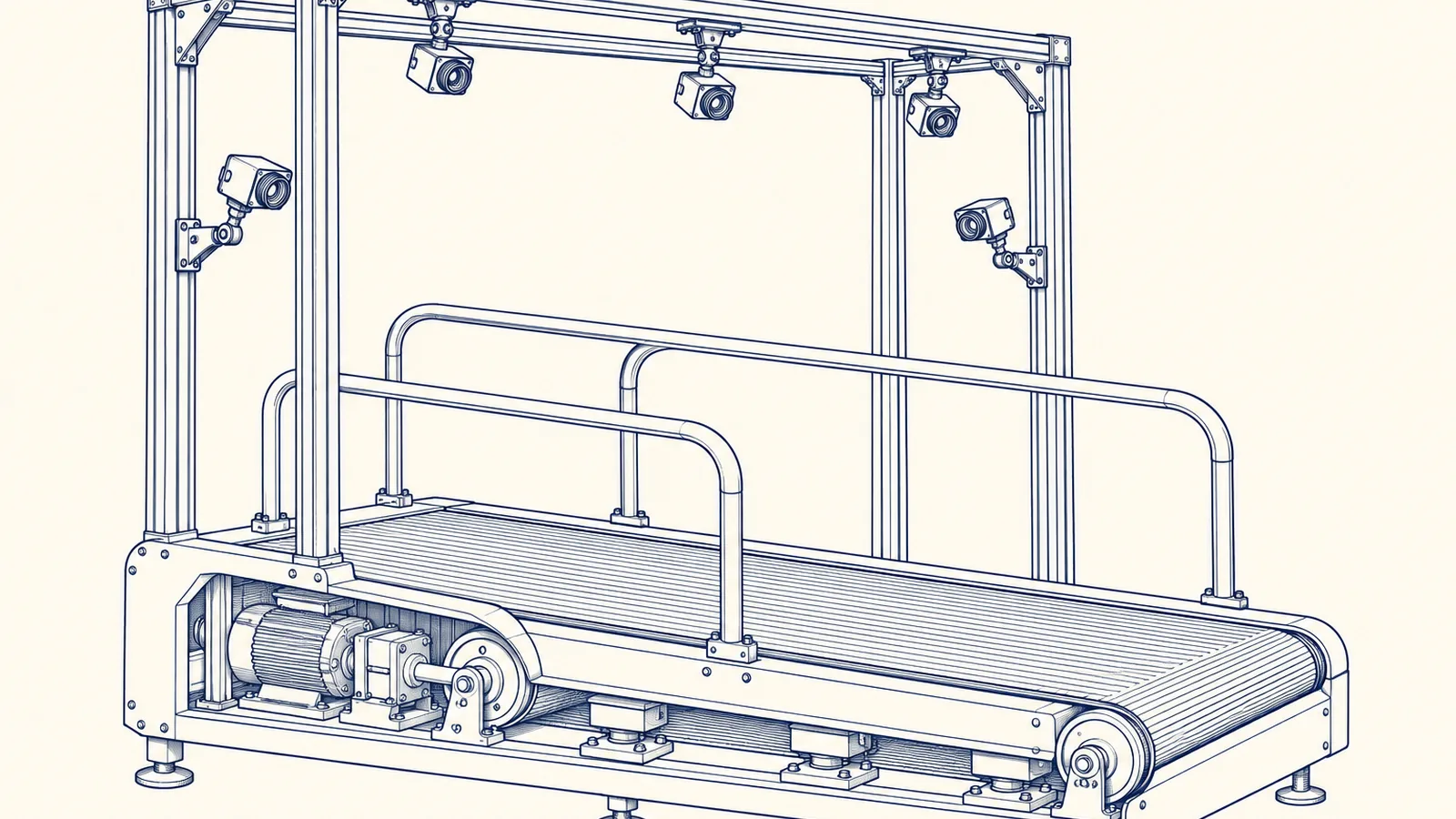
The study, led by Adam Gabet with senior author Eran Segal, opens with a line that would have sounded bold before 2011: “Gait is increasingly recognized as a vital sign.” Participants came from the Human Phenotype Project, Segal’s deeply measured Israeli cohort, and performed five motor tasks in front of a single depth camera, with Microsoft’s Azure Kinect body-tracking software converting each frame into a moving skeleton. Most of the analysis rests on short treadmill clips.
A gait lab normally reports a handful of numbers: stride length, cadence, symmetry and their relatives. The Weizmann team skipped those and let a foundation model learn its own compressed summary of each person’s movement, a numerical fingerprint the paper calls an embedding. Those fingerprints tracked age at r = 0.69, body mass index at 0.91 and visceral fat at 0.83, according to the published abstract. The preprint version adds that gait carried information about clinical diagnoses and medication use. Newton’s release goes further, saying movement improved predictions of liver stiffness beyond age and BMI “by as much as, or more than” adding the full panel of standard liver blood tests, a comparison the paper runs against routine liver biomarkers.
A camera can see a waistline
Read those correlations with some care, because the most impressive one may also be the least mysterious. A camera tracking a skeleton is watching a body’s size and build, and a heavier body moves differently. Visible body size could account for much of that 0.91 for BMI, and it would take no hidden biology for a model to see what a nurse sees when a patient walks in.
The authors anticipated this, and their answer is the most persuasive thing in the paper. After adjusting for age, BMI, visceral fat and height, gait still added predictive value in all 18 body systems in men and 17 of 18 in women. The engineered features clinics already use, stride and cadence and the rest, cleared significance for 188 measures in men and 213 in women against that baseline, while the learned embeddings cleared it for 823 in men and 723 in women (Gabet et al., Nature Medicine (2026)). That is three to four times as many significant results. A count of significant results isn’t the same as a count of useful predictions, since many of those 3,210 measures overlap with one another, but the gap does show that the familiar gait numbers leave something on the table.
| Gait measure | Men | Women |
|---|---|---|
| Stride, cadence and similar features | 188 | 213 |
| Learned embeddings | 823 | 723 |
The anatomy fits, too. When the team removed body regions one at a time, leg movement drove the metabolic and frailty predictions, while the torso carried sleep and lifestyle signals. The legs hold the body’s largest muscles, so it makes sense that how they handle load would say something about metabolism, though the ablation shows only where the signal sits and not why it’s there. Still, the direction is an appealing one: a measure of metabolic health that needs no needle, no fasting draw and no lab.
The medication results deserve the opposite caution. A model that picks out who takes a given drug might be detecting the drug’s effect on motor control, the condition it treats, or something else that travels with both, and a single cross-sectional snapshot cannot tell those apart.
The lab’s maker is on the author list
The competing-interests statement lists the three Newton VR employees and notes that Rotem is also affiliated with BioPilot AI. It adds that Segal and co-author Adina Weinberger are paid consultants of Pheno.AI Ltd, and the paper’s data-availability section directs researchers who want Human Phenotype Project data, for non-commercial purposes, to contact Pheno.AI. The acknowledgments list philanthropic and institutional funders, among them the Joseph Marks Foundation, the Seerave Foundation, an estate bequest and Weizmann chairs. The team posted its code publicly on GitHub, which matters later in this story.
The paper is a research article. The release reads like a product launch. It describes Newton’s MovementOS platform as something that “transforms video recordings of standard movement assessments into hundreds of objective biomechanical markers” and pitches it to drug developers: “The platform can be used prospectively or applied retrospectively to existing clinical trial videos.” It announces a multi-year agreement bringing the Movement Lab into the Motion Analysis Laboratory at Spaulding Rehabilitation Hospital, part of Mass General Brigham, where the system is already installed, and it quotes the lab’s director, Paolo Bonato. It also brings up a separate, exploratory, post hoc analysis of 20 participants in a NervGen Pharma spinal-cord-injury trial, which it acknowledges had nothing to do with the Nature Medicine study.
Then come the screening numbers. According to the release, adding movement data increased the number of diabetes cases identified in men by 83% and depression cases by 81%. The release never says against what. The paper’s screening analysis reports sensitivity at a top-10% referral threshold, for conditions participants had reported themselves, so these figures describe existing cases picked out of a cohort that already knew about them, not undiagnosed patients found in a clinic. The release does concede that “Screening and diagnostic applications remain investigational,” and that sentence is worth more than the percentages above it.
One cohort, one camera, no outside test
Inside its own dataset the paper is careful. Predictions were scored with five-fold nested cross-validation, repeated across 15 random seeds, which is a rigorous way to keep a model from memorizing the people it was trained on. That rigor stops at the edge of the cohort. Every participant came from the same Israeli project and walked in front of the same commercial system, and the paper describes no test in a different population or on different hardware, let alone the consumer phone video the authors imagine could someday make gait a passive vital sign.
The headline count has also moved. The March preprint described 3,414 participants and 1,980 significant predictions out of the same 3,210 targets, and the published version reports 3,328 participants and 1,887. The core correlations barely shifted (BMI went from 0.90 to 0.91, visceral fat from 0.82 to 0.83), which is reassuring, but a count that drops by 93 between versions is an output of analysis choices rather than a constant of human gait.
Studenski’s finding earned its place in geriatrics because it held across nine separate cohorts using a tool every clinic owns. The Weizmann model has one cohort and one vendor’s capture system, and that difference shapes the argument over what gait becomes: a public-health measure anyone can take, or a proprietary trial endpoint licensed to drug sponsors. The evidence alone doesn’t settle that question. Who runs the next test will go a long way toward settling it.
Spaulding will give the model new patients in Boston, but on Newton’s own equipment, in a lab under a commercial agreement with the company. The cleaner test sits with whichever group, with no stake in Newton or Pheno.AI, first takes the code the authors posted, runs it on its own patients and its own cameras, and publishes the numbers, good or bad.