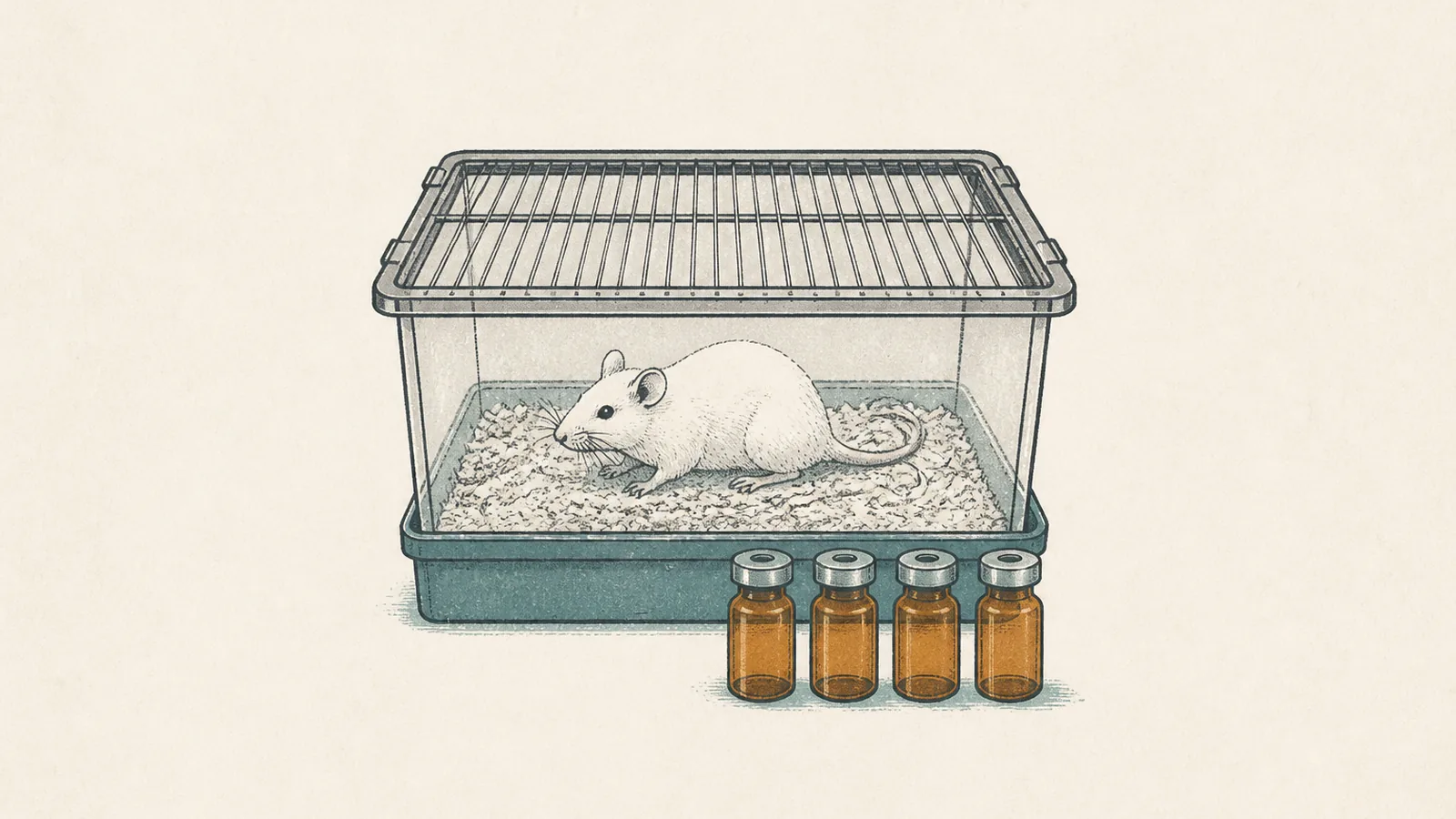
A fentanyl vaccine arrived this week, if you happen to be a mouse. The Scripps Research press release led with the line that the candidate “blocks deadly overdoses before they start,” which is the kind of sentence that gets a paper picked up by every health-news aggregator on the internet before lunch. The paper underneath, in the Journal of Medicinal Chemistry, describes four injections over eight weeks in rodents and antibodies that recognize a clutch of fentanyl analogues. In the headline experiment, brain fentanyl levels in vaccinated mice came in roughly seventy percent lower than in unvaccinated controls after a dose that would otherwise have flattened the animals’ breathing. The chemistry is real. The clinical part of the headline is doing more work than it has earned, because the actual lifesaver in the American overdose story is already in pharmacies, in pockets, and bending the curve without any help from a mouse.
The interesting part is what Kim Janda’s lab actually did to the molecule. Conventional opioid-vaccine design has always worked by linking something that looks like fentanyl to a carrier protein and hoping the immune system learns to chase the lookalike. Fentanyl analogues vary in their side chains and substituents, and a narrow antibody trained on one structure can fail entirely against a redesigned cousin. The Janda group’s move was to stop chasing the molecule and start training the immune system on a shape: they swapped fentanyl’s canonical piperidine ring for a strained little bicyclic, kept just enough of the spatial and physicochemical signature, and produced an immunogen with a radically different three-dimensional structure that still raises antibodies which cross-react with carfentanil, China White, acetylfentanyl, and furanylfentanyl while leaving morphine, oxycodone, remifentanil, and alfentanil alone. That last bit matters if you ever want a vaccinated patient to be operable in a hospital.
It is also exactly the kind of progress the Janda lab has been making, in installments, for the better part of a decade. A separate human-derived carfentanil antibody from the same group was reported in 2023 to be heading toward clinical trials and is still not in patients. The translational record of addiction vaccines is, to put it gently, not generous, because the biology is hard and the commercial pull is thin: an eight-week immunogen with no recurring revenue is a difficult pitch for a pharmaceutical balance sheet built around long-acting buprenorphine refills, and the patient population is, by definition, not the one a sponsor finds easiest to enroll. The federal funding line on this paper tells the same story in one beat: the Shadek Family Foundation, a private family fund, with no NIH grant numbers or industry sponsor listed.
The more honest comparison is not Scripps versus a press release but Scripps versus the University of Houston vaccine, licensed by the startup Ovax, that is already in human Phase 1 testing. That trial is small and is doing what Phase 1 trials do: looking for safety signals and immunogenicity, not lives saved. Even on the optimistic clock, an addiction vaccine that finishes Phase 1 in 2026 is several years and several hundred million dollars from anything a county health department can put in a syringe.
And the country is not waiting on it. Overdose deaths are falling, hard, and have been falling for three years running. The CDC’s most recent finalized data put 2024 total overdose deaths at 80,391, down nearly twenty-seven percent from the 110,037 estimated for 2023, with opioid deaths specifically dropping from about 83,140 to roughly 54,743 in the same span. STAT’s review of provisional 2025 data put the trailing twelve-month total through August at around 73,000, a further twenty-one-percent decline, with researchers and the U.S. News write-up of CDC’s release noting that a confident causal story is still out of reach. The candidates the experts cite are unsexy and concrete: wider naloxone availability after the FDA’s 2023 over-the-counter clearance, expanded medication-assisted treatment, opioid-settlement money finally trickling into the counties hit hardest, and tighter Chinese regulation of fentanyl precursors. None of them are an eight-week injection.
A vaccine that prevents overdoses before they start is a fine thing to develop. It is a strange thing to celebrate as if it were the missing piece in a crisis where the existing piece, a nasal spray that reverses respiratory depression in two minutes and now sits next to the ibuprofen at any drugstore, is one of the interventions actually credited with the decline. The country did not get from 110,000 dead to 80,000 dead in a year because of a clever immunogen. It got there because the cheap, boring tools finally reached the people who needed them.
There is also the matter of why the molecule has to be vaccinated against in the first place, which is that the industrial precursor pipeline feeding fentanyl into the American street kept Americans dying for years while the federal response moved at a regulatory pace. The same STAT review credits part of the recent decline to changes in Chinese precursor controls, which is to say: when supply tightens, deaths fall, and no antibody is required. An immunogen is a hedge for the people the supply chain reaches first. The supply chain is the question upstream of the hedge.
For now the mice at Scripps are doing better than they would have without four shots over eight weeks, and that is a paper worth publishing. The patients the press release pictured are still waiting on a Phase 1 readout from a different vaccine that will not deliver an answer for a long time. The lifesaver doing the actual work is sitting on a pharmacy shelf, in a small white box, and the country has finally decided to let people buy it.
Sources
- Journal of Medicinal Chemistry – Stewart, Janda et al., shape-based fentanyl-class immunogen (2026)
- News-Medical – “Experimental vaccine protects against fentanyl and related opioids” (June 11 2026)
- ScienceDaily – “New fentanyl vaccine blocks deadly overdoses before they start” (Scripps press release, June 12 2026)
- Scripps Research – Janda lab carfentanil antibody heading toward clinical trials (August 2023)
- Seattle Times – University of Houston / Ovax fentanyl vaccine heads for Phase 1 trials
- STAT – U.S. overdose deaths fell through most of 2025, CDC provisional data (January 14 2026)
- U.S. News – Overdose deaths dropped for third straight year in 2025 (May 13 2026)
- CDC NCHS – U.S. Overdose Deaths Decrease Almost 27% in 2024 (release, May 14 2025)