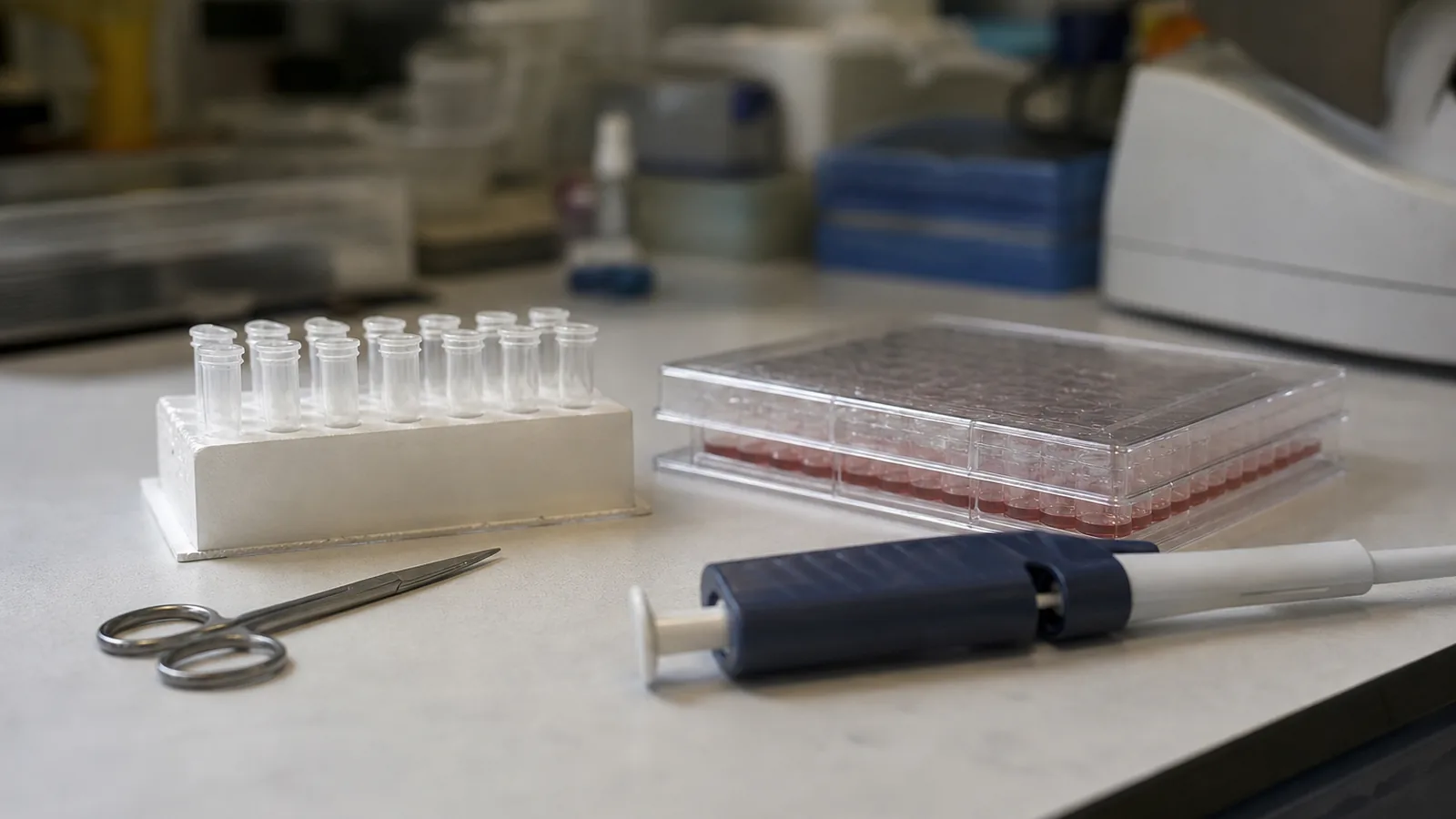
For about twenty years EXO1 has had a spotless reputation. It is a nuclease, a pair of molecular scissors the cell keeps on hand to trim damaged DNA and clean up the messy intermediates of replication. Its whole job is to fix things. You do not expect the repairman to be the one breaking the windows.
A team at Penn State College of Medicine now reports that, in sufficient quantity, it does exactly that. In a paper published June 20 in Nature Communications, Alexandra Nusawardhana, Claudia Nicolae, and George-Lucian Moldovan describe what a cell does when it makes too much EXO1: the scissors stop waiting for damage and start cutting structures that were supposed to stay intact. Newly copied DNA gets chewed back, single-stranded gaps widen, and stalled replication forks, the cell’s way of pausing to fix a problem mid-copy, get degraded instead of rescued. The result is the kind of genomic instability associated with cancer.
What turns an elegant cell-biology result into something the drug industry will read closely is the company EXO1 keeps. The damage signature it leaves in otherwise healthy cells looks remarkably like the signature of cells that have lost BRCA1 or BRCA2, the tumor-suppressor genes behind a large share of hereditary breast and ovarian cancer. Tumors with that signature respond to a specific, expensive class of drugs. So the Penn State result is not only a story about a repair gene gone wrong. It is a recipe for making ordinary tumors look like the ones a four-billion-dollar drug class was built to treat.
The group is careful about the distinction. This happened in BRCA-proficient cells, ones with working BRCA genes. The cancer-like vulnerability came from the surplus scissors, not from a broken repair pathway. To show the cutting activity was the culprit and not the mere presence of the protein, they built nuclease-dead versions of EXO1, scissors with the blades removed, and the damage disappeared.
Then comes the part that gets a paper like this read outside cell biology. Tumor cells engineered to overproduce EXO1 responded to olaparib, the PARP inhibitor sold as Lynparza, and to cisplatin chemotherapy the same way BRCA-mutant cancers do. The lab had manufactured what oncologists call BRCAness, a tumor that behaves like a BRCA-mutant without carrying the mutation, and then shown it could be hit with the same drugs.
EXO1 is overproduced in roughly 20 to 30 percent of breast, ovarian, melanoma, testicular, cervical, and hepatobiliary cancers, the researchers note. Moldovan’s framing, in the Penn State announcement, is the one the coverage leads with: “We shouldn’t treat cancers based on what tissue they come from but based on the landscape of the genetic mutations present in the tumors.” It is a good idea, and an old one, and it points at a very large number of patients.
That is where a clean piece of science meets a market that has been waiting for exactly this kind of news. Lynparza is a roughly four-billion-dollar drug. AstraZeneca and Merck, who share it, are projected to hold that line through 2027 even as key patents begin to expire. The commercial logic of a PARP inhibitor is the size of the eligible population, and the eligible population is defined by a biomarker. Right now that biomarker is mostly BRCA status and a handful of related repair defects. Every new way to label a tumor BRCA-like is, in the most literal sense, a way to enlarge the prescription base. Add high EXO1 to the list of qualifying signatures and you have added a revenue line, whether or not anyone at Penn State was thinking about one.
Keep that history in view, because the PARP class has spent the past few years getting smaller, not bigger, under regulatory pressure. Between June and September 2022, three monotherapy indications for recurrent ovarian cancer were withdrawn after follow-up data showed no survival benefit for heavily pretreated patients, and in some analyses a higher risk of death: rucaparib from Clovis, olaparib from AstraZeneca and Merck, niraparib from GSK. The SOLO3 trial found a 33 percent increased risk of death in the olaparib subgroup that had received three or more prior lines of therapy. The FDA later convened an advisory committee to scrutinize Lynparza in prostate cancer after its PROpel trial failed to show a statistically significant survival benefit, with some subgroups doing worse than the population overall. The difference between a broad prostate label and a narrow one was worth, by SVB analysts’ estimate at the time, about two billion dollars a year. The drugs work, sometimes beautifully, in the right patient. The recurring trouble has been the pressure to define the right patient generously.
Which is the honest place to land on the EXO1 work. It is a cell-line study, elegant and well controlled, that establishes a mechanism and a hypothesis. The olaparib sensitivity was measured in engineered tumor cells in a dish, not in a single human being. No trial has tested whether a patient with a high-EXO1, BRCA-normal tumor lives longer on a PARP inhibitor, and the recent history of this drug class is a standing warning that “responds like a BRCA-mutant in the lab” and “extends life in the clinic” are not the same sentence. The work was funded by the National Institutes of Health and by Four Diamonds, Penn State’s pediatric-cancer fund, about as clean a funding line as oncology offers.
The biology is interesting on its own terms: a trusted repair gene that, in excess, becomes an agent of the instability it was built to prevent. What happens next is a different question, and it will not be settled in a dish. The mechanism is published. The trial that would tell a patient whether any of this helps them has not been run. In a field this practiced at turning a biomarker into a billing code, that gap tends to get filled by marketing before it gets filled by data.
Sources
- Nature Communications – Nusawardhana, Nicolae & Moldovan, “The nuclease EXO1 promotes genomic instability by degrading nascent DNA in BRCA-proficient cells” (2026)
- ScienceDaily – “This DNA repair gene went rogue and exposed a cancer weakness” (Penn State, June 2026)
- JCI – “BRCAness, DNA gaps, and gain and loss of PARP inhibitor–induced synthetic lethality”
- BioPharma Dive – “FDA asks advisers to review Lynparza amid growing scrutiny of PARP drugs”
- GlobalData – Lynparza projected to lead the PARP market with $4 billion in sales by 2027
- PMC – “Regulatory histories of recently withdrawn ovarian cancer treatment indications of 3 PARP inhibitors in the US and Europe”