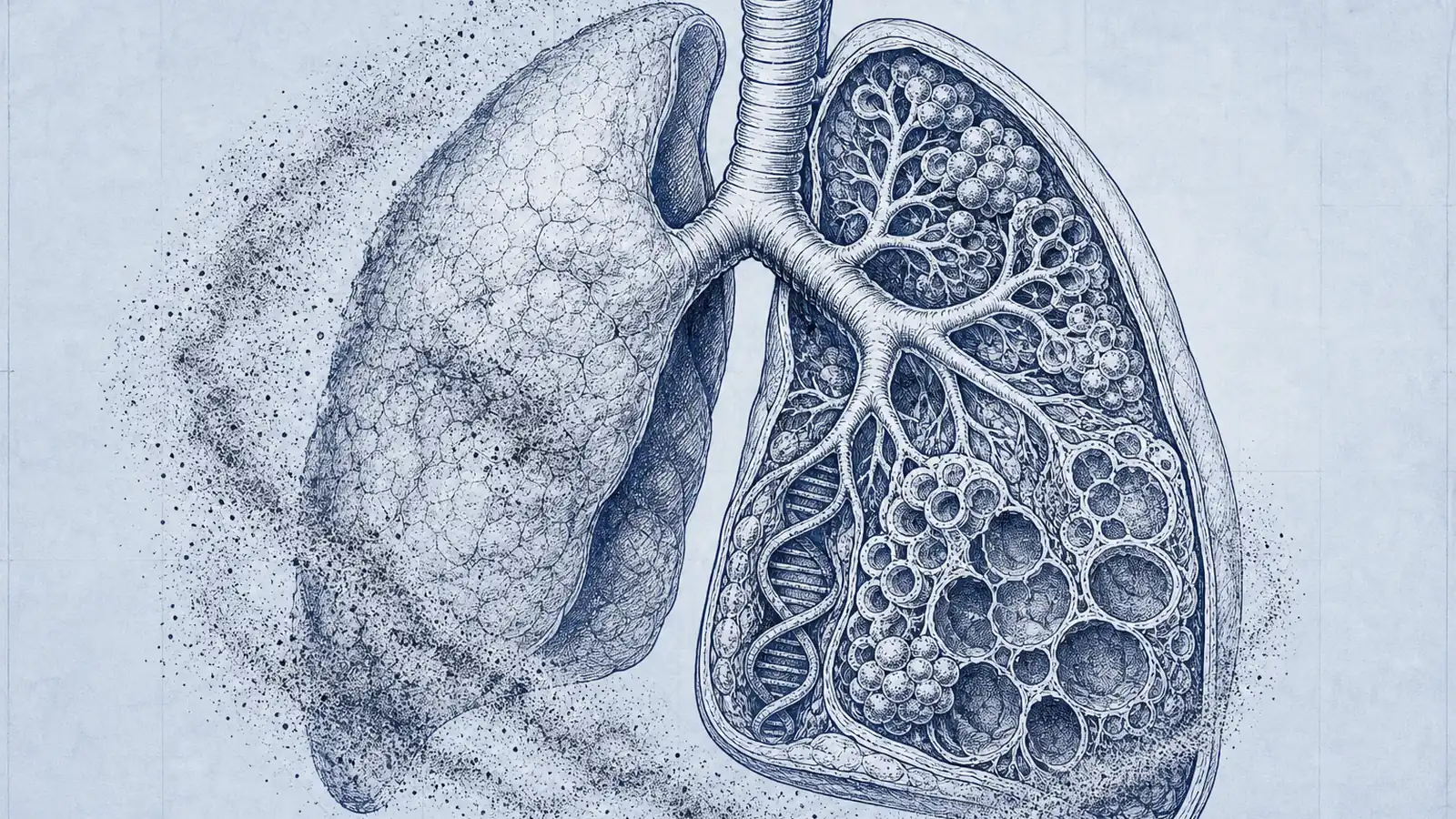
Here is what I could not stop thinking about after reading this study: two people with the same asthma, standing on the same smoggy street corner, breathing the same lungful of particulate haze, can walk away with completely different damage. One barely notices. The other ends up wheezing in an ER. For years that gap had no good explanation, just a shrug and the phrase “individual variation.” A team at the University of Pittsburgh School of Public Health just put names to the variation. Seven of them, actually. Seven genes.
Your sequence is the script, but the performance is what lands you in the hospital.
And before the gene-test marketers get their hooks into this, let me say the thing the researchers themselves say out loud: the most effective intervention here is not a swab kit. It is less pollution. Hold onto that, because the science is elegant and the temptation to misuse it is obvious.
The work, published in eBioMedicine in June 2026 by Shuangjia Xue and the longtime severe-asthma researcher Sally Wenzel, leaned on something most genetics studies do not have: actual lung tissue. The team drew on nearly 1,000 adults with asthma enrolled in the Severe Asthma Research Program, then went further with about 200 of them, threading a bronchoscope down to brush living cells off the inside of the airway. So they were not just reading DNA off a cheek swab and guessing. They could line up a person’s genetic variants against how that person’s airway cells actually behaved when pollution hit them.
And here is what I did not see coming. The damage does not run straight from “dirty air” to “bad lungs.” It runs through your RNA.
Let me walk through it. When you breathe in PM2.5, the fine particulate matter that pours off traffic and wildfire smoke and industry, those particles set off a chemical brawl inside your cells called oxidative stress. Reactive molecules start tearing at cell components. Your body has a defense crew for exactly this: a set of roughly 450 oxidative-stress-control genes that fire up RNA responses to neutralize the threat. The Pittsburgh team scanned all of them. 7 stood out as the ones that most shaped whether a person coped or buckled.
Two of them, OXSR1 and PXDN, work the way you would expect once you see the logic. People carrying the less common variants mounted a weaker protective RNA response when pollution arrived, and their lung function suffered for it. Less defense, more damage. Clean. OXSR1 in particular was not a total stranger here; a 2022 study had already tied OXSR1 variants to asthma exacerbations in non-smokers, so this is a second, mechanistically richer look at a gene that was already on the radar.
But then there is TPO, and TPO is the one that made me sit up. A variant in TPO was linked to worse lung function too, except it did it by driving a stronger RNA response. Wait, why would more defense be worse? That breaks the pattern, and it is a good reminder that biology is not a morality play where “more protective signaling” always means “healthier patient.” Sometimes the response itself, cranked too hard or pointed the wrong way, becomes part of the problem, the body overcorrecting and bruising itself in the process. Xue and Wenzel do not pretend to have that fully nailed down, and I respect that they let the weird result stand instead of sanding it smooth.
Wenzel framed the takeaway in a line I keep turning over: “Genes lay out who we could be, but the RNA, and the proteins they transcribe, are what make us who we are.” Your sequence is the script, but the performance is what lands you in the hospital. Across the whole cohort, the blunt finding held: higher PM2.5 exposure tracked with lower lung function, full stop. The genes help explain who pays the steepest price.
Now, the part where I get a little skeptical, because I always do when a study lands on the doorstep of a product. Wenzel floated the obvious application: “You could imagine a simple test for a panel of genes that could be used to flag someone as highly susceptible to the effects of pollution.” And sure, I can imagine it. I can also imagine it becoming the next direct-to-consumer swab kit marketed at scared parents long before anyone proves the panel changes a single outcome. This is a cross-sectional study of people who already have asthma. It does not show that knowing your OXSR1 status leads to a different decision that protects your lungs. The researchers are honest that their next questions, whether antioxidant therapies or behavioral changes actually help high-risk carriers, are unanswered. And gene-panel diagnostics are a real business with real money behind them, which is exactly why I want the proof before the product.
There is a cleaner truth sitting underneath all of it, one the team to its credit says out loud: a genetic panel that flags the most vulnerable is useful science, and it should not become a permission slip to keep the air dirty and hand individuals a susceptibility score instead of clean lungs. The genes explain who gets hurt worst. They do not change who is doing the hurting.
What I would actually watch for: whether anyone runs the prospective study, taking high-risk carriers and testing whether a real intervention moves their lung function. Until then this is an elegant piece of mechanism, and a sharp argument that “individual variation” was never random. It was written in your oxidative-stress genes the whole time.
Sources
- eBioMedicine – Xue, Wenzel et al., oxidative-stress gene variants and pollution-driven lung function in asthma (2026)
- News-Medical – Scientists identify genes linking air pollution to severe asthma
- Medical Xpress – Why pollution affects some asthma patients more than others
- BMC Pulmonary Medicine (2022) – OXSR1 variants associated with asthma exacerbations in non-smoking asthmatics