For most of my adult life I filed eosinophils under the cell that makes allergies miserable. That was all I carried: a granule-stuffed white blood cell that swarms into asthmatic lungs and inflamed skin, sprays out toxic proteins, and leaves scorched tissue behind. Useful against a parasite, a menace everywhere else. Which is awkward, because we now sell blockbuster drugs whose entire job is to erase this cell from the body. So when a review landed this month in Nature Immunology arguing we have had the cell close to backwards, I wanted to know exactly what we had been deleting.
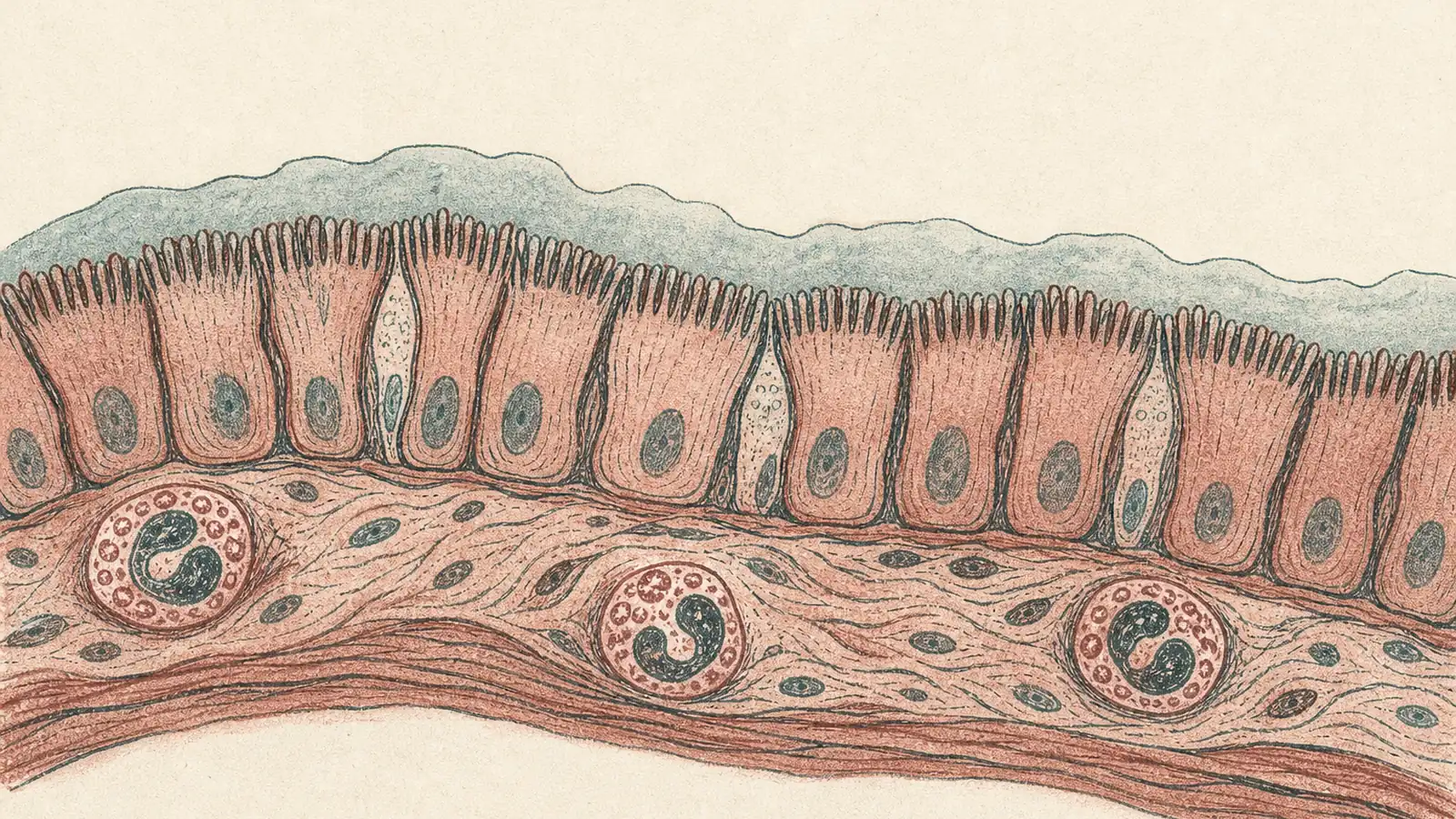
The allergy framing hides something basic. At steady state, when nothing is inflamed and nothing is wrong, eosinophils already live quietly inside your healthy organs. The gut is the biggest reservoir by far: in the intestinal mucosa, tissue-resident eosinophils can make up 5 to 25 percent of the resident leukocytes, and they also settle into the thymus, the uterus, the mammary gland, and, of all places, your fat, their numbers rising and falling with your hormones and your development. They are not lurking there to cause trouble. They are doing a job.
That job is what pulled me in. Take the fat. Why would an allergy cell take up permanent residence in lean, healthy adipose tissue? Because in mice, at least, eosinophils are the main local source of the cytokine IL-4 in white fat, and that IL-4 keeps nearby macrophages in a calm, alternatively activated state that supports normal glucose handling. Pull the eosinophils out, and mice fed a high-fat diet get fatter, more glucose-intolerant, and more insulin-resistant than mice that keep them.
It gets stranger, and better. When you get cold, your body wants to burn fat for heat, and in mice the signal that kicks off that burning runs straight through these cells. Cold exposure releases a hormone called Meteorin-like, which prods adipose eosinophils to pour out IL-4 and IL-13. Those cytokines flip nearby macrophages, the macrophages release catecholamines into the fat, and the fat starts building thermogenic beige cells that actually generate heat. Delete the eosinophils and that whole browning circuit stalls. I had written this cell off as pure collateral damage, and here it was holding a wire in the furnace. Nobody had noticed because nobody was looking at healthy tissue; the cell only ever got studied where it was making people sick.
The intestine runs its own version. Eosinophils sitting in the gut wall coax B cells into becoming IgA-producing plasma cells, the antibody factories that patrol your mucosal surfaces. Remove them and, again in mice, the mucus layer over the gut lining thins, the barrier gets leakier, and the microbial community in the lumen shifts. Unglamorous maintenance, the kind that keeps a body sealed and running, quietly handled by the cell we call an allergy cell.
So how do the villain and the housekeeper fit inside one cell? The review’s central claim is elegant: there is no single eosinophil. The tissue programs it. Raise mice germ-free and their gut eosinophils turn up with shrunken granules, because the microbes that normally teach them are gone. Single-cell work has split intestinal eosinophils into a calmer basal type near the crypts and a more secretory active type near the lumen, with a fibroblast signal called IL-33 acting as the switch that decides which one you get. The lung has its own resident, regulatory eosinophil that restrains allergic responses, the mirror image of the inflammatory kind that floods in during an asthma attack. Same lineage, opposite job, sorted by where it lives and what it hears.
And here is where the new biology runs headlong into the pharmacy. We now have blockbuster drugs whose entire mechanism is erasing this cell body-wide. Anti-IL-5 and anti-IL-5-receptor biologics like mepolizumab and benralizumab treat severe eosinophilic asthma by stripping eosinophils out of the blood, and benralizumab does it nearly completely, its engineered antibody flagging the cells for natural killer cells to kill off. For people whose lungs are being wrecked by these cells, the drugs work, and I am not going to pretend otherwise.
But look at what the reassurance actually rests on. Almost all of the maintenance biology above was mapped in mice, not people, which is exactly why it never landed on a human trial’s checklist. The largest real-world safety read on near-complete depletion follows 123 patients on benralizumab for 48 months and reports 0 cases of cancer and no clear rise in serious infection. Notice what that counts, and what it does not. It counts asthma attacks, hospitalizations, obvious infections, tumors. It does not count the thickness of your gut mucus, your steady-state IgA, your metabolic flexibility in the cold, the slow homeostatic chores the new biology just spent a decade documenting. Those were never endpoints, because when these drugs were tested nobody believed the cell was doing anything worth measuring. An absence of harm you never looked for is not the same as safety.
That is the gap I would want my own doctor watching. If I had severe eosinophilic asthma and needed one of these drugs, I would take it without hesitation, because uncontrolled asthma will hurt you now and the benefit is not in question. But I would also ask to track my gut symptoms, my IgA, and my metabolic markers year over year while I was on it, precisely because the people who ran the studies never did. I would rather be the first one in the room to notice than the last.
Sources
- Nature Immunology – Rediscovering eosinophil identity through tissue adaptation (Review, 2026)
- Journal of Experimental Medicine – Emerging functions of tissue-resident eosinophils (2023)
- Science – Wu et al., Eosinophils sustain adipose alternatively activated macrophages associated with glucose homeostasis (2011)
- Cell – Qiu et al., Eosinophils and type 2 cytokine signaling orchestrate development of functional beige fat (2014)
- Cell – Rao et al., Meteorin-like regulates immune-adipose interactions to increase beige fat thermogenesis (2014)
- Immunity – Chu et al., Eosinophils promote IgA-expressing plasma cells and gut immune homeostasis (2014)
- Journal of Clinical Investigation – Mesnil et al., Lung-resident eosinophils represent a distinct regulatory subset (2016)
- Journal of Clinical Medicine – Long-term eosinophil depletion with benralizumab: real-world safety and durability (2024)