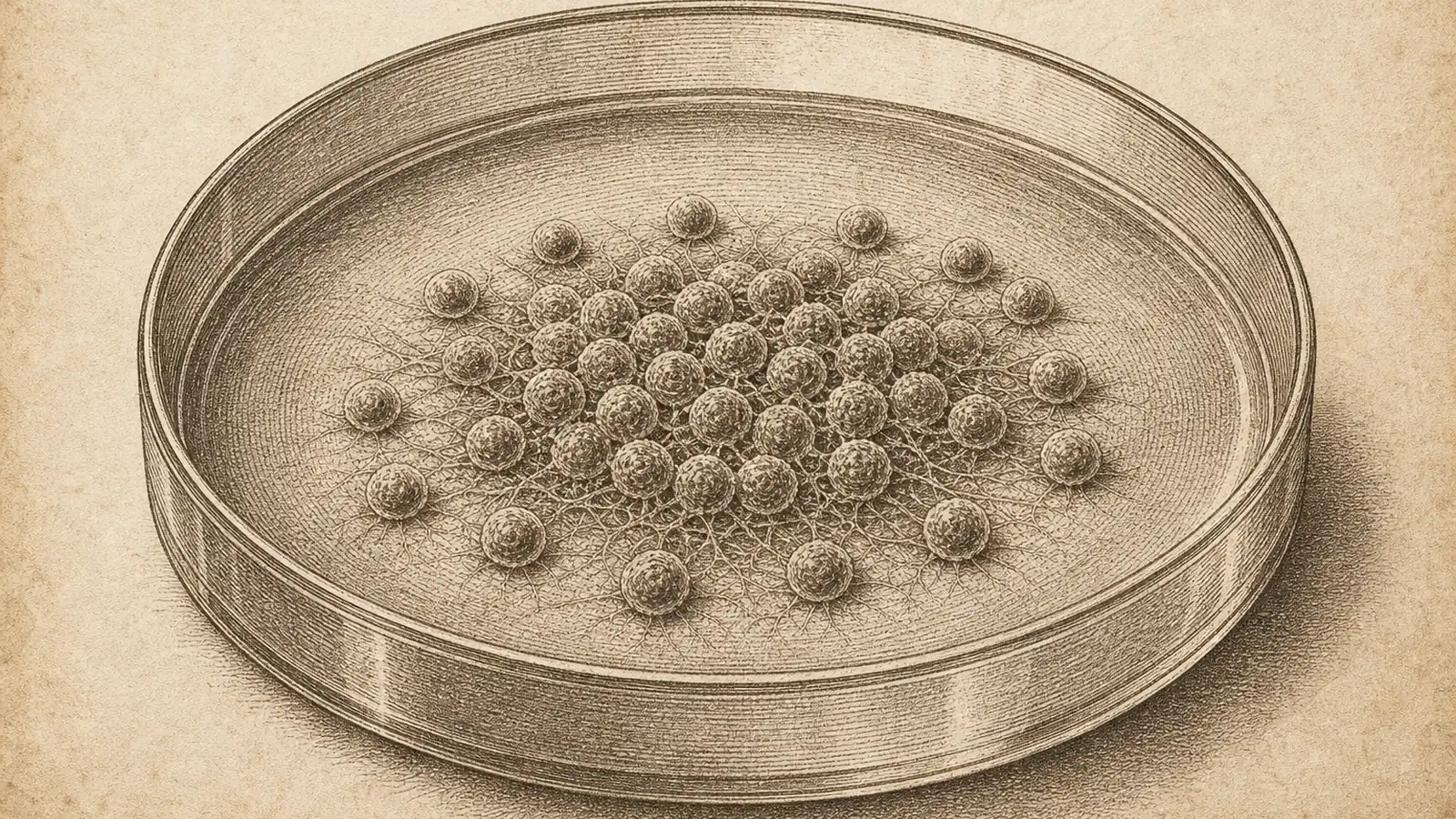
There is a population of cells in your lymph nodes whose entire job is to keep your immune system from turning on you, and for fifteen years almost nobody could get a good look at them. They are rare. They hide in the busiest corner of the immune system. And, in a detail that would be funny if it had not cost the field so much time, they sometimes disguise themselves as the very cells they are supposed to police. A lab in Bonn has now done the unglamorous, genuinely useful thing: it figured out how to grow them on demand.
You cannot study a brake reliably if you cannot tell it apart from the accelerator.
The cells are called follicular regulatory T cells, Tfr for short, and they only entered the literature in 2011. Think of them as the editors sitting in the room where antibodies are made. That room is the germinal center, the structure inside lymph nodes, tonsils and spleen where your body road-tests new antibodies against a pathogen and selects the ones that bind hardest. It is a powerful process, and a dangerous one, because the same machinery that learns to recognize a virus can just as easily learn to recognize you. Tfr cells are the brake. When they work, you get a sharp response to the infection and not to your own tissue. When they fail, you get autoantibodies and autoimmune disease.
So they matter. The problem has always been getting enough of them, in a clean enough state, to actually run an experiment. In a living animal Tfr cells are scarce and tangled up with their near-twins, the follicular helper T cells that drive antibody production rather than restrain it. The two share so much surface machinery that older studies, leaning on transgenic blocking tricks, kept tripping over their own controls. You cannot study a brake reliably if you cannot tell it apart from the accelerator.
The Bonn group, led by first author Luisa Bach and Prof. Dirk Baumjohann at the University Hospital of Bonn, took the other road. Instead of fishing rare Tfr cells out of an animal, they coaxed ordinary CD4+ T helper precursors into becoming Tfr cells in a dish, and then watched which molecular switches did the work. Their report in Cellular & Molecular Immunology lands on a clean trio. The growth factor TGF-β was both necessary and sufficient to push a precursor down the Tfr path. The signaling molecule IL-2, long known as a master dial on T cells, pushed back against it. And a transcription factor called c-Maf was required to finish the job. Turn TGF-β on, keep IL-2 low, make sure c-Maf is present, and you can manufacture the immune system’s antibody editors more or less to order.
That is the achievement, and it is worth being precise about what it is: a tool, not a therapy. The headline you will see elsewhere gestures at autoimmune disease, and the link holds, but the distance between “we can grow these cells in a dish” and “we can fix lupus” is the entire length of medicine. A dish is not a body. Tfr suppression has a documented habit of behaving one way in culture and another in an animal; one earlier study found their suppressive function in vitro was context-dependent, shifting with the signals around them. A cell that does what you want under glass is a hypothesis, not a result.
The deeper caution comes from the biology itself, and it cuts against the tidiest version of the press story. The intuitive pitch is that more or better Tfr cells should mean less autoimmunity. The evidence is messier than that. Work published in 2024 found that Tfr cells expand to control the germinal center’s output of antibody-producing plasma cells but fail to curb autoreactivity over the long run. Knock them out and you get a brief surge of plasma cells; over time, the runaway self-directed response proceeds anyway. The brake, it turns out, is better at managing volume than at stopping a car that has already decided to crash. Any therapeutic dream built on these cells has to reckon with that, and a lab model is exactly the place to do it.
Which is the honest reason this method is good news. Not because it cures anything, but because it hands researchers a controllable supply of a cell they previously had to ambush. You can now ask, directly, what makes a Tfr cell suppress well versus poorly, why it loses its grip in chronic autoimmunity, whether it can be steered. The same questions matter for the other half of the germinal center’s job, the half nobody markets: a sharp, well-edited antibody response is also what you want out of a vaccine, and Tfr cells sit on both sides of that ledger.
There is no FDA notice here, no trial readout, no company with a stock price riding on it. Just a German lab that solved a tedious supply problem that had quietly bottlenecked a corner of immunology for over a decade. The breakthroughs that get the press releases are usually the ones with a product attached. This one has none, and it may end up mattering more than most of them.
Sources
- News-Medical: New cell culture method allows targeted study of antibody regulation, reporting Bach et al., Cellular & Molecular Immunology (2026)
- Clinical & Translational Immunology: Huang et al., “Follicular regulatory T cells: a novel target for immunotherapy?” (2020)
- Differentiation, functions, and roles of T follicular regulatory cells in autoimmune diseases (PMC)
- T-follicular regulatory cells expand to control germinal center plasma cell output but fail to curb autoreactivity, 2024 (PMC)
- T follicular regulatory cell suppression of T follicular helper cell function is context-dependent in vitro (PMC)