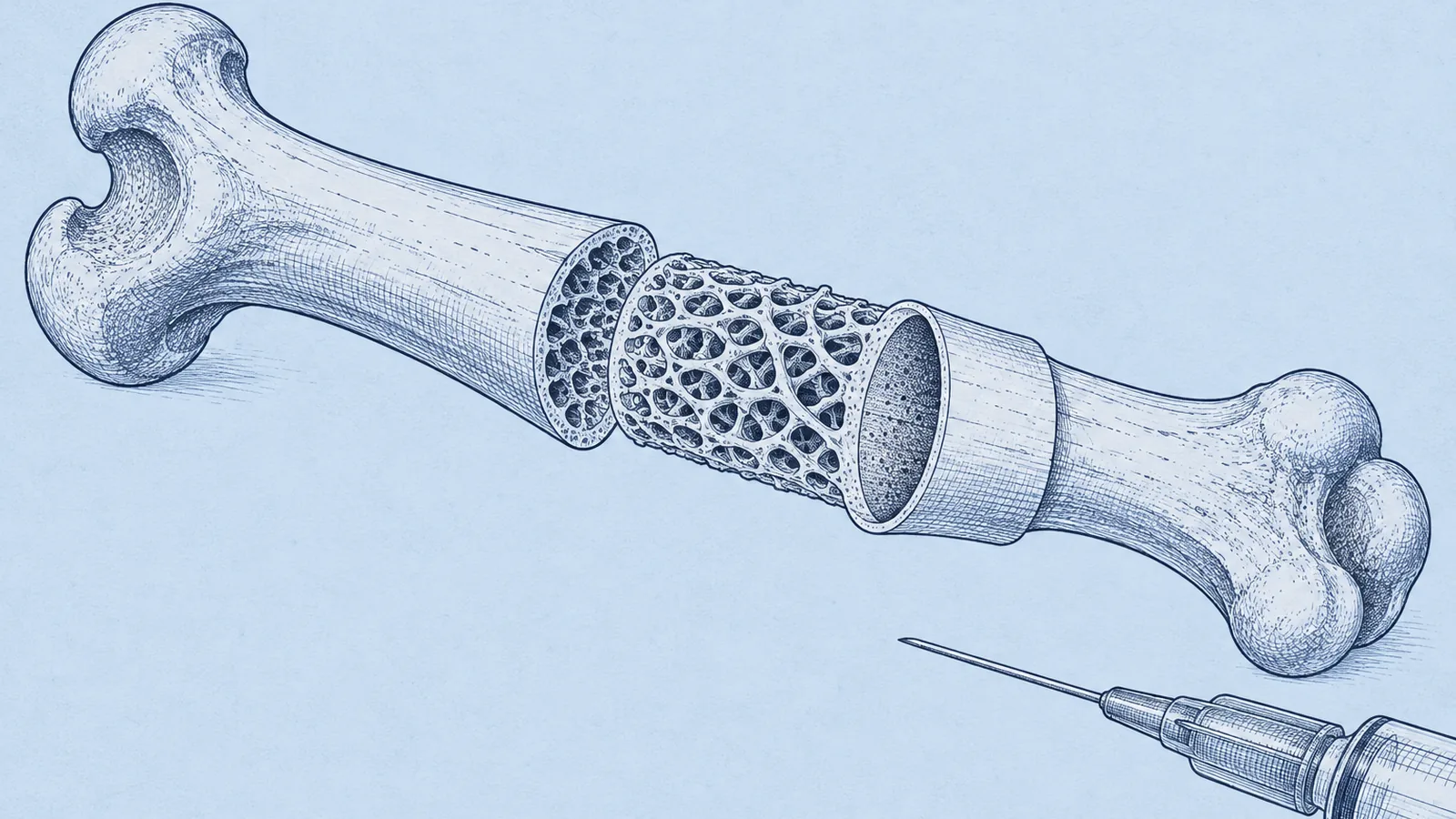
In a lab at Leipzig University, a group of female mice had their ovaries removed, waited a month for their skeletons to thin the way a postmenopausal woman’s does, and then got a daily injection of a compound called AP503. Four weeks later their bones had thickened back toward normal, with more trabecular bone, a thicker cortex, and enough recovered strength to hold up under a three-point bending test roughly the way an untouched bone would. The work is careful and clever. It is also, by the authors’ own written account, nowhere near a treatment for a single human being.
You would not know that from the headline.
“Scientists find a bone-building switch that could fight osteoporosis,” ScienceDaily announced on September 9, 2026. Good headline. It is also at least the third time the same mouse experiment has been served up as fresh news. The underlying study, led by Professor Ines Liebscher with first author Dr. Juliane Lehmann, was published in Signal Transduction and Targeted Therapy on June 30, 2025. It surfaced that July as “Key receptor for bone cell strength and regeneration identified”, then again in September 2025 as the cheerier “Scientists may have found a way to strengthen bones for life”. One mouse experiment, a rolling publicity calendar, a verb that keeps getting stronger.
The science under all that noise is worth understanding on its own terms. The switch is GPR133, also called ADGRD1, a member of the adhesion G protein-coupled receptor family, and in bone it sits at the fulcrum between the two cell types that spend a lifetime undoing each other’s work: the osteoblasts that build bone and the osteoclasts that resorb it. Switch GPR133 on and the balance tips toward building. What makes it a tidy target is that the receptor answers to two things at once, a protein ligand called PTK7 and raw mechanical force, and mechanical loading is exactly what strengthens a real skeleton in the first place. AP503, pulled out of a computer-assisted screen, is the small molecule that throws the switch chemically.
Now the parts the aggregators leave out. The osteoporosis model was bilateral ovariectomy in mice, 8 animals per group, dosed at 2 milligrams per kilogram by intraperitoneal injection every day for four weeks; the supporting rescue experiments ran on five to fourteen animals apiece. The press writeups call the effect “significant” and leave it there. The actual magnitudes live in the paper’s figures, not in any percentage a casual reader will ever bump into. The strongest cautions in the whole story come from the authors themselves. Clinical translation, they write, “remains a future goal.” Mouse bone “differs slightly from humans.” “Future studies must focus on human patient specimen to validate the applicability of our results.” The mice got their bones back. No person has taken the compound.
What makes this one worth telling straight instead of dismissing is who is not in it. There is no drug company. The work was paid for by the German Research Foundation and Chinese national science programs, public money, and the scientists’ language is measured to the point of modesty. The overpromising is coming from the layer above the bench, where a university press office and a chain of health aggregators turn 8 ovariectomized mice into “a way to keep your bones strong for life” and then reissue it every few months as though something new had happened. They do it because the market underneath is enormous, which is the context the excitement politely skips.
Here is why a clean bone-builder would be worth a fortune. The anabolic drugs already on the shelf are hemmed in. Parathyroid-hormone therapy, the workhorse, carries only a limited two-year window before its bone-eating effects start to show, a limit the Leipzig authors note by name. Romosozumab, approved by the FDA in 2019, arrived with a boxed warning for heart attack, stroke, and cardiovascular death after the ARCH trial turned up a cardiovascular signal the developers had not advertised. The authors put the incumbents plainly: existing pharmacological treatments are “associated with severe side effects.” A compound that added bone without those liabilities, and that, per an earlier 2025 Leipzig study, also strengthened skeletal muscle without the trouble that comes with androgens, would hit both halves of aging’s musculoskeletal decline at once. It is an attractive target. It is also exactly the sort of prize that gets every promising rodent result amplified as if it were a therapy.
For now, nothing changes for anyone with thinning bones. The published materials name no registered human trial, no timeline, and no developer, only the team’s note that follow-up projects are underway. The honest read is that GPR133 is a promising lead and AP503 a promising tool compound, and that promising leads fail in people far more often than they pan out.
Which leaves one small, telling gap. In the paper, the sentence reads: clinical translation “remains a future goal.” In the headline that circled the world, it reads: a switch that could fight osteoporosis, a way to keep your bones strong for life. The distance between those two sentences is roughly the distance between a mouse and a woman, and Liebscher’s team is the one that wrote the accurate half.
Sources
- Signal Transduction and Targeted Therapy – Lehmann, Liebscher et al., GPR133/ADGRD1 enhances bone formation (full text, PMC)
- Signal Transduction and Targeted Therapy – article landing page (DOI 10.1038/s41392-025-02291-y)
- ScienceDaily – “Scientists find a bone-building switch that could fight osteoporosis” (Sept 9, 2026)
- ScienceDaily – “Scientists may have found a way to strengthen bones for life” (Sept 2025, earlier framing of the same work)
- MedicalXpress – “Key receptor for bone cell strength and regeneration identified” (July 2025)
- Leipzig University SFB1423 – “Research for stronger bones and muscles in old age” (AP503 muscle findings)
- Therapeutic Goods Administration – “New warnings of romosozumab (Evenity) cardiovascular risks”