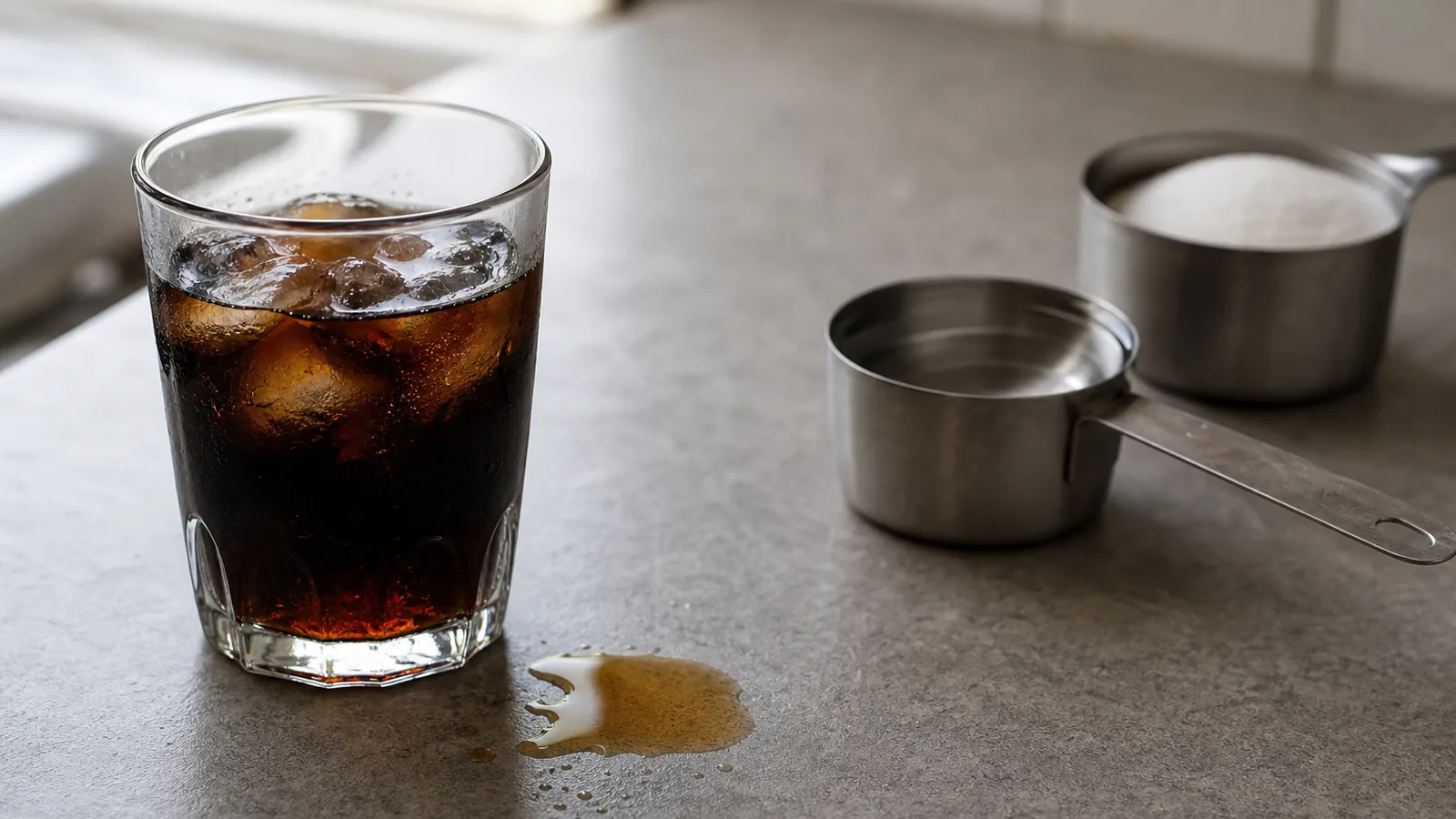
I always assumed sugar was sugar. Not that it’s good for you, I gave that up long ago, but in the boring biochemical sense: a calorie of fructose and a calorie of glucose land in your body as the same problem, and your brain doesn’t much care which one showed up. That turns out to be wrong in a specific and kind of fascinating way. Your brain runs separate hardware to tell the two apart, and the sweetener the American food industry leans on hardest, the glucose-fructose blend in your soda, is the one that worked the hunger circuitry hardest of all in this study, and the one the animals kept choosing.
That comes from the Monell Chemical Senses Center, published June 10 in Neuron by a team led by Amber Alhadeff with first author Aaron McKnight. One thing the press release was coy about, so let me put it where you can see it: every result here is in mice. The headline that ran on ScienceDaily and elsewhere, “fructose doesn’t satisfy hunger like glucose,” is true as far as it goes, but it flattens the part that actually surprised me, which is how the brain pulls off the distinction.
Start with the brain cells. Deep in your hypothalamus sits a cluster called AgRP neurons. They’re the gas pedal for hunger: when they fire, you feel driven to eat, and when something quiets them, the urge eases off. The textbook story was that food in the gut, and the glucose it pours into your blood, tamps those neurons down. Eat, blood sugar rises, pedal lifts.
So the Monell team fed mice glucose and watched. Strong, fast suppression, the pedal off hard, exactly as expected. Then they fed the mice fructose, same number of calories, and the neurons barely budged. A weak dip where glucose had produced a slam.
Wait, why would two molecules this chemically similar get such different treatment from the same cells? That’s the question the study chases, and the answer is the part I keep turning over. Fructose doesn’t talk to those hunger neurons directly at all. It triggers the release of a gut hormone, PYY, which travels up the vagus nerve, the information highway running from your gut to your brainstem, and only then does a faint “ease off” reach the AgRP neurons. Glucose skips the detour and quiets the neurons through a different, stronger route that doesn’t lean on PYY at all. When the researchers cut the PYY pathway, fructose lost even its weak effect. Glucose kept right on working.
So fructose isn’t failing to signal fullness. It’s signaling through a longer, quieter wire, and the message arrives thin. Your brain keeps two separate phone lines for two sugars a nutrition label treats as one.
Then comes the detail that should make anyone who’s ever finished a 32-ounce soda without noticing sit up. The team also tested high-fructose corn syrup, the glucose-fructose blend that sweetens most American soft drinks, and it suppressed the hunger neurons more strongly than pure fructose, and the mice preferred it. Not just tolerated, preferred, developing a measurable taste for the version that hit their hunger circuitry hardest. Eaten alone, each sugar made the mice eat about the same amount in the short term. The divergence showed up in what the animals learned to want.
It’s hard not to sit with where that points. HFCS went from essentially nothing in the American diet in 1970 to a peak near 66 pounds per person in 1999, and even after sliding about 40 percent since 2000 it still runs around 37 pounds a head and sweetens the soda aisle wall to wall. You don’t need a conspiracy to find that uncomfortable. The blend the industry standardized on for cheapness and shelf life is, at least in a mouse brain, the one that suppresses the hunger circuit hardest and the one the brain works to get more of.
I want to be careful here, because the lever this study hands you is a wiring diagram, not a verdict on your diet. It’s a mouse hypothalamus, recorded with a precision nobody has yet brought to a human one, and the press-release line about “modern diets” is doing work the experiment didn’t, since there wasn’t a person in it. Hold that framing at arm’s length until someone runs the gut-brain recordings in people. The funding, for what it’s worth, is NIH, the American Heart Association, and a stack of research foundations, with no soda money among the named backers, which is about as clean as this corner of nutrition science gets.
What pulls me toward taking it seriously anyway is how neatly it fits a pattern we already had reasons to suspect. Fructose has long been the odd sugar out: unlike glucose, it does little to stimulate insulin or leptin, the two hormones that normally tell your body it has eaten enough. This adds a third quiet channel. The molecule that slips past your insulin signal and your leptin signal also, it now seems, barely registers on the hunger neurons. Three different “you’re full” systems, and fructose gets soft-pedaled by all of them.
So what do I do with this? I’m not going to pretend a mouse brain is mine. But I stopped buying anything with high-fructose corn syrup on the label a while ago, and nothing here makes me want to walk that back. If the cheapest sweetener in the store is also the one wired, at least in an animal, to leave the hunger pedal pressed and to teach a craving for itself, I’d rather keep it out of my cart and drink water with the occasional thing that doesn’t come pre-engineered to be hard to put down.
Sources
- Neuron – McKnight, Alhadeff et al., “Attenuated hypothalamic response to fructose via a dedicated gut-brain pathway” (June 10, 2026)
- Neuron – DOI landing for the study
- Monell Chemical Senses Center – summary of the findings
- ScienceDaily – “Researchers discover why fructose doesn’t satisfy hunger like glucose”
- Medical Xpress – “Fructose sends a weaker satiety signal to the brain than glucose”
- USDA Economic Research Service – U.S. caloric sweetener deliveries decline, driven by lower HFCS use (2019)
- American Journal of Clinical Nutrition – Bray et al., HFCS consumption and the obesity epidemic (2004)