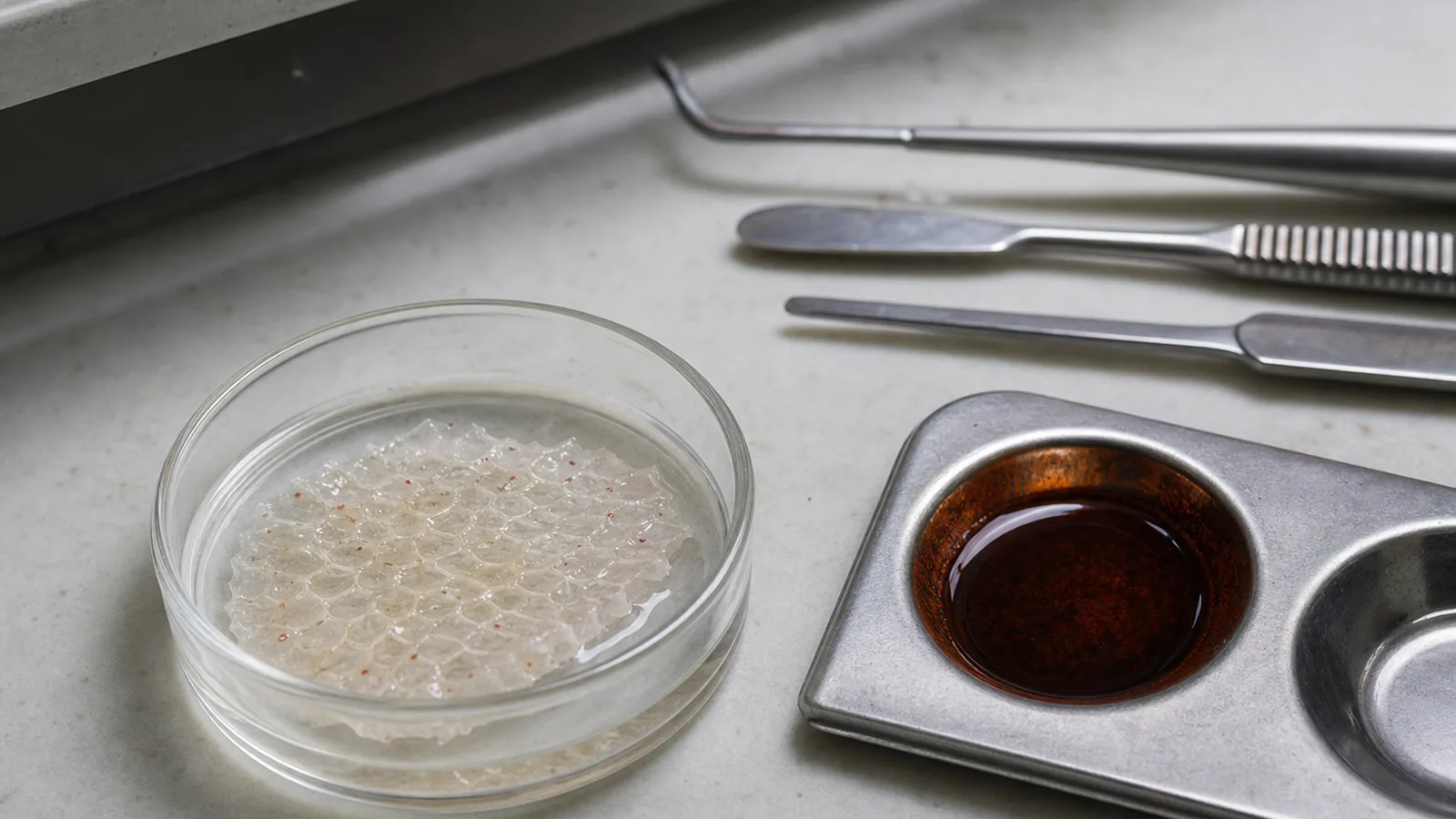
The first cell Salmonella breaks into when it gets past your stomach is an ordinary lining cell of the gut, and for decades that cell was treated as scenery: the wall the bacterium climbs over on its way to the immune cells that do the real fighting. A team at the University of Vermont has now caught that wall doing the fighting itself. In a study published in PNAS in late June, Leigh Knodler’s lab at the Larner College of Medicine shows that the intestinal epithelial cell runs its own metal-starvation program against the bacterium it has just swallowed, withholding the iron and manganese Salmonella needs to grow, without waiting for an immune cell to give the order.
To see why that is a surprise, you have to know how old the underlying trick is. The oldest defense your body has against an infection is not an antibody or a fever. It is starvation. Bacteria need metal to grow, iron above all, and a healthy body hides its iron the moment an invader shows up. The immunologist Eugene Weinberg named the idea half a century ago, in a 1975 paper titled, plainly, “Nutritional immunity: host’s attempt to withhold iron from microbial invaders.” We have spent the decades since filling in the machinery, and almost all of that machinery turned out to live inside immune cells.
The canonical example is the macrophage. A transporter called NRAMP1, identified in a mouse locus that decided which strains survived Salmonella, Leishmania, and tuberculosis, sits in the membrane of the cell’s internal vacuole and hauls iron and manganese away from whatever the macrophage has engulfed. That transporter and its relatives became the textbook face of nutritional immunity. The defense was understood as something the immune system did. The gut lining was the part that got breached.
What Knodler’s team found is that the lining has a copy of the same weapon. The protein doing the work is SLC11A2, the close cousin of the macrophage gene, better known to physiologists as DMT1, the transporter that normally pulls dietary iron into your body from the gut. During infection it gets redirected. Inside an infected epithelial cell it is recruited to the membrane of the vacuole holding the bacterium and strips iron and manganese away from the invader trapped inside, the household iron-importer turned against the thing it just let in.
The convincing part is how they watched it. The team engineered Salmonella Typhimurium to carry fluorescent sensors that brighten or dim according to how much metal each bacterium can reach, then tracked individual bacteria inside gut tissue, including an animal intestinal model that keeps the architecture of a real infection intact. They could see a subpopulation of invaders being squeezed in real time, the metal around them collapsing cell by cell, a starvation so local it varied from one host cell to the next. Knock out SLC11A2 and the trapped bacteria were measurably less starved for iron and manganese. That is targeted withholding of the two metals the bacterium most depends on, not a general failure of the cell.
There is no drug here, no trial, no patient. This is a mechanism paper in cells and an animal gut, funded by a two-year NIAID R21, the small exploratory grant the NIH hands out to test an idea. What it answers is a real clinical question that has never had a clean answer: why the same exposure that means a miserable week for one person is cleared in silence by the next. Part of that decision, this work argues, is made in the epithelial cell itself, in the first minutes, before the immune system has fully woken up.
That question is not academic for a bug that sickens more than a million Americans a year and has no licensed vaccine for the common non-typhoidal strains. The stakes are clearest where the bug turns lethal. The same non-typhoidal Salmonella that causes food poisoning here slips out of the gut and into the bloodstream across much of sub-Saharan Africa, where invasive disease carries a case fatality of 20 to 25 percent and, by one estimate, killed roughly 681,316 people worldwide in 2010 out of 3.4 million illnesses, most of them in Africa. If the gut lining’s own iron-withholding machinery helps decide who stays in the bad-week camp and who falls into the bloodstream camp, then the strength of that machinery becomes something worth measuring in people.
We have reason to think it varies. The macrophage version of this gene is not uniform across humans: variants in NRAMP1 were tied to tuberculosis susceptibility in West Africans in 1998, hard evidence that small differences in a metal transporter can change who gets sick. The logical next study is whether ordinary human variation in SLC11A2 tracks with who clears Salmonella and who develops invasive disease. That is the data point to watch. The body has been starving its invaders for at least the fifty years we have had a name for it, and we are still counting how many of its cells know the trick.
Sources
- PNAS – Knodler lab, SLC11A2 withholds iron and manganese from Salmonella in the gut epithelium (2026)
- News-Medical – University of Vermont report on the Salmonella metal-withholding discovery (June 26, 2026)
- Weinberg, “Nutritional immunity: host’s attempt to withhold iron from microbial invaders” (1975)
- Nature Reviews Microbiology – nutritional immunity and the battle for nutrient metals (2022)
- Feasey et al., “Invasive non-typhoidal salmonella disease: an emerging and neglected tropical disease in Africa,” The Lancet (2012)
- NEJM – NRAMP1 variants and tuberculosis susceptibility in West Africans (1998)
- bioRxiv – fluorescent metal-sensor Salmonella preprint (sensor methods)