I have spent most of my career believing, without ever really examining it, that a brain has to be big to be clever. Not consciously. It is just the water we swim in: intelligence lives in primates and parrots and octopuses, and everything smaller is running on reflex. So when I read that a bumble bee had solved a puzzle designed to test great apes, on the first attempt, without being taught the trick, my first reaction was not wonder. It was suspicion. Show me the controls.
The controls, it turns out, are where I stopped rolling my eyes.
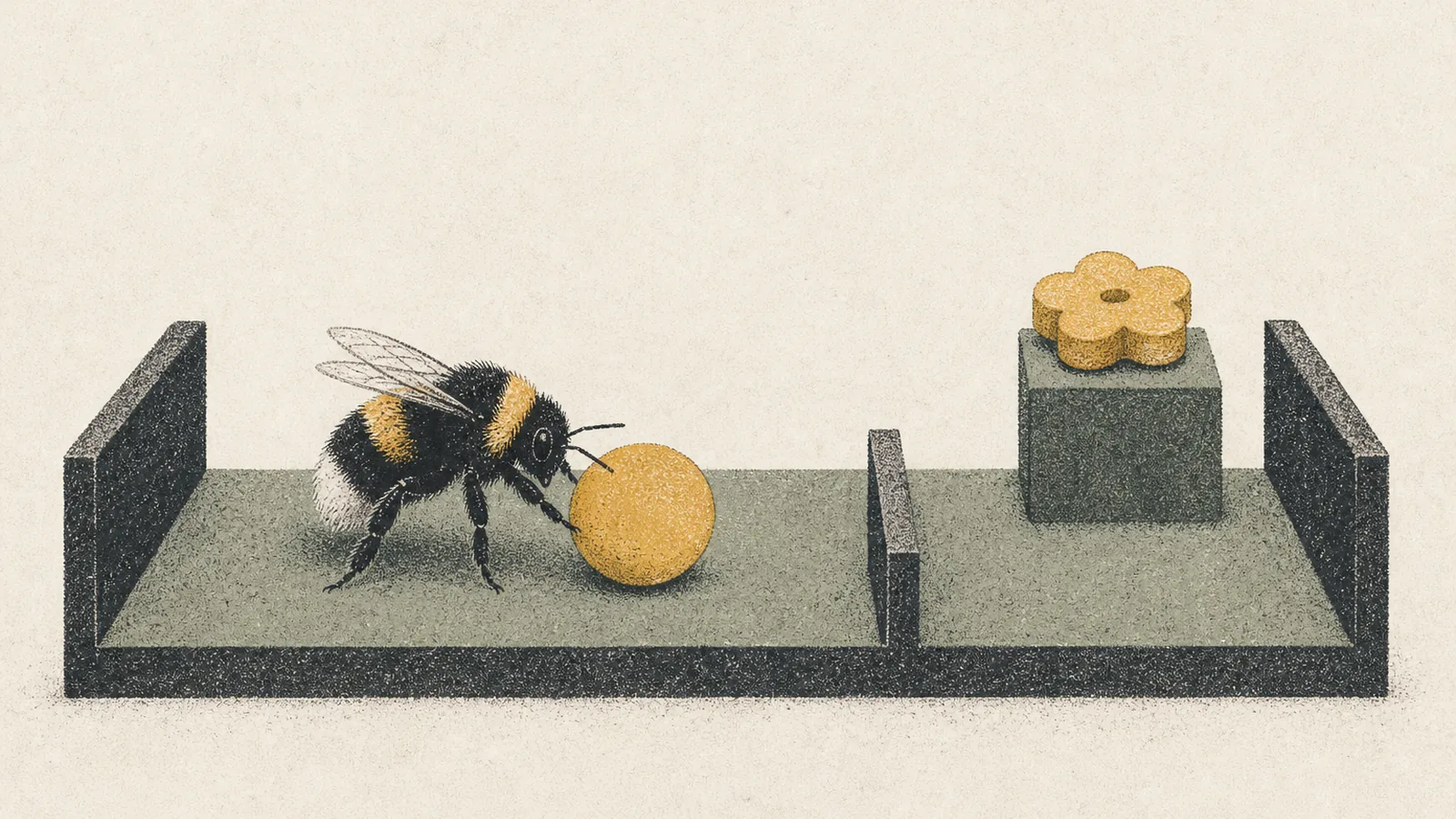
Here is what happened. A team led by Olli Loukola and Akshaye Bhambore at the University of Oulu in Finland ran the experiment and published it on June 4 in Science. They took Bombus terrestris, the common buff-tailed bumble bee, and taught it two completely separate, boring facts. Fact one: a blue artificial flower holds sugar water. Fact two: there is a little ball nearby, it moves when you push it, and it will not hurt you. That is the entire curriculum. Two unrelated lessons, learned in isolation, with no hint they would ever meet.
Then the researchers moved the flower up to the ceiling of a clear arena, out of reach, and walked away.
And a bee, on its own, walked over to the ball, rolled it into position underneath the flower, climbed on top of it, and drank. Nobody had ever shown it that sequence. As Loukola put it, “this is essentially an insect version of the classic box-and-banana problem”, the exact test Wolfgang Köhler built for chimpanzees in the 1920s, where an ape stacks boxes to reach a banana hung too high. The apes who did it were treated as a landmark in the study of animal insight. The bee pulled the same move from a head smaller than a sesame seed.
This is where the suspicion drops and I get rattled instead, so let me ask the question I actually want answered: how? How does a nervous system that small take two memories that were never connected and fuse them, in real time, into an action it has never performed? That is not learning by repetition. There was no repetition. It is closer to what we grandly call reasoning.
The Oulu team clearly anticipated every eye-roll like mine, because the control experiments are almost aggressive. Maybe the bees were just knocking the ball around at random and got lucky under the flower? So the researchers hid the flower from view while the bee moved the ball, and the bee still positioned it in the right spot, working from a memory of where the reward had been rather than chasing something it could see. Maybe it was blind trial-and-error, the bee flailing until something worked? Bhambore’s answer is that the successful bees did not look like they were flailing at all: “by analyzing the bees’ behavior across unusually stringent control experiments,” he said, they showed the bees “were not simply reacting to visual stimuli or moving the ball randomly,” and the ones who solved it moved with more directed intent. Co-author Ece Nur Akmeşe described the thing that gives me chills: one moment the animal is wandering, apparently aimless, and the next it snaps into a highly efficient sequence leading straight to the reward. That switch, from noise to purpose, is what insight looks like from the outside.
What I keep circling back to is the fusion itself. Two experiences, stored separately, no bridge between them, and the bee builds the bridge on demand. In a mammalian brain we would reach for the hippocampus and talk about a cognitive map, some internal model of the world flexible enough to run a simulation before the body commits. A bumble bee has a mushroom body, a dense little knot of tissue that handles its learning and memory. A human brain runs on about 86 billion neurons; a bumble bee makes do with roughly 1 million, and somehow that knot is doing combinatorial work we assumed required a scaled-up vertebrate brain. This is not a mammalian hippocampal architecture, and we do not yet know the wiring that pulls the trick off. What they saw holds up; what it means is wide open, which is exactly the kind of gap I find thrilling rather than frustrating.
And here is where I want to push on the old hierarchy, because it has been comfortable for a very long time. The century-old picture, the one I absorbed without noticing, puts primates and parrots and octopuses near the top and files insects under reflex machines, little automata that react but never decide. That ranking has been quietly doing a lot of work: it shapes how we treat animals and how casually we write off the small ones. Loukola is careful, and I respect the care. “We are not claiming that bees think like humans,” he says, and the bees were fully naïve going in. He is not overselling. But the modest version of this finding is still a demolition charge under a very old wall. This kind of spontaneous, invent-it-on-the-spot solution had never been documented in an insect before. Now it has been.
It does not arrive out of nowhere, either. This lab and others have spent years chipping at the reflex-machine story. In 2022, researchers reported that bumble bees will roll small wooden balls around with no reward at all, for no reason a strict behaviorist can explain, and the younger bees rolled them more than the older ones, which looks uncomfortably like juvenile play. Last year a group documented positive affective contagion in these bees, mood-like states that spread the way the raw materials of emotion would. Put the play, the mood-like states, and now the insight together, and you get a picture the field spent a hundred years insisting was impossible: a tiny brain running rich, flexible cognition.
One footnote I cannot resist, given my usual beat: the Novo Nordisk Foundation, endowed by the company that sells the world its blockbuster metabolic drugs, is listed among the study’s funders alongside Finland’s KONE Foundation and EU research programs, and the reach of that particular checkbook into a Finnish bee lab made me grin.
So what do I do with this? I do not need to believe a bumble bee thinks the way I do, and the evidence does not ask me to. It asks something smaller and harder: that I stop treating the small ones as furniture. I used to be the person who swatted at the bee bumping the kitchen window and thought nothing of it, a bit of buzzing in my way. I won’t anymore. Once you have watched one weigh its options and choose a solution built for an ape, an open window is the least I owe it.
Sources
- Science – Bhambore, Loukola, et al., “Spontaneous problem-solving in bumble bees” (2026)
- University of Oulu – press release with researcher quotes and study design (2026)
- Phys.org – “Bumble bees show spontaneous problem-solving, challenging big-brain assumptions” (2026)
- Animal Behaviour – Galpayage Dona et al., “Do bumble bees play?” (2022)
- Science – “Positive affective contagion in bumble bees” (2025)