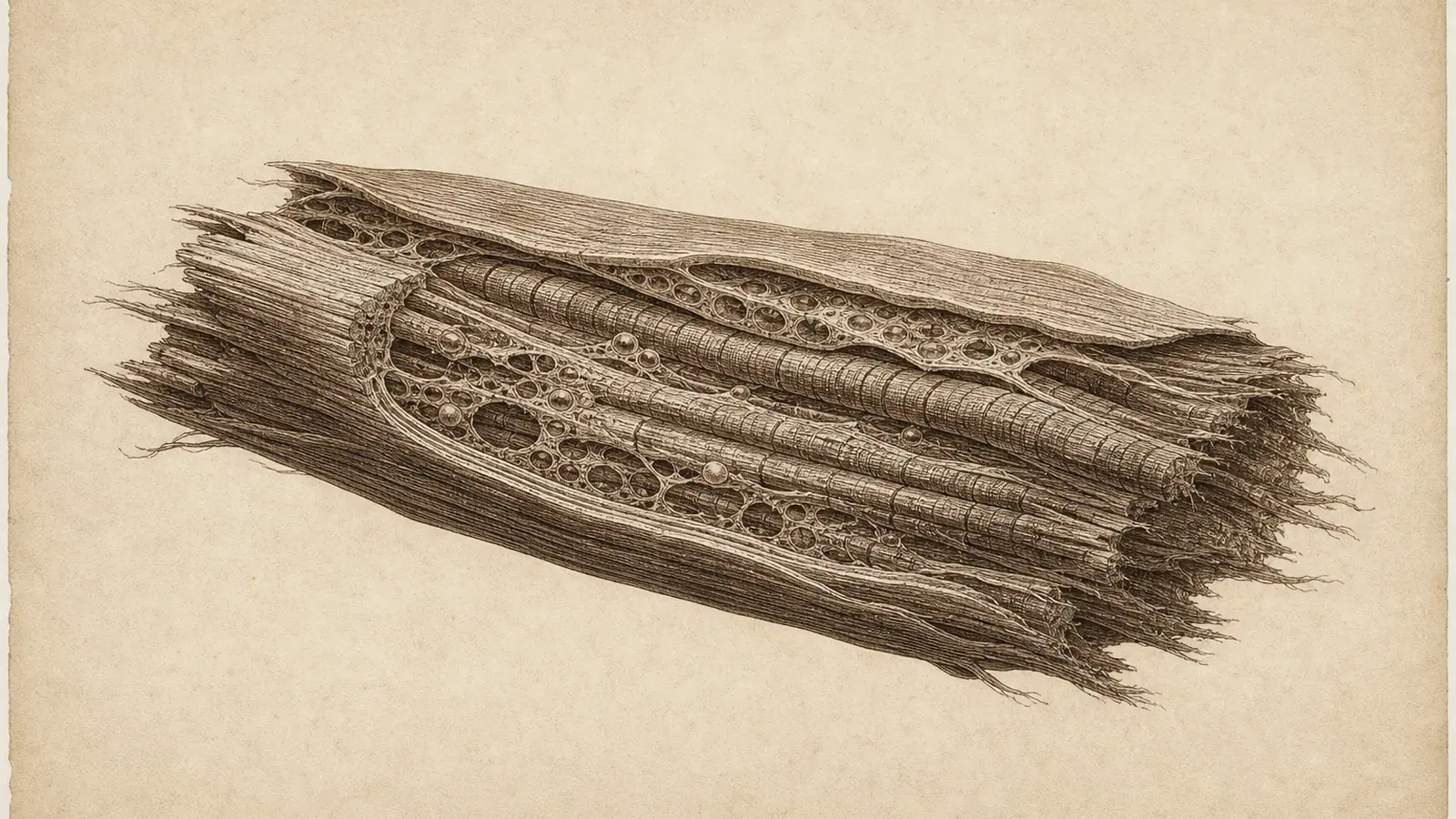
For years I had the story of aging muscle exactly backwards, and it turns out most people do. I always pictured old muscle running low: too little protein synthesis, too little growth signal, the tank draining toward frailty. Then I read that the problem is the opposite. The growth signal gets jammed permanently on, and that is what wrecks the tissue. I reread the sentence twice.
lowering DEAF1 helps older muscle "almost like hitting the rewind button."
That backwards little fact sits at the center of a study out of Duke-NUS Medical School in Singapore, published in the Proceedings of the National Academy of Sciences. A team led by Assistant Professor Tang Hong-Wen went looking for why old muscle loses its ability to repair itself, and they landed on a gene most people have never heard of: DEAF1.
Start with the switch. Your muscle runs on a master growth control called mTORC1. When you lift something heavy, mTORC1 flips on and tells the muscle to build new protein. Good, useful, that is how you get stronger. But mTORC1 has a second job. When it goes quiet, the muscle does its housekeeping, hauling out damaged proteins and recycling the wreckage. Biologists call that autophagy, which is a fancy word for the cell eating its own garbage before the garbage kills it. Young muscle toggles cleanly between the two modes. Build, then clean. Build, then clean.
Old muscle, the paper reports, gets stuck in build mode. mTORC1 stays switched on, the cleanup never comes, damaged proteins pile into aggregates, and the muscle drifts toward senescence. It is not starving. It is choking on trash nobody hauls away.
So what jams the switch? This is where DEAF1 walks in. The Singapore team found that DEAF1 climbs with age, and that DEAF1 is a transcription factor, which means it does not just react to mTOR, it turns mTOR up at the source, raising how much of the growth control the muscle makes. More mTOR, more mTORC1 activity, more time locked in build mode, less housekeeping. A companion commentary in the journal Autophagy frames DEAF1 exactly this way, as a transcriptional brake clamped on muscle’s ability to clean itself.
Wait, why would a gene evolve to sabotage the tissue it lives in? It does not, not really. In young muscle, DEAF1 is held on a short leash by a family of proteins called FOXOs, which act as the brake on the brake. FOXO activity fades with age, the leash slips, DEAF1 creeps up, and the tidy build-then-clean rhythm falls apart. The genome did not turn against you. The regulator that used to keep order just got quiet.
And here is the turn that landed this study in my feed. When the team put older mice through exercise, FOXO switched back on, DEAF1 dropped, mTORC1 came back into balance, and the muscle started clearing damage again. They checked the direction of causation the hard way: push DEAF1 artificially high, and the muscles weakened faster, exactly as the model predicts. That is the kind of confirmation I trust, because it is not only “we exercised the animals and they improved,” it is “we forced the specific gear we think matters and watched the decline speed up.” They saw the pattern in both fruit flies and aged mice, two species split by hundreds of millions of years of evolution, which tells you this wiring is ancient and conserved.
Choy Sze Mun, the study’s first author, put it the way I wish more scientists would. In the Duke-NUS announcement, Choy said exercise tells muscles to “clean up and reset,” and that lowering DEAF1 helps older muscle “almost like hitting the rewind button.” I love that framing because it is honest about the physics of it. Nothing is being added. Something is being turned down, so the cell can do maintenance it already knew how to do.
The sober part fits in one breath: this is still flies and mice, not a seventy-year-old’s quadriceps, and that leap is not guaranteed. The researchers also flagged a hard floor. In some very old muscle, DEAF1 climbs so high or FOXO drops so far that exercise alone may not pull it back. We do not yet know where that floor sits in people, which is exactly why you would not want to find out by waiting.
Which brings me to the part that made my pharma-skeptic antenna twitch. The paper closes by proposing the FOXO-DEAF1-mTORC1 axis as a therapeutic target, a place to point a future drug. I get it, that is how translational research justifies the next grant. But look at what actually reset the axis in this study. The intervention that switched FOXO on, drove DEAF1 down, and restarted the cleanup crew was exercise. Free. Available today. No molecule, no prescription, no manufacturer with a patent. The headline result is that your body already owns the switch, and I will be curious to watch how fast that reframes from “move your body” to “here is a compound that mimics moving your body,” and who ends up profiting when it does.
The practical read is almost boring, and I mean that as a compliment. It maps onto advice you have heard your whole life, the same coverage in Medical News Today keeps circling: keep lifting, and keep your heart rate up. DEAF1 does not overturn any of that. It hands you the molecular reason it was true all along. Tang’s own line is the one I keep coming back to, that physical activity lowers DEAF1 and lets aging muscle “clear out damaged proteins, rebuild themselves properly, and stay stronger and more resilient.”
So here is what I am doing with it. I am not waiting for the DEAF1 pill, and I would tell my own mother the same. I am treating the lift-plus-cardio combination as the intervention this study actually validated, and I am starting it now, not at the age where the researchers admit the switch may already be stuck.
Sources
- PNAS – Choy et al., “Exercise suppresses DEAF1 to normalize mTORC1 activity and reverse muscle aging” (2025)
- ScienceDaily / Duke-NUS Medical School – “Scientists discover why exercise reverses muscle aging” (2026)
- PubMed – abstract, PMID 41284871
- Medical News Today – “Aging muscles: How does exercise help prevent protein decline?”
- Autophagy – commentary on DEAF1 as a transcriptional brake on muscle autophagy