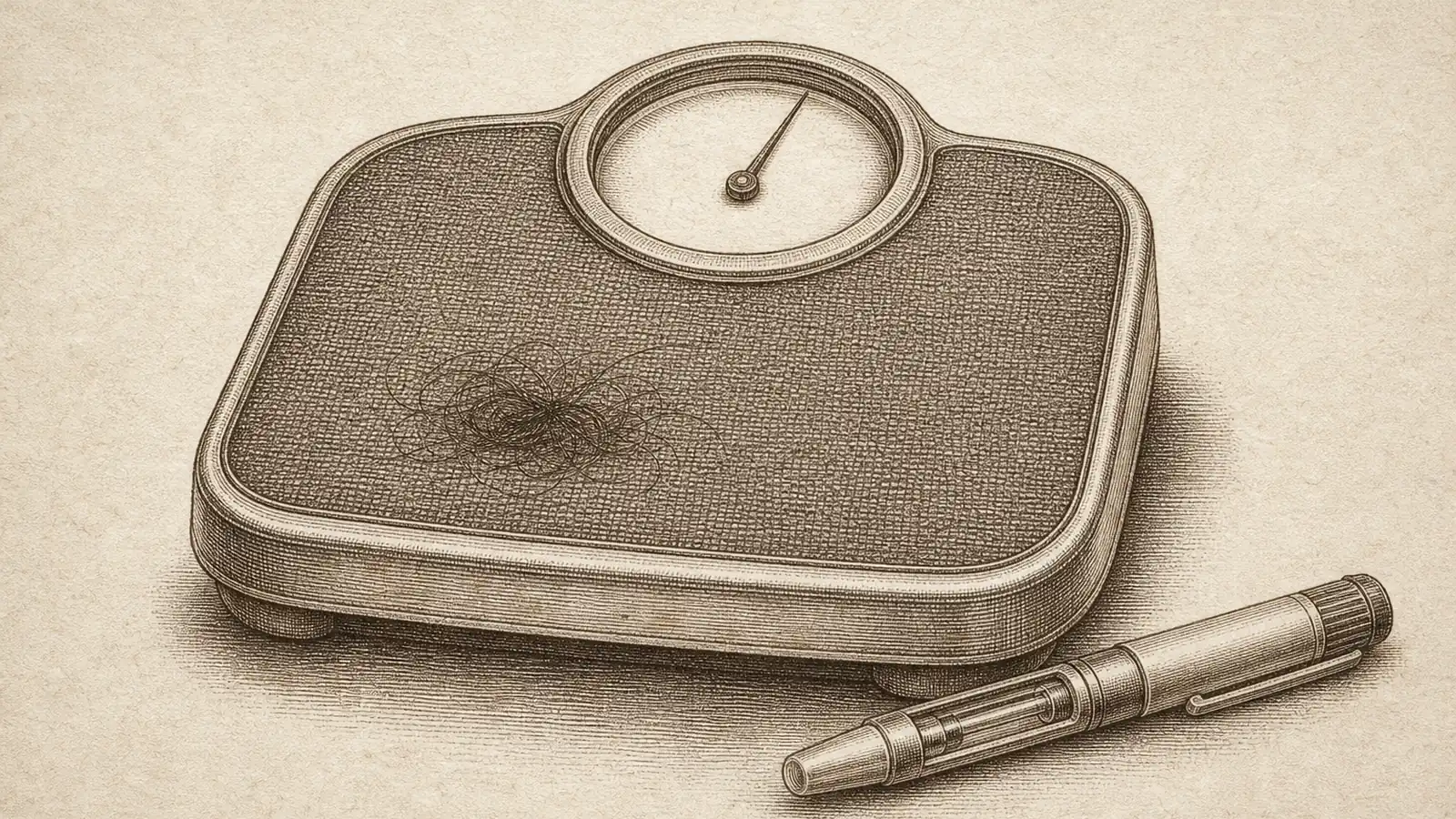
For a while I filed the Ozempic-hair-loss posts under internet noise. Every blockbuster drug grows a folklore, and a few thousand people swearing their ponytail went thin is how an anecdote hardens into a syndrome. So I went in ready to wave it off, and instead found something I didn’t expect: a stack of cohort studies too large to shrug at, a signal that lands hardest on women, and a tell buried in the numbers. The drugs that shed the most hair are the ones that strip weight the fastest. That points the finger away from the molecule and toward the scale.
Start with what just landed. An active-comparator cohort study drawn from the TriNetX network of US health records found that adults with type 2 diabetes who started a GLP-1 receptor agonist had more clinically recorded hair loss than similar patients put on other diabetes drugs. That’s the version MedPage Today reported this week, and the design matters: not people on the drug versus people on nothing, but people on the drug versus people managing the same disease a different way.
The bigger number comes from a George Washington University team. In a matched analysis of 547,993 GLP-1 users published in JAAD International this year, the adjusted odds of telogen effluvium, the diffuse shedding kind, ran about 76 percent higher at twelve months (an odds ratio of 1.76), androgenetic alopecia about 64 percent higher (1.64), and nonscarring hair loss overall about 40 percent higher (1.40), independent of age, sex, BMI, and diabetes status. Here is what reset my priors: it held whether or not the person even had diabetes. It tracked the drug, not the disease.
And it doesn’t fall evenly. When a 2026 systematic review of 24 studies worked through the numbers, the adjusted hazard ratio for hair loss on semaglutide came out significant only in women, at 2.08 (95% CI 1.17 to 3.72); in men the signal essentially vanished. The same review put the raw incidence at about 6.0 cases per 1,000 patient-years on GLP-1s versus 0.8 in placebo groups, a three-fold jump that is still small in absolute terms. Small, but landing on women’s scalps first.
So why would a diabetes drug pull hair from a woman’s head and mostly spare a man’s? This is where I stopped being skeptical and got genuinely curious, because the answer isn’t in the follicle. Hair grows in cycles. Most of your follicles sit in a long growth phase at any moment, and only a small share are resting. Then the body takes a shock, a high fever, childbirth, major surgery, a crash diet, and a big slice of those growing follicles gets shoved all at once into the resting phase. Weeks later they let go together, and the drain fills up. That’s telogen effluvium, and the trigger isn’t a poison. It’s speed. Lose weight fast enough and the follicle reads the caloric drop as an emergency and evacuates.
If the molecule itself were attacking hair, every GLP-1 would do it about equally. They don’t. The review found the signal concentrated on semaglutide and tirzepatide, the two that take weight off hardest, while gentler agents like dulaglutide and liraglutide showed up far less often, though in fewer studies, so read that gap with some caution. The same review notes that tirzepatide’s shedding risk doesn’t differ substantially from hair loss after bariatric surgery, another place people lose weight in a hurry. So the signal seems to cluster with the drugs that drive the fastest, largest weight loss. That’s not a follicle story. It’s a metabolism story wearing a follicle costume.
The studies don’t all agree, and that split is worth sitting with. A large target trial emulation in Frontiers in Endocrinology matched 169,630 GLP-1 users against people on a different diabetes drug class and found no significant alopecia link at all, a hazard ratio of 1.13 with a confidence interval that comfortably crossed one. Look at why: when you compare a GLP-1 against another drug in people who are also losing some weight, the weight gap between the groups narrows, and so does the hair-loss gap. That is exactly what you’d expect if pace, not the molecule, is doing the work. It doesn’t help that hair loss coded in a medical record undercounts badly, because most people who notice thinning in the shower text a friend, not their endocrinologist. Dermatologists flagged this as a signal worth chasing back in 2024, and the field is still arguing the size of it.
What bothers me isn’t the biology. Patients keep saying nobody warned them. The GW team put it plainly: physicians may not be counseling patients about this risk at all, even as these drugs go out to millions. The follicle biology has been reassuring the whole time, the shedding was predictable from the mechanism, and still the warning didn’t travel with the prescription. These get sold as clean, one-problem-one-pill fixes, and “your hair may fall out” doesn’t fit that pitch. The shedding was foreseeable. The silence was a choice.
The reassuring half holds up, and it’s the half worth keeping. Telogen effluvium is non-scarring: the follicle isn’t dead, it’s resting, and the review found the shedding is typically self-limited, with recovery generally showing up within 3 to 6 months once weight stabilizes. A few reports even show hair improving as blood sugar and inflammation settle. And the lever is pace. The same review suggests gradual dose escalation to avoid rapid weight swings, plus enough protein and the micronutrients hair actually runs on, iron, zinc, vitamin D, B12, all of it aimed at softening the shock the follicle is reacting to.
If I were starting one of these tomorrow, I wouldn’t quit over hair, and I wouldn’t panic at month four when the drain looks alarming, because that timing is just the mechanism doing what it does. I’d go up on the dose slowly, guard my protein like it’s the point, and I’d want my doctor to say the word “shedding” out loud before the shower says it for me.
Sources
- Systematic review of GLP-1 therapies and hair loss, 24 studies (Gupta et al., 2026)
- George Washington University / JAAD International, matched cohort of 547,993 GLP-1 users (2026)
- Journal of the American Academy of Dermatology, active-comparator TriNetX cohort (2026)
- Frontiers in Endocrinology, target trial emulation, 169,630 matched patients (2026)
- MedPage Today, coverage of the active-comparator GLP-1 hair-loss study (July 2026)
- International Journal of Dermatology, GLP-1 agonists and hair loss: a call for further investigation (2024)