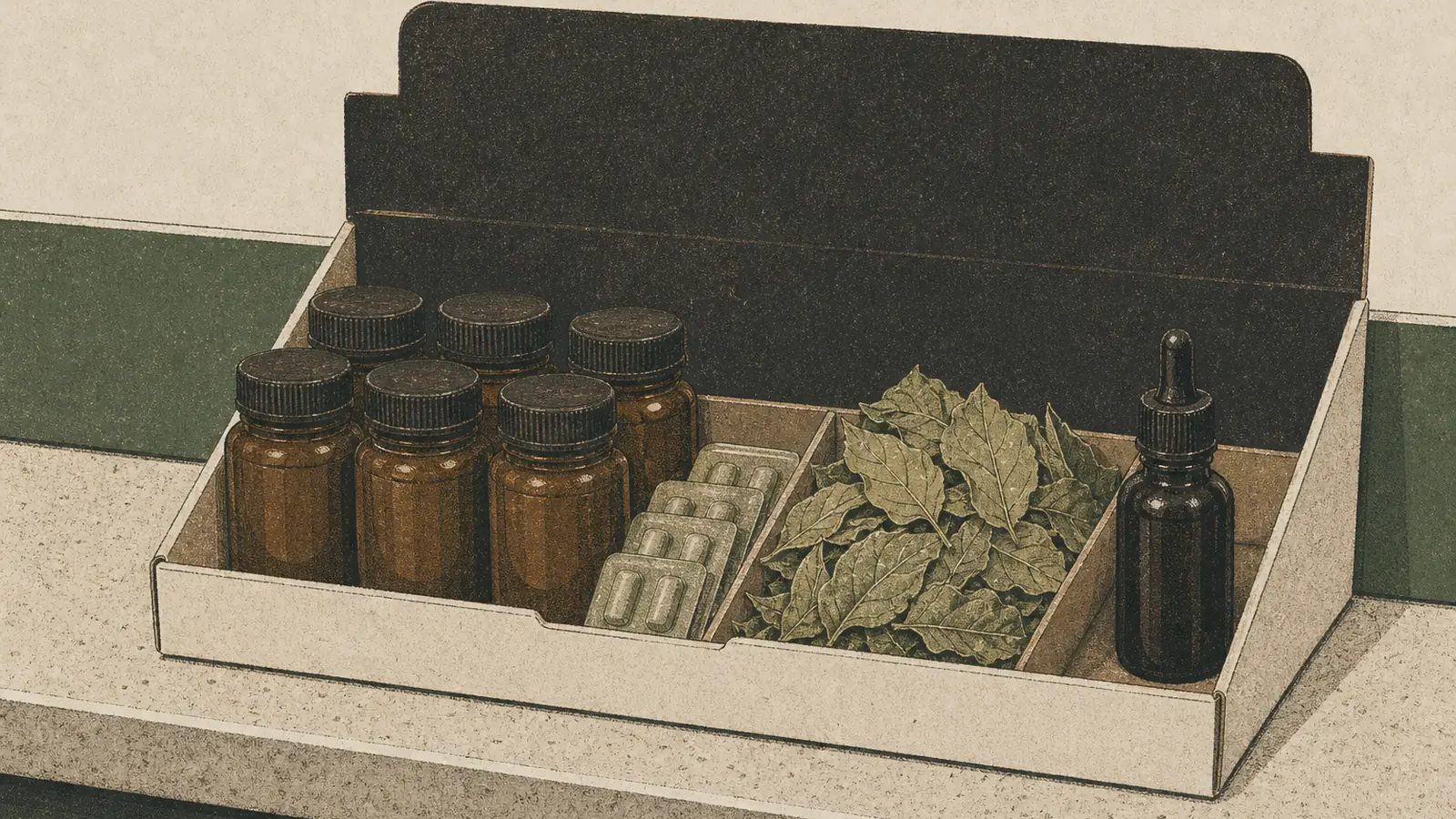
When “DEA moves against kratom” crossed my feed, I did the lazy thing and assumed I already knew the shape of it: another federal agency reaching for a plant people use to feel better, another crackdown dressed up as concern. I have watched that movie, and I went in ready to be annoyed. Then I read what the DEA actually filed, and the annoyance had nowhere to land, because the thing being scheduled is barely in the plant at all. It is a concentrated opioid wearing kratom’s name.
On July 1 the DEA filed notices of intent to temporarily place 7-hydroxymitragynine, or 7-OH, into Schedule I, the same legal tier as heroin. The Federal Register notice landed July 6, and the ban runs two years with a possible third. Buried in the fine print is the number that reframes the whole thing: it only bites above 0.05 percent of 7-OH by dry weight, or more than one milligram in a processed product. Natural kratom leaf sits comfortably under that line. The leaf is not what got caught.
So I did what I do when one number decides everything and I can’t see why, which is chase the biology. Why would a hundredth of a percent separate an herbal tea from a Schedule I opioid? Because 7-OH is not really a kratom ingredient in the way the label implies. It is a metabolite. When you swallow kratom, your gut and liver take the leaf’s main alkaloid, mitragynine, and convert a small share of it into 7-OH, the piece that actually sits down hard on your mu-opioid receptors. In the raw leaf, 7-OH is a trace passenger, less than 2 percent of total alkaloids, and your body meters the conversion out slowly. That slow drip is why traditional leaf reads less like a clean opioid hit and more like a strange, stimulating tea that only lightly brushes the same receptors.
Now isolate that trace metabolite, concentrate it, and press it into a tablet, a gummy, or a “shot.” You have skipped the slow conversion entirely and handed the receptor a flood of the most opioid-like molecule in the plant. And it is strong. The FDA calls concentrated 7-OH more potent than morphine; lab work puts it at 13 to 40 times morphine’s strength at the receptor, depending on the assay. Some gas-station products carry more than 30 times the 7-OH of natural leaf. That is not kratom with the volume turned up. It is a semi-synthetic opioid using kratom’s name because “kratom,” until this week, was a word regulators had left in limbo.
Here the story stops being the one I expected. The loudest cheer for the DEA came not from prohibitionists but from the American Kratom Association, the plant’s most organized defenders, who have spent years telling anyone who would listen that chemically manipulated 7-OH products “are not kratom.” A second trade group, SABER, welcomed the action in nearly the same breath, praising it for hitting concentrates while preserving the leaf. When the people who sell a substance are begging the DEA to schedule the knockoff, the knockoff was eating their reputation. Every overdose tied to a “kratom shot” that was really a 7-OH pill became a headline that threatened the actual plant.
And that leaf matters to real people, which is the part Washington’s press release flattens. In one NIDA-funded survey of 129 users, the reasons people reached for kratom were not what a drug-war framing would predict. 67 percent used it just to feel less crappy and improve quality of life. 54 percent were self-treating anxiety. Right around half used it for low energy or for pain, 50 percent each. About 25 percent used it as a short-term substitute for opioids, and 19 percent specifically to blunt opioid withdrawal. That last group, the roughly one in four climbing down off something worse, is exactly who you punish if you lump their leaf in with a gas-station opioid. Do that and you don’t protect them; you risk shoving the people using leaf to stay off pills back toward the pills.
So does the DEA get a clean win? Not quite, and the FDA does not get to play careful hero here. This is the same agency that let the market metastasize for a decade by refusing to give natural kratom an honest regulatory home, and its own materials still take swipes at the safety of the leaf itself even as it claims to be preserving access. You cannot spend ten years treating a plant as a nuisance you would rather not deal with, watch a concentrated synthetic opioid rush into the vacuum you left, and then hold a press conference about protecting consumers as if you were never part of the setup. The threshold in this order is smart. The victory lap around it is Washington arriving late, acting decisive, and writing itself as the rescuer.
The honest version is narrower and more useful than either the “DEA bans kratom” headline or the agency’s own celebration. A concentrated semi-synthetic opioid got mislabeled as an herbal supplement and sold next to the energy drinks, and it is finally being treated as what it pharmacologically is. The leaf that people use to manage pain and get off oxycodone was, this time, left alone. Both things are true, and keeping them apart is the whole point.
Me, I read the threshold before I read the outrage. If a “kratom” product lists an isolated or enhanced 7-OH content, or shows up as a precisely dosed tablet, gummy, or shot instead of plain leaf powder, I treat it as the opioid it is and walk past it. Plain leaf powder in one hand, an enhanced 7-OH shot in the other: those are not the same product, and I keep my skepticism aimed at the agencies now taking credit for cleaning up a shelf they spent a decade helping to stock.
Sources
- DEA – Temporary scheduling of 7-OH and related substances (July 1, 2026)
- Federal Register – Temporary placement of 7-hydroxymitragynine above a specified threshold in Schedule I (July 6, 2026)
- FDA – FDA takes steps to restrict 7-OH opioid products
- FDA – Concentrated 7-OH opioid products (agency briefing document)
- Pharmacy Times – FDA moves to restrict 7-OH opioid products (potency and concentration figures)
- American Kratom Association – DEA scheduling action confirms chemically manipulated 7-OH opioids are not kratom
- SABER – Welcomes DEA action while preserving access to natural leaf kratom
- American Journal of Drug and Alcohol Abuse – Kratom use as more than a “self-treatment” (NIDA-funded survey of 129 users, 2022)
- PMC review – From kratom to 7-hydroxymitragynine: evolution of a natural remedy into a public-health threat
- Healio – FDA asks DEA to classify 7-OH as a controlled substance (July 29, 2025)
- TrialSite News – DEA targets potent 7-OH compounds, but the kratom story is more complicated