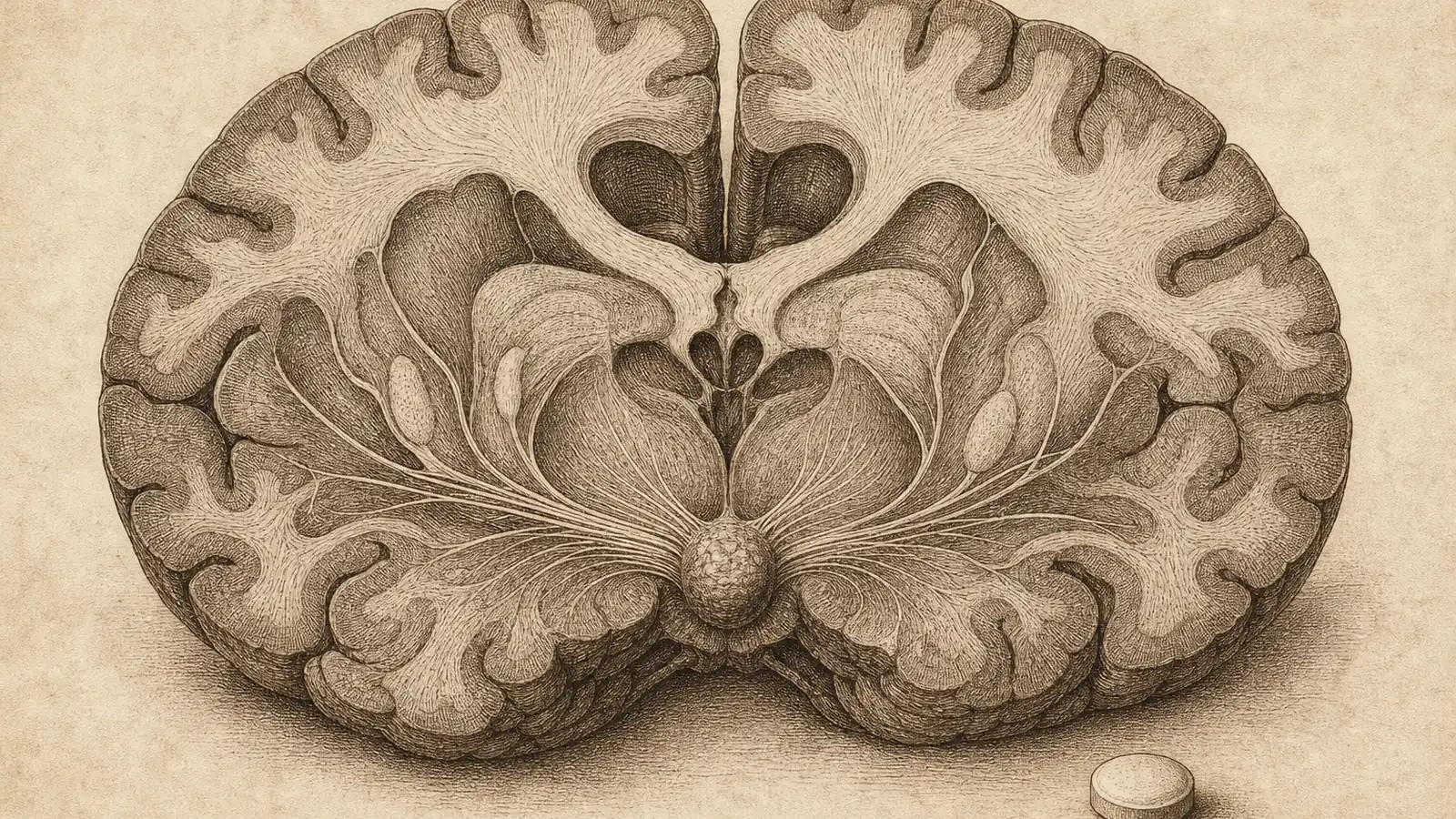
For a long time I had the GLP-1 drugs filed under one word. Appetite. They make your stomach feel full sooner, you eat less, the weight comes off, tidy. That is what I believed, and it is mostly what the injectable peptides earned, because when scientists went looking for where semaglutide acts they kept landing in the hunger machinery of the hypothalamus and the hindbrain. Then a team at the University of Virginia went looking for where the oral pills land, and what they found is not an appetite story at all. It is a reward story, about dopamine, about pleasure, and about a pill a lot of people are now swallowing every day.
The food just stops paying off.
In a study published in Nature and announced by the NIH on July 24, researchers traced two next-generation small-molecule GLP-1 drugs, Eli Lilly’s orforglipron and Pfizer’s danuglipron, into a part of the brain nobody expected them to reach. The central amygdala. It sits deep, a knot of tissue in the reward system that governs desire, and in mice engineered to carry human-like GLP-1 receptors these pills reached it directly, a region scientists had not thought GLP-1 drugs could touch head-on. Once there they switched on a specific population of neurons that projected down the line and lowered dopamine release in the nucleus accumbens, the hub that lights up when you eat something you love. The drugs did not only dial down hunger. They quieted the pleasure of eating itself.
Wait, why would a pill you swallow for your waistline reach a circuit that deep? That is the question the study actually chases, and the answer is a small, elegant piece of chemistry. The blockbuster injectables are big peptide molecules, clumsy at slipping past the blood-brain barrier, so they mostly work the brain’s outer, appetite-facing rooms. The new oral drugs are small molecules, small enough to cross where the peptides mostly do not, small enough to sit right down on GLP-1 receptors in the central amygdala. The researchers describe them recruiting a discrete group of GABAergic neurons there, which reach out to the ventral tegmental area and turn the tap. Dopamine output falls. Less of it pours into the nucleus accumbens during a palatable meal. I read that mechanism three times before it settled.
So the mechanism is not hunger. The food just stops paying off. The pleasure of eating gets thinner, and that lever, not fullness, may be what explains the thing GLP-1 users keep reporting that pure appetite suppression never quite captured, the way the food noise simply goes quiet.
Here is where I put the brakes on my own excitement. This is a preclinical animal study. Mice, humanized receptors, a lab, a long way from a mouse’s central amygdala to yours. The ScienceDaily writeup says the drugs “may quiet the brain’s food craving circuit,” and a co-author’s line is that they “dial back eating for pleasure,” both true, both in rodents. Reward biology has humbled confident predictions before, so the honest read is mechanism, not promise. The danger is not that the finding is weak. It is that a clean, vivid mechanism like this one gets carried into human expectations long before the human data shows up.
Now look at who else is in the room. One of the two star drugs here, Pfizer’s danuglipron, is already dead. Pfizer scrapped it in April 2025 after a trial participant suffered a drug-induced liver injury and the company decided the math no longer worked. So half the next-generation evidence in this paper rests on a compound its own maker walked away from over safety. The other half, orforglipron, went the other way. The FDA approved it as Foundayo on April 1, 2026, clearing Lilly’s application in a 50-day sprint under a program built to shorten reviews, and sold it as the GLP-1 pill you can take any time of day with no food or water restrictions. The drug this study shows reaching deep into the reward system is approved, on pharmacy shelves, and being prescribed.
And the government’s addiction shop is watching closely. The NIH release quotes Lorenzo Leggio, clinical director at the National Institute on Drug Abuse, on how important it is to understand these mechanisms “as accessibility rises and uptake increases,” with follow-up studies planned on whether the same pills can blunt cravings for substances beyond food. I follow the logic. A drug that turns down accumbal dopamine during one reward might turn it down during others, and a cheap oral craving-blocker would matter a great deal for addiction medicine. But sit with what is being proposed. A mass-market pill, taken by people who mostly just want to weigh less, that reaches into the same deep circuit we spend our lives learning to feel good from. Dopamine in the nucleus accumbens does not only track food. It moves for a lot of what we call pleasure, and nobody in the cheerful version of this story is asking what turning it down at dinner does to the rest of what that circuit handles. That is the anhedonia question, and it is the one the upbeat framing skips.
I am not swearing off the class. This is some of the most interesting neuroscience I have read all year, and if I needed one of these drugs I would take it. But eyes open means something specific for me here. Before I ever filled that prescription I would sit my doctor down and ask what turning down that circuit does to everything else it governs, the appetite for a good meal and the appetite for a good day, and I would want a straight answer before the pill, not a shrug after it.
Sources
- Nature – “A brain reward circuit inhibited by next-generation weight-loss drugs in mice” (2026)
- NIH news release – “Oral small-molecule GLP-1 drugs penetrate deep into the brain to suppress cravings” (July 24, 2026)
- ScienceDaily – “Oral GLP-1 drugs may quiet the brain’s food craving circuit”
- Eli Lilly – FDA approves Foundayo (orforglipron), oral GLP-1 pill for weight loss (April 1, 2026)
- CNBC – “Pfizer scraps daily weight loss pill danuglipron after a liver injury” (April 14, 2025)
- Nature news – “How obesity drugs quiet ‘food noise’ in the brain”