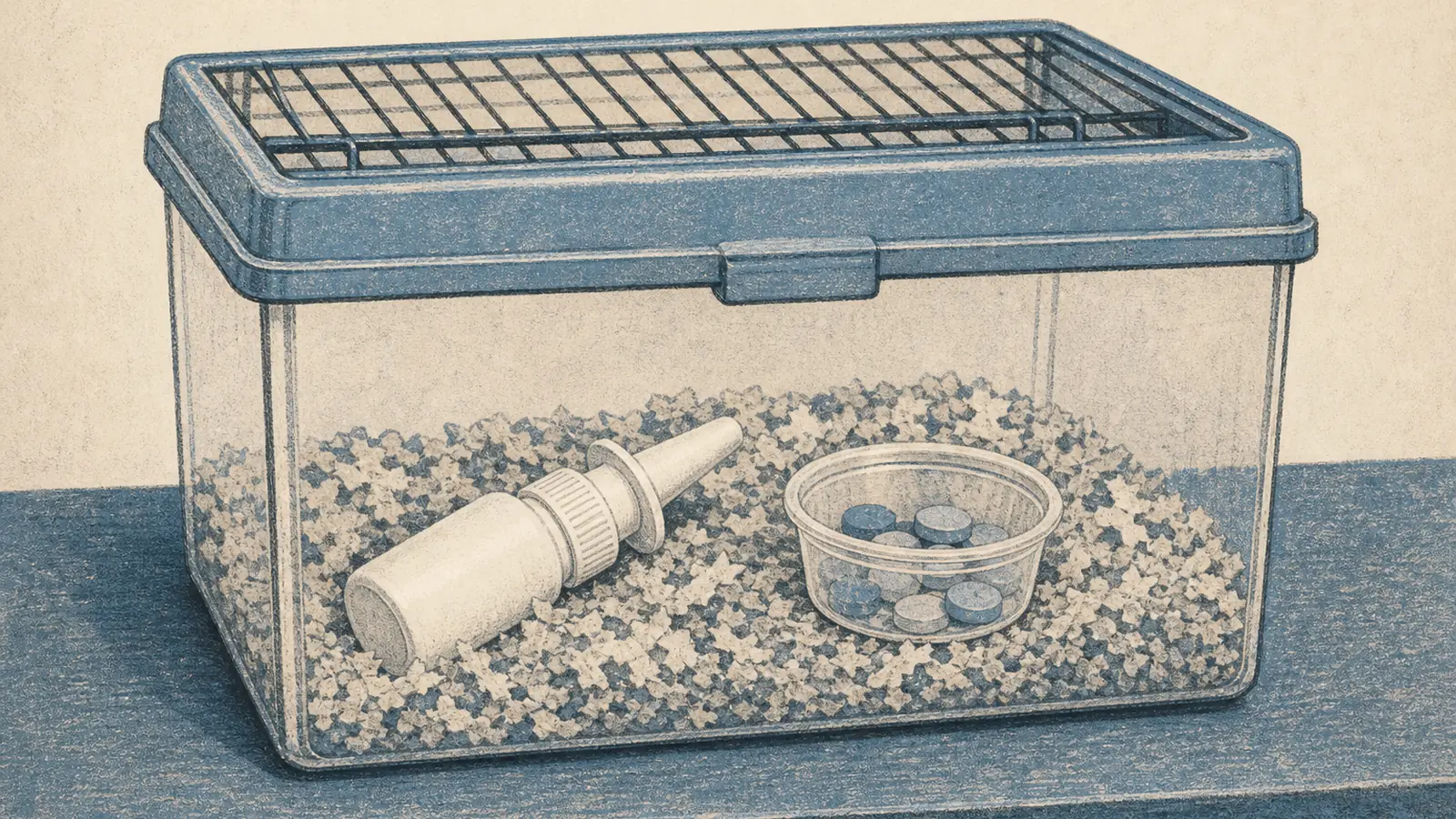
Styliani Karanika put the honest sentence in her paper and then watched it get left behind. Additional research, she wrote, will be required before any of this can advance to human clinical trials. What traveled instead, resurfacing in health feeds this week, was the fun version: a nose-spray DNA vaccine that fights the world’s deadliest infection. What her lab actually did was help mice who were already swallowing a full course of antibiotics clear tuberculosis a little faster. Those are not the same story, and only one of them fits in a headline.
The team at Johns Hopkins Medicine and the Bloomberg School of Public Health, led by Karanika, built a therapeutic DNA vaccine you squirt up the nose. It fuses two genes, relMtb and Mip3α: the first codes for a protein that helps tuberculosis survive when antibiotics are trying to kill it, the second summons dendritic cells to wave those bacterial proteins in front of the immune system’s T cells. Delivered into infected mice alongside their drugs, it sped up how fast their lungs went clear, calmed the inflammation, and kept the disease from relapsing after treatment stopped. In rhesus macaques it generated TB-specific immune responses that lasted at least six months.
Read that last part slowly, because the press release rather hopes you won’t. The monkeys were never infected. They were checked for an immune reaction, not a cure. The animals that actually cleared tuberculosis were mice, and the mice that cleared it faster were the ones already on a full course of the antibiotics that cure TB on their own. The vaccine did not cure the mice. The antibiotics did, a little quicker, with the spray along for the ride.
That is the gap between the verb and the record. “Develop a vaccine” is what the newsroom wrote. What the lab produced, and published this year in the Journal of Clinical Investigation under the considerably less thrilling title Immunotherapy targeting drug-tolerant Mycobacterium tuberculosis persisters accelerates tuberculosis cure in preclinical models, is a plasmid that shortens a cure in mice when it is bolted onto the drugs. The word preclinical was sitting in the study’s own title the whole time. It just didn’t survive the trip to the feed.
None of this would matter much if DNA vaccines had a habit of keeping their promises. They don’t. For about thirty years the technology has done exactly this, performing beautifully in the mouse and then going quiet the moment it meets a human being. A review of the field is blunt about why. “An ongoing problem,” its authors write, “is the poor ability to predict human vaccine responses based on mouse immunogenicity data,” and the 100 to 1,000-fold gains that dazzle in mice tend to shrink to 2 or 3-fold in people. After decades of candidates against HIV, influenza and the rest, exactly one DNA vaccine has ever reached human licensure anywhere on earth: ZyCoV-D, a COVID shot cleared under emergency authorization in India in 2021. The mouse is not a small human. On this platform it has been an unusually unreliable narrator.
The money is worth a glance while we’re here. The work ran on the usual NIH grants, a couple of Johns Hopkins development awards, two small foundations, and a Gilead HIV Research Scholar Award to one of the investigators. That last line didn’t bankroll the TB vaccine, and no one should pretend it did. It’s a marker of the water this research swims in, where a pharma name in the acknowledgments is unremarkable, “breakthrough” is the house dialect, and the caveats get set in the fine print.
The appetite for a breakthrough is enormous, and that is exactly the problem. Tuberculosis killed an estimated 1.25 million people in 2023, more than any other single infection on earth, and the only licensed vaccine against it, BCG, is more than a century old and only patchily protective. A field that hungry will call almost anything a vaccine. It is the perfect climate for a mouse study to be crowned a nose spray that fights TB, three months after publication, with the researcher’s own hedge stripped off for travel.
Karanika, to her credit, left the hedge in. She told anyone still reading that the work has a great deal to clear before it goes anywhere near a person, and her paper said the same thing in its title. Everyone downstream of her just picked the louder sentence.
Sources
- ScienceDaily: Johns Hopkins scientists develop nose spray DNA vaccine for tuberculosis (July 2026)
- Journal of Clinical Investigation: Karanika et al., “Immunotherapy targeting drug-tolerant Mycobacterium tuberculosis persisters accelerates tuberculosis cure in preclinical models” (2026)
- Technologies for enhanced efficacy of DNA vaccines: the poor translation of mouse immunogenicity to humans (PMC3293989)
- JAMA: India’s new COVID-19 DNA vaccine (ZyCoV-D) is a first
- WHO Global Tuberculosis Report 2024: TB mortality and BCG’s limits