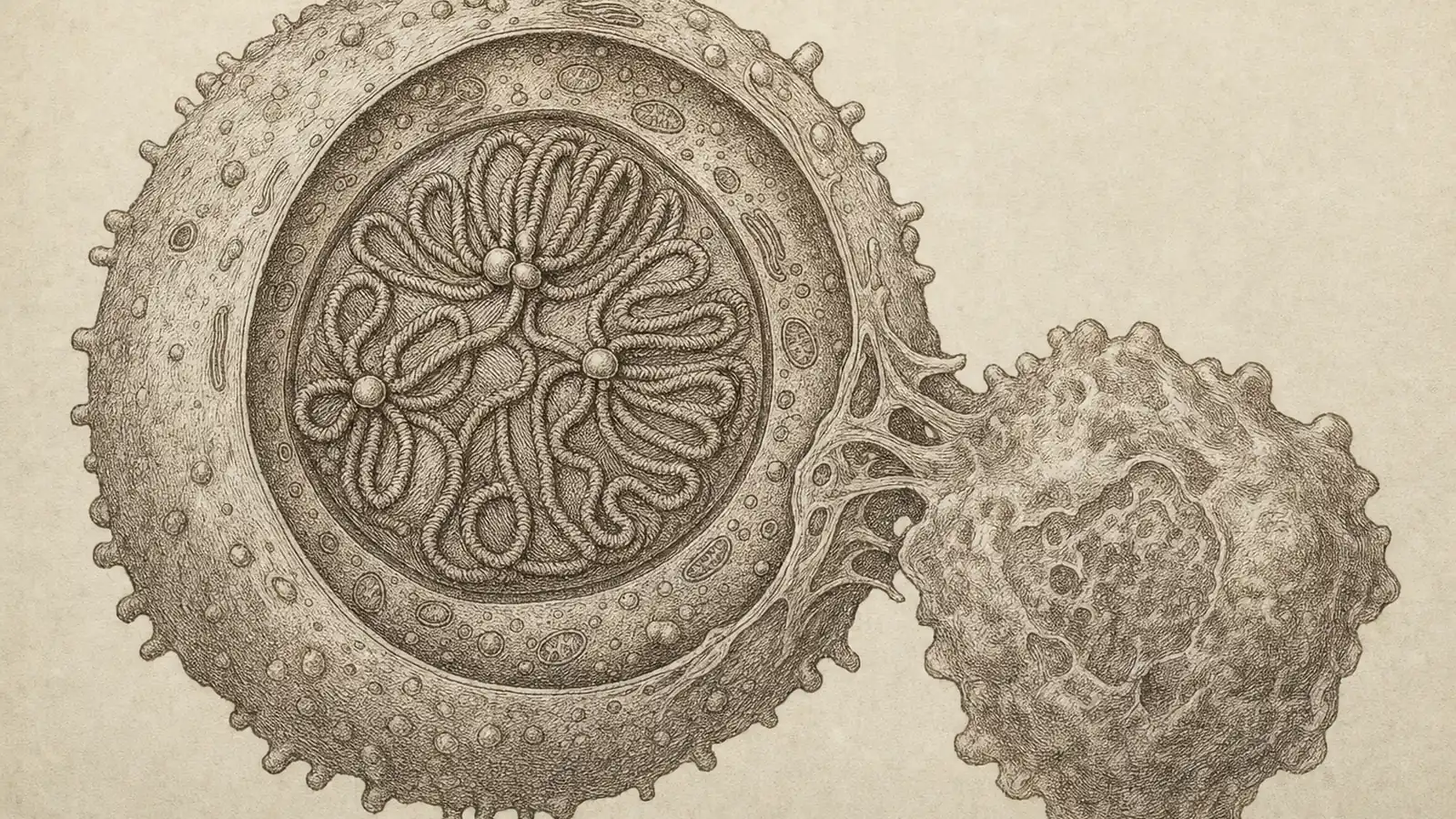
I used to picture an exhausted T cell the way I picture myself after a brutal week: same cell, just out of gas. That turns out to be almost entirely wrong. Whether one of your killer T cells stays in the fight against a tumor or collapses into uselessness has less to do with how tired it is than with how its genome is physically folded inside the nucleus. Same DNA, same letters, folded two different ways, two different cells.
It is one of the cleaner explanations for why the same drug rescues one patient and does nothing for the next.
That is the destabilizing takeaway from a commentary in Nature Immunology this month, published 6 July under the pun-happy title “Exhausted CD8+ T cell subsets differ a TAD”, which pulls together a run of work showing these cells settle their fate less by wearing out than by being physically rewired.
Here is what that means, because it took me a second too. Your DNA is not a loose noodle floating in the cell. It is packed into loops and neighborhoods called topologically associating domains, TADs for short. Think of them as rooms with walls: a gene and the switches that control it get shut into the same room so they can talk, while everything in the next room is held at arm’s length. The protein that builds those walls, that clamps the DNA into loops and decides what shares a room with what, is called CTCF. It is the architect. And the architecture shapes what these cells become.
Exhausted CD8 T cells are not one thing. They sit in a hierarchy. At the top are the progenitor cells, TCF-1-positive, self-renewing, the ones that can be woken back up. Down the line they diverge into terminally exhausted cells that are studded with PD-1 and TIM-3 and have mostly quit. This distinction is why the hierarchy matters in the clinic. Checkpoint drugs like anti-PD-1 work largely by reinvigorating that progenitor pool, so if a patient’s tumor has already shoved their T cells over the edge into terminal exhaustion, there is much less left to rescue. It is one of the cleaner explanations for why the same drug rescues one patient and does nothing for the next.
So what shoves a cell over that edge? This is where I stopped and reread the paragraph. In 2025 work mapping the 3D genome of exhausted T cells, a transcription factor called IRF8 turns out to physically recruit CTCF to build new loops inside the TADs, wiring enhancers to the genes that drive terminal exhaustion. IRF8 is, in effect, the foreman who tells the architect where to put the walls that wire a cell into the terminal-exhaustion program.
Wait, so just delete IRF8 and free the cells? That was my first thought, and it is wrong in a way that is far more interesting than being right. When researchers knocked IRF8 out, the exhausted cells did not spring back to life. They failed to differentiate properly and lost their antitumor function anyway. The folding that drives cells toward exhaustion is the same folding that lets them fight at all. Exhaustion is not the immune system breaking. It is the immune system doing something on purpose, in three dimensions, and the “off” switch and the “fight” switch sit in the same room.
Then the story wandered onto my home turf, metabolism, and I stopped skimming. The genome does not fold in a vacuum. It reads a chemical code written on the histones, the spools the DNA wraps around, and that code gets written from raw material the cell eats. In a 2025 Science paper, the switch came down to acetate versus glucose. Functional T cells run acetate through an enzyme called ACSS2 to feed one set of histone-writers; exhausted cells switch to glucose-derived carbon through ACLY to feed a different one. It is not a metaphor. When the team deleted ACLY, nudging cells back toward the functional metabolism, the progenitor pool nearly doubled. Delete ACSS2 instead and cells slid toward terminal exhaustion, PD-1 and TIM-3 climbing. Overexpress the acetate enzyme in the nucleus, add an anti-PD-L1 drug, and tumors came under control. What you feed the cell tilts the fold.
None of this came from nowhere. The same CTCF logic builds the good cells too: back in 2022, researchers showed that TCF-1 and CTCF co-bind at TAD boundaries to organize the architecture that gives a progenitor CD8 T cell its identity in the first place. CTCF was never new to this story. What is new is watching the same clamp, redirected by a different foreman and fed different chemistry, build a fighter in one cell and a quitter in the next.
None of it is a therapy yet, and that gap is worth naming plainly. This is a folding map, a mechanism worked out mostly in mice and cultured cells, and no trial has tested whether you can refold a person’s T cells and keep their immunotherapy working. People are already trying to engineer around the problem: one 2026 effort armored CAR-T cells to favor effector over exhausted fates before they ever go in. But that is engineering hope, not a proven treatment. For now we can see the switch far better than we can flip it in a patient.
Still, seeing it changes something. I have retired the tired-cell image for good. The next time I read that a checkpoint drug or a CAR-T “stopped working” in someone, I will not read it as the immune system giving up. I will read it as a genome folded into a corner, and the first thing I will want to know is whether anyone tried to unfold it. That is the question I am bringing to every immunotherapy headline from here on.
Sources
- Nature Immunology – “Exhausted CD8+ T cell subsets differ a TAD” (News & Views, 2026)
- Nature Immunology – Analysis of the three-dimensional genome of exhausted CD8+ T cells reveals a critical role of IRF8, which recruits CTCF (2025)
- Science – Nutrient-driven histone code determines exhausted CD8+ T cell fates (2025)
- Nature Immunology – TCF-1 promotes chromatin interactions across topologically associating domains in T cell progenitors (2022)
- Journal of Immunology – Stem-like progenitor exhausted CD8+ T cells diverge into terminally exhausted cells and long-lived memory T cells (2025)
- Journal for ImmunoTherapy of Cancer – Systemic pre-conditioning favors effector over exhausted CD8 T-cell subsets following Sup2-IL33 armored CAR T-cell therapy (2026)