I always filed “pregnancy lowers your risk of breast cancer” under hormones. That is how it usually gets taught: a first full-term pregnancy matures the breast, the milk-making machinery differentiates, lifetime estrogen exposure shifts, and the tissue comes out the other side somehow more resistant. Tidy story. It turns out to be half of one at best, and the missing half is stranger than any hormone curve.
This is not a metabolic afterglow. It is an occupation.
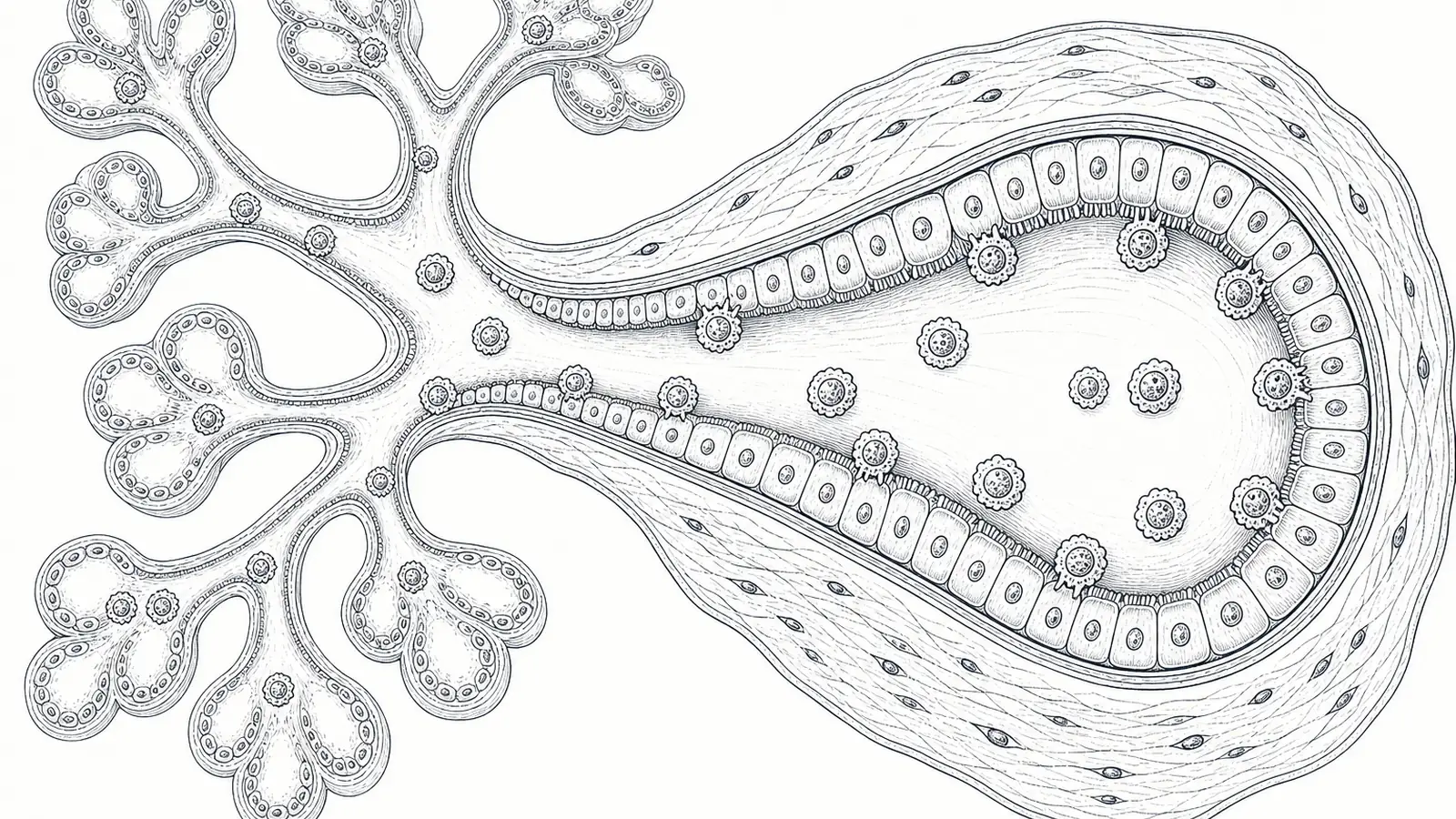
Because pregnancy does something no hormone chart captures. It stations an immune garrison inside the breast and leaves it there for years. A team at Melbourne’s Peter MacCallum Cancer Centre and the Peter Doherty Institute reported in early July in Nature Immunology that during pregnancy the body recruits killer T cells, the CD8+ tissue-resident memory kind, into the breast epithelium, where they burrow into the milk ducts and set up house. Then they refuse to leave. Associate Professor Kara Britt, who co-led the work, told Medical Xpress: “We examined breast tissue 10 years post-pregnancy and found these T cells were still present.”
Let me say what these cells actually are, because the clinical name buries the drama. Most of your T cells are travelers, riding the bloodstream, sweeping through tissues, moving on. Tissue-resident memory T cells do the opposite: they plant themselves in one organ, wire into it, and stay put, killing cells that turn abnormal on their patch. A standing population of them in the milk ducts of women who gave birth a decade earlier reframes the whole “pregnancy is protective” idea. This is not a metabolic afterglow. It is an occupation.
The question I kept circling was why these cells stay at all. A killer T cell built to patrol should get bored and wander off, so what feeds it, what holds it in place? Here is where the biology got its hooks in me. The cells do not survive on their own. Co-lead Dr. Ajithkumar Vasanthakumar told Medical Xpress the resident T cells “rely on the milk-producing breast cells for survival and growth.” According to the study, those epithelial cells pour out two signals, the cytokines IL-15 and TGF-beta, and the signals work as leash and food bowl at once. Block proper alveolar differentiation, the process that turns breast tissue into a working milk factory, or cut off IL-15 and TGF-beta, and the resident population shrinks. No milk machinery, no signal; no signal, no guard. The lactation biology and the cancer-surveillance biology turn out to be the same biology, which is not how I would have guessed this worked.
That mechanism gives teeth to numbers epidemiologists have stared at for decades without a satisfying explanation. Per the National Cancer Institute, a woman whose first full-term pregnancy comes before age 20 has about half the breast cancer risk of a woman whose first comes after 30, and women who have carried five or more children run roughly half the risk of women who never gave birth. Those associations have always been real and always been a little mysterious. A resident immune force that installs during pregnancy, gets reinforced by lactation, and holds position for years is a proposed mechanism that finally fits the shape of the data, though the Melbourne work shows the cells and the correlation, not a line drawn straight through those exact epidemiologic curves.
I want to be honest about the part that complicates the fairy tale, because it is also in the record. Pregnancy is not a clean, immediate shield. The same NCI evidence shows that in the years right after giving birth a woman’s breast cancer risk actually ticks up, and it only declines after about 10 years. The Melbourne work is a plausible reason the long game breaks in your favor: it takes time for the resident cells to establish and for their surveillance to outweigh the tumor-friendly churn of a recently remodeled, recently involuted breast. And the protection skews toward hormone-receptor-positive disease, not every subtype, which the NCI fact sheet also flags for the early-pregnancy and multiple-birth effects. This is an edge, not a magic wand, and anyone selling it as a magic wand is not reading the whole chart.
There is prior evidence that these guard cells earn their keep. A 2022 Science Immunology study found that CD39-positive resident memory CD8 T cells in the breast mediate antitumor immunity, and a 2026 Trends in Immunology review had already tied lactation and tissue-resident immunity to breast cancer protection. The new work runs the same direction: higher levels of these intramammary T cells track with better breast cancer outcomes. So the cells are not just present. When they are abundant, the tissue does better.
Which brings us to the move everyone is going to fixate on. The Melbourne team showed, in mouse models plus human tissue, that experimental hormone treatment can induce these protective resident T cells without a pregnancy at all, and Vasanthakumar called the findings a new avenue for “immune-preventive interventions.” Read that as the start of a research program, not a product on a shelf. Summoning a durable killer-cell population with a hormone regimen, on the strength of animal models and human tissue correlation, is a hypothesis with a good mechanistic story behind it and zero human prevention trials under it. And I would watch the framing closely as this moves. A free, decade-long protective effect of pregnancy and breastfeeding is going to get reverse-engineered into something with a patent and a price, and the honest version of that pitch has to admit it is trying to bottle what a body already does for nothing. This study was funded by the National Breast Cancer Foundation and Australia’s NHMRC, not a company with a molecule to sell. The next paper might not be.
So this is my conclusion. The pharmaceutical version is a maybe, years out, and I would not line up for a pregnancy-in-a-syringe on the current data. But the biology already changed one thing for me. I had quietly filed breastfeeding under “nice if it happens,” and this is the study that moved it up my list, because the milk machinery is not only feeding a baby, it is what keeps these resident cells fed and stationed. If I have kids, I would nurse as long as I reasonably could, and I would do it knowing the science now hands that choice a second reason I had not credited before.
Sources
- Nature Immunology – Pregnancy-induced tissue-resident memory-like T cells contribute to tumor control in breast cancer (2026)
- Nature Immunology – Tissue-resident CD8+ T cells link pregnancy to breast cancer protection (2026)
- Medical Xpress – Peter MacCallum / Doherty Institute team on pregnancy-recruited killer T cells, with Vasanthakumar and Britt quotes (2026)
- National Cancer Institute – Reproductive History and Cancer Risk fact sheet (parity, age at first birth, transient post-partum risk, receptor-subtype specificity)
- Science Immunology – CD39+ tissue-resident memory CD8+ T cells mediate antitumor immunity in breast cancer (2022)
- Trends in Immunology – Lactation, tissue-resident immunity, and protection against breast cancer (2026)