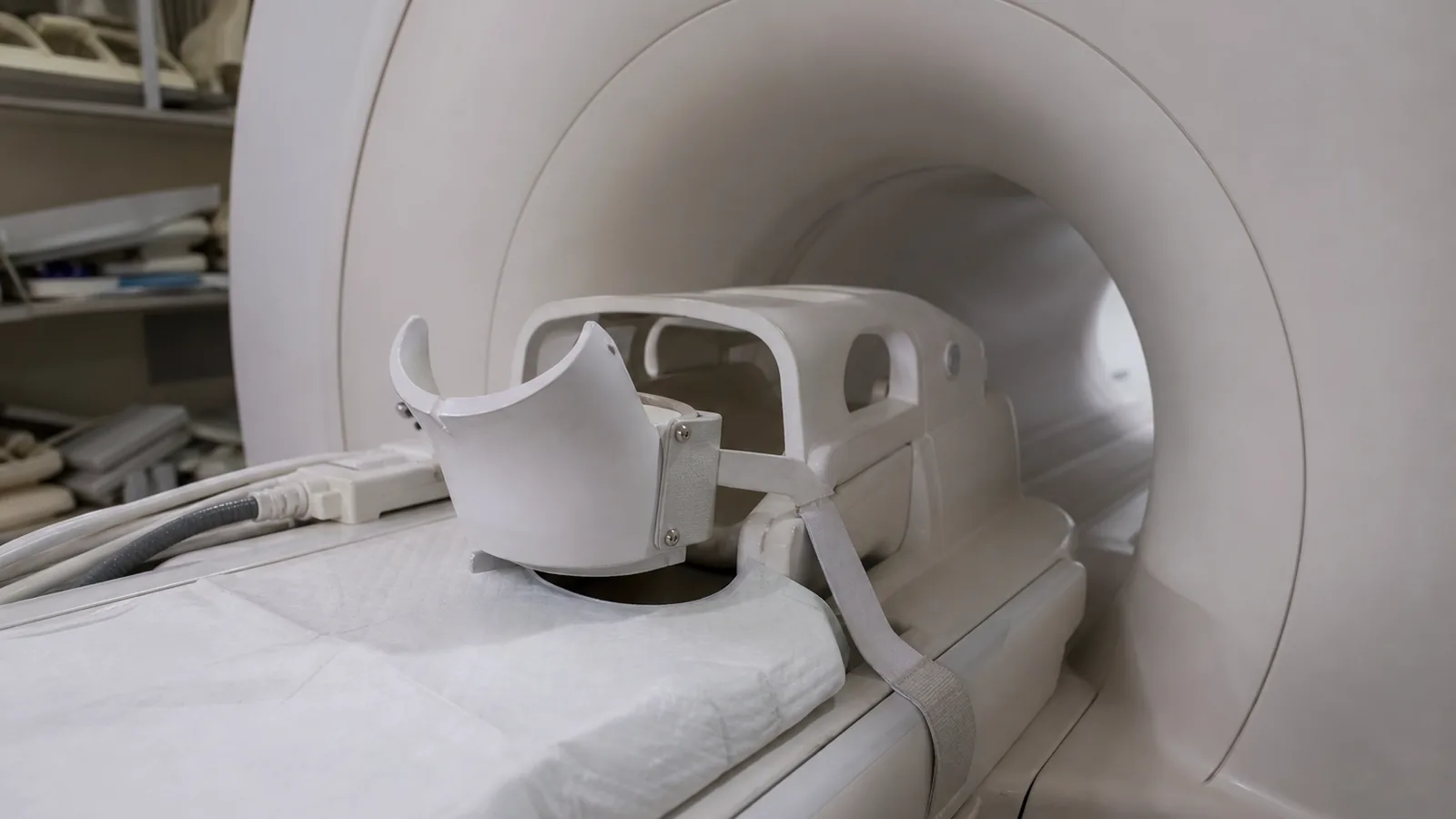
The eye is the one organ you can shine a penlight into and stare straight at, so for years I filed it under “easy to see.” That is exactly backwards. Slide someone into an MRI and the eye turns into one of the most stubborn things in the body to image: it is small, it sits deep in a bony socket, and it will not hold still, because your eyes twitch in tiny involuntary jumps even when you are trying to freeze them. The standard head coils that ring the skull put their best sensitivity out near the scalp, which is the wrong place. By the time the signal claws its way in from the surface of the eye to the retina and the optic nerve behind it, it has faded to almost nothing.
So when a team out of Berlin said it got a scanner to see clean into the living eye without buying a new scanner, I wanted to know two things: how, and what is the catch. The how is a piece of physics I keep re-reading. The catch is smaller than you would expect, and I will get to it.
What they built is not a new machine and not a new magnet. It is a new antenna, the piece that actually sends radiofrequency energy into your tissue and then listens for the faint echo that becomes the picture. Nandita Saha, a doctoral student in Thoralf Niendorf’s ultrahigh-field MR lab at the Max Delbrück Center in Berlin, built it with colleagues at Rostock University Medical Center and published it in Advanced Materials in early 2026. They call it a metamaterial-integrated antenna, and it works with the 7-tesla scanners that some research centers already run instead of replacing them.
A metamaterial is just an ordinary material, copper here, arranged into a lattice of structures far smaller than the wavelength it works with, so the array as a whole bends electromagnetic fields in ways the raw metal never would. Saha’s team laid down a sheet of what are basically split-ring resonators, little looped rings with a gap in them, tuned to hum at the exact frequency a 7-tesla magnet uses. The layer is completely passive. No wires running to it, no power feeding it, no watts added to the patient. It sits next to the working antenna and, through resonant near-field coupling, pulls the radiofrequency field in tighter and concentrates it where you want it, then helps scoop up the whisper coming back out.
Wait, why would a dead sheet of metal rings make an antenna hear better without anyone turning up the power? That is the question the physics actually answers, and it is the part I had to slow down on. The rings resonate in sympathy with the antenna’s field, like a second string vibrating when you pluck the first, and that sympathetic resonance reshapes the near-field so more of the energy lands in the eye instead of dissipating into the scalp. On the receive side the same coupling boosts sensitivity to the returning signal. You are not adding energy. You are steering the energy you already have.
The numbers back the mechanism up. In phantom tests the transmit efficiency ran 13 to 21 percent higher than a conventional loop, and receive sensitivity in gradient-echo imaging jumped by roughly 94 to 132 percent, close to a doubling. In three living volunteers the signal inside the eye itself rose by 25 to 51 percent, depending on the eye and the direction measured. More signal is the currency that buys everything else in MRI. You can spend it on finer resolution, or you can spend it on a shorter scan, which for someone who has to hold their gaze steady inside a loud tube is not a small mercy.
That is where I want to plant a flag, because a lot of the coverage leaned on the word “faster” harder than the paper does. The study’s hard evidence is signal and resolution, not a stopwatch. A sensitivity gain this size can be traded for speed, and the team is reasonable to expect it, but “could shorten scans” is a consequence, not a scan-time number they clocked. I would keep those two things apart.
The clinical hint is genuinely charming. In their three volunteers the sharper picture caught things nobody went looking for: a sinus cyst turned up incidentally in one orbital scan, and the antenna cleanly imaged a retinal haemangioma in a volunteer who had been treated for it. That is the whole promise of seeing better. You find the thing you weren’t hunting for. Ocular tumors, optic-nerve disease, the retinal changes that ride along with diabetes and high blood pressure all live in exactly the deep-orbit territory that standard coils blur, which is why a tool that reaches back there matters beyond the three people in this study.
Now the honest floor, said plainly because it is part of the story and not a disclaimer to bury. This is three healthy volunteers plus a stack of phantom benchtop tests, not a clinical trial. “Breakthrough” is a press-release word; what actually happened is an elegant, well-measured piece of engineering validation on a handful of people. It is not medicine yet. And I will give credit where the funding earns it, because I spend a lot of my time squinting at device studies bankrolled by the company that sells the device: this one was paid for by the Deutsche Forschungsgemeinschaft, Germany’s public research council, not by a scanner manufacturer with a product to move. The safety math held up too. Specific-absorption-rate stayed under international limits, and tissue-heating tests showed about a 1.5-degree rise at the highest-power setting, which is the boring detail that actually matters before anything goes near a patient’s eye.
Seven-tesla scanners are still specialist machines, so this is not landing at your local imaging center next year. But the design does not fight the installed base, it upgrades it, and that is the part I keep turning over. If I were facing a scan of the back of my eye or my optic nerve, I would want to be read on the antenna that actually reaches back there, and I would ask whether the center running the machine has moved past the coil that stops listening at the scalp.
Sources
- Advanced Materials – Saha et al., “Metamaterial Antennas Enhance MRI of the Eye and Occipital Brain” (2026)
- Physics World – Metamaterial antennas enhance MR images of the eye and brain
- Max Delbrück Center – New material boosts MRI image quality
- Technology Networks – New Material Boosts MRI Image Quality
- ScienceDaily – New MRI breakthrough reveals the brain and eye like never before
- SciTechDaily – New MRI Breakthrough Captures Stunningly Clear Images of the Eye and Brain
- Medical Xpress – MRI antenna can boost image quality and shorten scan times without changing existing machines