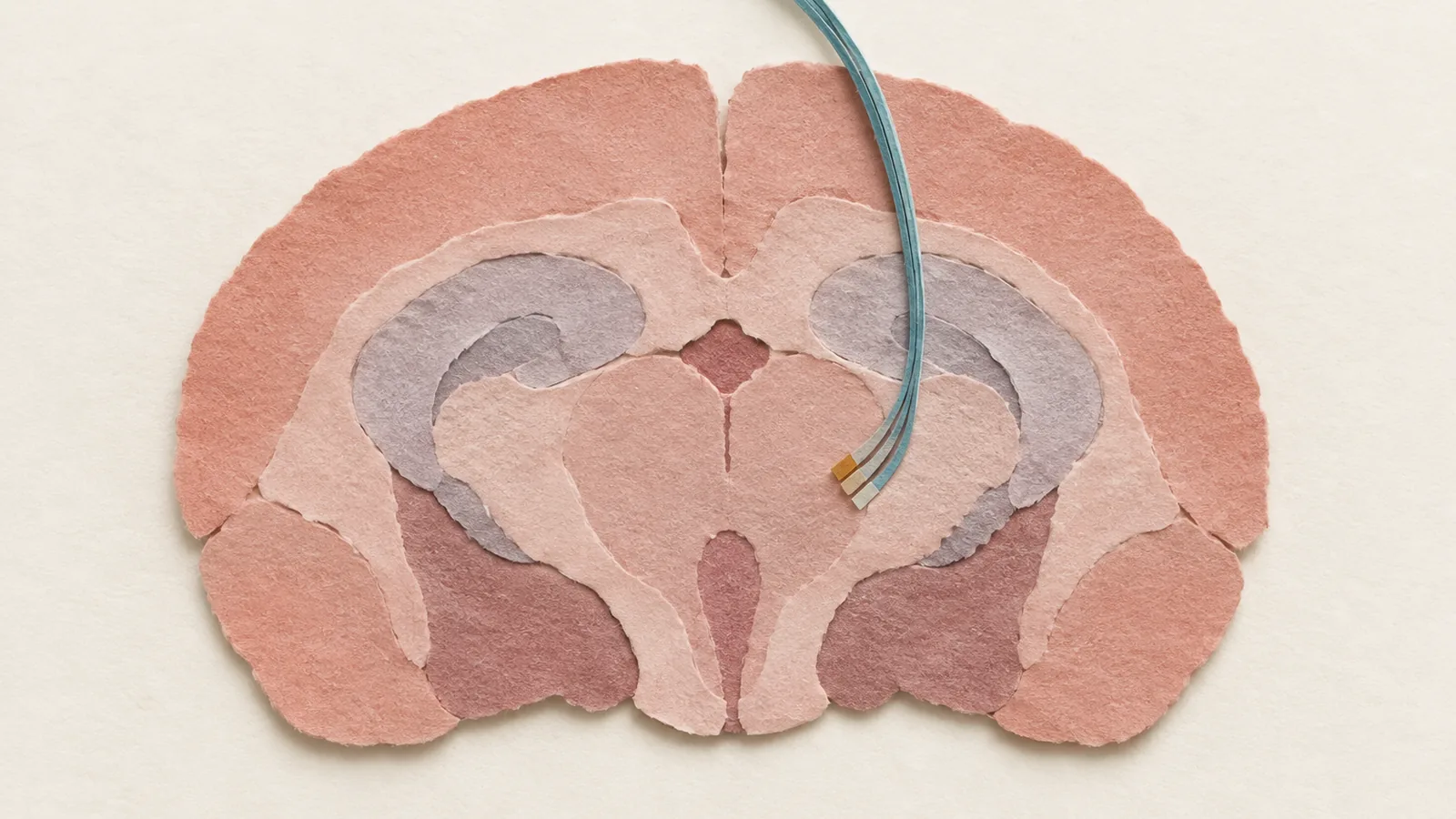
I always assumed the hard part of wiring a brain was the wiring. The electrodes, the miniaturization, the sheer engineering of getting something small enough into something that soft. It turns out the hard part is the brain itself. Your brain knows the difference between itself and a foreign object, and when you slide a stiff shard of silicon into it, the tissue treats it like a splinter: it attacks, and it walls the thing off in scar. That slow immune reaction is a big reason so many neural implants fade after a few months, right when you would most want them still working.
So when I read that a Danish-led team had built a brain probe designed to dodge exactly that, my first reaction wasn’t “wow, futuristic.” It was “okay, what did they actually do differently?” The answer surprised me, and it wasn’t what the headlines led with.
The device is called the microfluidic Axialtrode, or mAxialtrode, and it comes from researchers at the Technical University of Denmark, the University of Copenhagen, and University College London, published in Advanced Science. It is a single soft fiber, less than 0.5 mm across, roughly the thickness of six human hairs bundled together. Inside that one strand: a light-conducting core down the middle, eight microscopic channels that can either carry fluid or hold hair-thin metal wires, and a tip angled to part the tissue instead of punching through it.
The materials are what pulled me in, because this is really a materials story wearing a neuroscience headline. Most brain implants are built on hard silicon, and postdoc Kunyang Sui, who led the work, put the problem plainly: those hard implants “can irritate the brain and trigger inflammatory reactions”. The mAxialtrode is made of soft, plastic-like optical fiber instead, flexible enough to bend as the tissue moves. Which made me ask the obvious question: why would softness matter that much to an immune system? Think about what your brain does all day. It pulses with every heartbeat, it shifts when you turn your head. A rigid probe holds still while the tissue slides against it thousands of times an hour, and every one of those tiny grinds is another insult the immune system logs. A fiber that bends and drifts along with the tissue gives it far less to catch on. That is the design rationale, at least. Whether it holds up over months in a living brain is exactly what a mouse study can’t tell you yet.
And it does three jobs at once, which is the line everyone repeated. In living mice, the fiber stimulated neurons with light, recorded electrical activity at two different depths at the same time, the cortex near the surface and the hippocampus deeper down, and injected different substances at separate depths up to about 2.7 millimeters apart. One insertion, three modes, no shuffling separate instruments in and out of the same delicate tissue. As a piece of engineering, it’s legitimately elegant, and I don’t want to undersell that.
The turn comes fast. This is a mouse study, a preclinical one, and the coverage is already floating epilepsy as the payoff. Sui himself was careful to say that extensive testing, further development, and regulatory approvals are still needed before any of this reaches a patient. That’s the researcher being straight with you. What happens between his mouth and the headline is another matter. Notice the timing, too: the paper and the first press wave landed in January, and the “scientists create” round you’re seeing in late September is a rerun, the same result recirculated as if it were fresh. And one detail I went looking for and couldn’t find in any of the write-ups: how many mice. When coverage leads with the concept and never the sample size, it’s asking you to be impressed by the idea, not the numbers.
Then there’s the money, which in brain-implant research is never neutral. The work was funded by the Lundbeck Foundation’s Multi-BRAIN program and an EU EIC Pathfinder project called Move2Treat. The Lundbeck Foundation owns roughly 70 percent of H. Lundbeck A/S, a Danish pharmaceutical company built around drugs for depression, schizophrenia, Alzheimer’s, Parkinson’s, and migraine, exactly the neurological and psychiatric territory a drug-delivering brain probe would target. That doesn’t make the science wrong. It does mean the people paying for a device that squirts medication into precise brain regions have a direct stake in there being better ways to squirt medication into precise brain regions. The team is also pursuing patents and exploring clinical testing. This is an early-stage product, not a gift to the commons, and it’s worth reading the enthusiasm with that in mind.
| Measure | Value |
|---|---|
| of Lundbeck owned by its foundation | 70% |
So where does that leave me. Impressed by the soft-fiber idea, because the foreign-body response is a wall the field has hit for years, and “make the implant flex like the tissue” is a smart, physical answer I’ll be watching. Unpersuaded by the epilepsy talk, which is a hope, not a finding. If a probe like this reaches human trials with published safety data and a real sample behind it, I’ll pay close attention. Until then I’d file the mAxialtrode where it belongs: an elegant proof of concept in mice, and a reminder that when the money comes from people who sell brain drugs, I read the press release twice.
Sources
- ScienceDaily – “Scientists create a needle-thin brain implant that can do three jobs at once” (2026-09-21)
- EurekAlert – “Gentle implant can illuminate, listen, and deliver medication to the brain” (2026-01-21)
- Advanced Science – mAxialtrode, DOI 10.1002/advs.202519744
- News-Medical – “Needle-thin brain implant enables recording and targeted drug delivery” (2026-02-06)
- Lundbeck – organization and ownership