I have handed a kid a juice box without a flicker of guilt, right after waving off the soda, feeling like I had made the grown-up call. One hundred percent fruit juice. No added sugar. The label practically thanks you for it. So the data that landed this summer stung a little, because it says the responsible-feeling pour and the one I smugly refused behave more alike inside a child’s body than anyone selling the juice wants you to know.
Researchers reporting in the American Heart Association journal Circulation followed 25,749 people from childhood. They were 9 to 16 when they enrolled in the Growing Up Today Study, filling out diet questionnaires again and again for up to 25 years, until the median person in the cohort was 36. By then 1,625 of them, about 6.3 percent, had been diagnosed with high blood pressure. Kids who drank two or more sugary drinks a day carried a 52 percent higher risk of getting there than the kids who drank fewer than three a week. That part I expected. Liquid sugar has been a known bad deal for years.
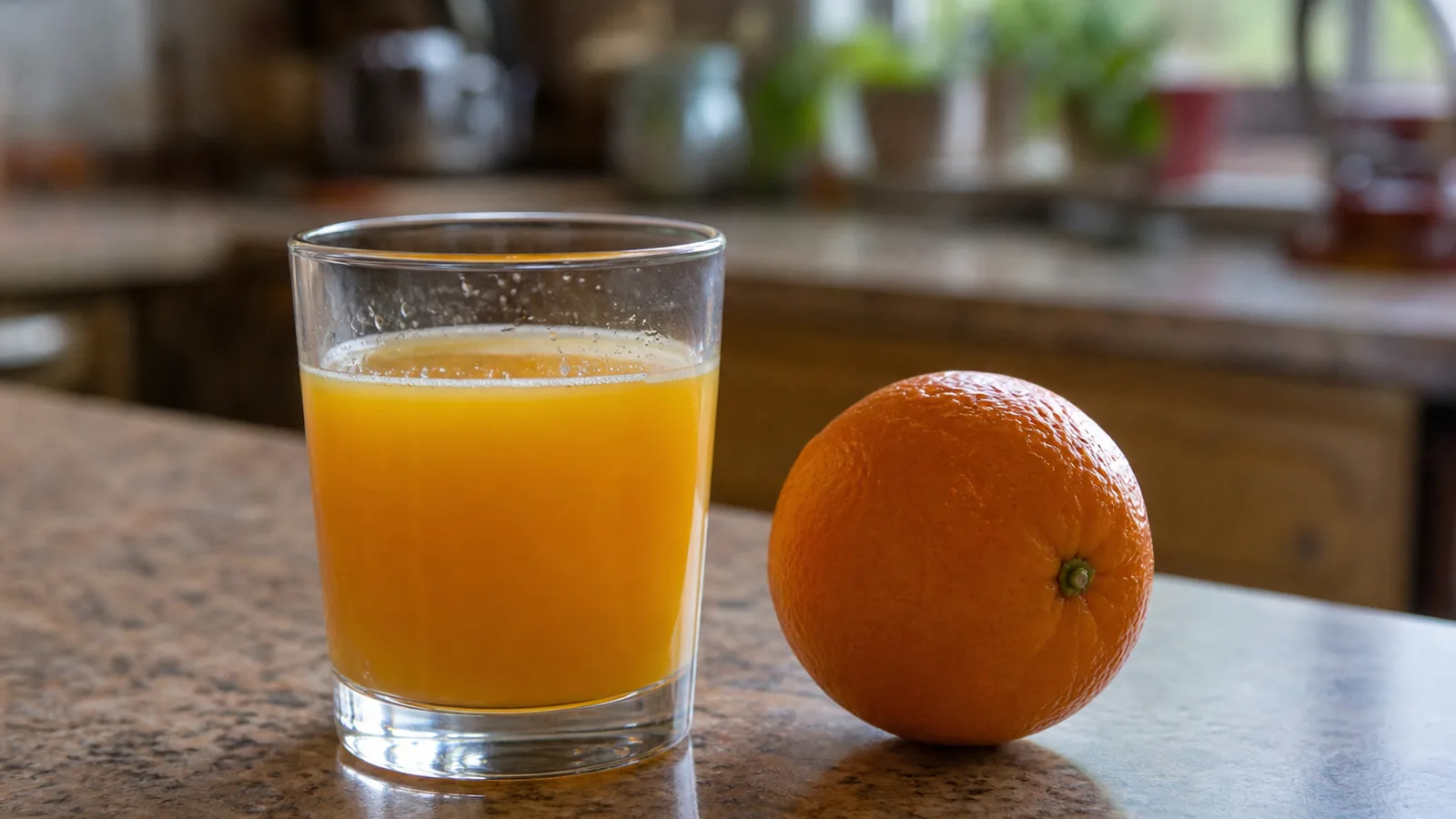
Then came the one I did not expect. Per additional daily serving, the risk barely cared which drink you handed the kid: sports drinks ran about 36 percent higher, soda about 23 percent, and orange juice, the wholesome breakfast staple your grandmother poured you, 20 percent. Fruit juice overall, at a serving and a half or more a day, ran 35 percent higher. Orange juice is not soda’s ugly cousin. It is soda’s neighbor, two doors down, pretending it belongs to a nicer family.
Whole fruit, meanwhile, showed no meaningful link to high blood pressure at all. Swap one daily sugary drink for a piece of actual fruit and the risk dropped about 22 percent; swap the juice specifically for whole fruit and you got roughly 19 percent lower risk. Same fruit, roughly the same sugar, wildly different outcome. So what is the actual difference between an orange you drink and an orange you eat?
The difference is fiber, and it is more physical than “fiber is good for you” ever makes it sound. Eat a whole orange and the sugar comes trapped in a fibrous matrix; your gut has to break the fruit apart and let the fructose out in a trickle your liver can keep up with. Juice throws that scaffolding in the trash. What is left pours into your gut as liquid fructose and hits the liver in one fast slug, and here is where I got genuinely curious, because why would speed alone matter this much? When the liver processes fructose in a hurry it generates uric acid as a byproduct, and uric acid tamps down nitric oxide, the little molecule that tells the muscular walls of your blood vessels to relax and stay open. Less nitric oxide, stiffer vessels. Around the same time fructose nudges the kidneys to hold onto salt and leans on the renin-angiotensin system, the body’s own pressure-raising machinery. Constrict the pipes, hold the salt, and pressure can climb. The same fructose inside a whole apple arrives on a much slower delivery system, slow enough that the cascade may never really get going. None of this was proven inside these particular kids, but it is the kind of fingerprint liquid fructose is known to leave, and it fits what the cohort watched happen over 25 years.
What sticks with me is that this is neither fringe nor new. The metabolic case against liquid fructose has been building for years, and yet “100 percent fruit juice” spent decades wearing an official health halo. Federal rules still let pasteurized 100 percent juice count toward the fruit in school meals, up to half of it, a generous accounting for a drink the same guidelines quietly concede is worse than the fruit it stands in for. It is easier to sell a parent a shelf-stable carton that counts as a serving of fruit than a bag of oranges that goes soft in a week. The marketing went to the industry. The blood pressure, apparently, went to the kids.
None of this comes from a perfect study, and the gaps all run the same direction. The high blood pressure was self-reported rather than measured in a clinic, so some real cases were surely missed. The cohort was 96 percent non-Hispanic White, so the exact numbers may not port cleanly onto everyone. And an observational study, however long and however large, watches what happens without proving the juice did it. But the mechanism the cohort cannot supply, the biology already fills in, and the two point the same direction.
So I am not going to wait for a randomized trial that will probably never be run on toddler juice boxes. In my kitchen the rule is already the one this data quietly endorses: the fruit stays whole, and the default drink is water. I will keep buying the orange. I am just going to make you eat it.
Sources
- American Heart Association Newsroom – Does drinking juice, soda during childhood increase the risk of high blood pressure? (Circulation, 2026)
- Harvard T.H. Chan School of Public Health – Drinking sugary beverages starting in childhood may increase adult blood pressure risk
- ScienceDaily – Popular childhood drinks may raise blood pressure decades later (2026)
- StudyFinds – Childhood sugary drinks linked to hypertension in adulthood (effect sizes by beverage)
- Uric acid and the origins of hypertension – the fructose, uric acid, nitric oxide pathway (PMC)
- Fructose-enriched diet, salt retention, and reduced renal nitric oxide – mechanistic study (PMC)
- USDA Food and Nutrition Service – National School Lunch Program meal pattern (100% juice credits toward the fruit component, up to half)