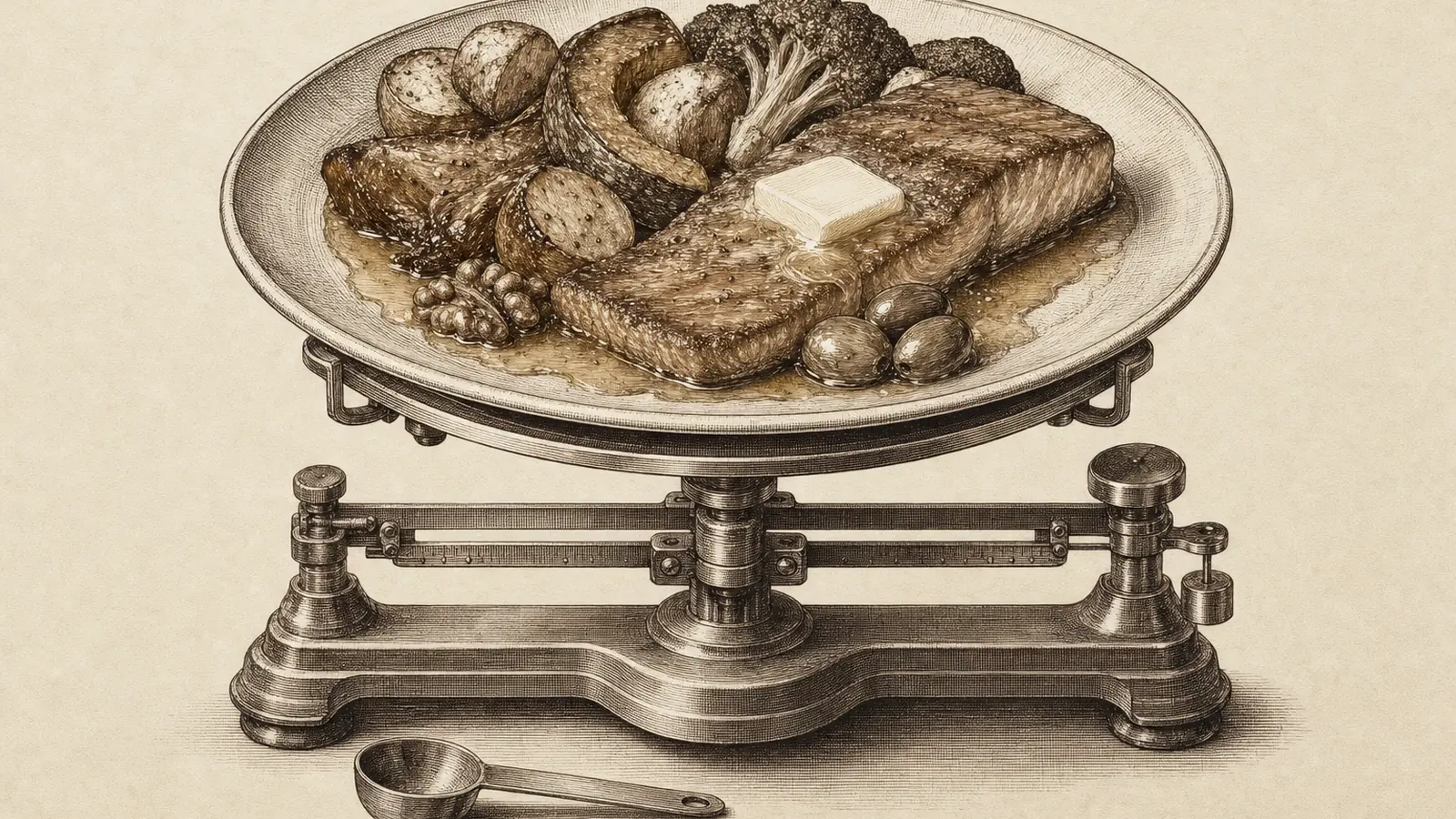
For about two years I let a little number run my lunch. Photograph the plate, wait for the app to finish thinking, take whatever calorie count it hands back as the honest truth of what I just ate. It felt like stepping on a scale. Objective. Settled. A camera does not have feelings about your burrito.
So when I read what researchers at the NIH’s diabetes and digestive disease institute just did to those apps, what got me was not the size of the error but its direction. The apps did not scatter around the truth, some high, some low, the way random noise would. They missed the same way, on the same macronutrient, over and over. That is not random error. That is a lean, and a lean has a cause.
At NUTRITION 2026, the American Society for Nutrition’s annual meeting in National Harbor, Maryland, NIDDK research fellows Olivia Charles and Aaron Hengist fed standardized meal photos to four of the most popular photo-based calorie trackers: MyFitnessPal, Lose It!, CalAI, and Appediet. The photos came out of the metabolic kitchen at the NIH Clinical Center, where every ingredient on the plate is weighed to the nearest 0.1 gram before anyone is allowed to eat it. They started with 102 meals from that kitchen, then ran more than 200 more. For a question like this, it is about as close to ground truth as nutrition research gets: a plate where the real number is not estimated, it is known.
Against that known number, all four apps came in low. On average they undercounted calories by 250 to 345 per meal, and they undercounted fat by roughly 30 grams. Call it a quarter to a third of the meal, just gone.
Sit with the fat number for a second. Fat carries about 9 calories per gram, more than double what carbohydrate or protein delivers. 30 grams of missing fat is around 270 missing calories all by itself, which is to say the fat error very nearly is the calorie error. The apps were not vaguely bad at everything. Charles and Hengist found they estimated carbohydrates the most consistently, and choked specifically on fat.
And that is the moment I actually said “wait, why” out loud. Why would a camera be good at carbs and blind to fat? Then it clicked, and it is almost obvious once you see it. Carbohydrate tends to have a shape. Rice is a visible mound. Bread has edges. A model trained on a million food pictures can look at a shape and guess a portion. But fat mostly does not have a shape. It is the olive oil the vegetables drank in the pan, the butter melted into the mashed potato, the marbling running through the meat, the cream already stirred into the sauce. It has soaked into the food and vanished from the surface. The app is reading a photograph, and a photograph only sees what light bounces off. The most calorie-dense thing on your plate is the thing hiding inside everything else, and no picture can show you what has been absorbed.
Which explains the cruelest detail in the readout. This app test is a spinoff of a larger NIH study comparing how the body processes a ketogenic diet versus a standard one, so the researchers had a stack of genuine high-fat, low-carb meals sitting right there. The apps struggled the most with exactly those keto plates. For keto and low-carb dieters, who are the ones most likely to be photographing a fatty, low-carb plate in the first place, that is exactly the failure mode that matters. The tool fails hardest for the audience leaning on it hardest.
The evidence boundary here is worth saying plainly: this is a conference abstract, not a peer-reviewed paper yet, so the precise figures could move once it clears the full statistical scrub. But the direction of the finding is clean and the method is unusually rigorous. Hengist’s own advice is the dry version, that people using a photo app without weighing or entering their portions “should take the results with a grain of salt,” because what they actually ate is likely higher than what the app shows.
Here is the part the coverage mostly skips. Two of the four apps that flunked are now the same company. In March, MyFitnessPal acquired CalAI, the viral photo-scanning app built by two teenagers that pulled in tens of millions in revenue in under two years by promising you could point your phone at dinner and be done. So one of the biggest names in calorie tracking now owns two of the tools an NIH metabolic ward just caught reading low. And a number that keeps erring low is a comfortable product. It tells you that you have more room than you do, that you were more disciplined than you were. Nothing about the business model pushes hard toward fixing a flattering answer.
I care about that most where these apps are heading, which is straight at young users. Photo tracking is frictionless in a way that older logging never was, and researchers have already documented that calorie-tracking apps correlate with perfectionism and disordered-eating tendencies in the people who use them. Handing a teenager a tool that spits out an authoritative, scientific-looking number, one that happens to be systematically wrong, is not a neutral act. The confidence is the danger. That decimal point is doing rhetorical work the data cannot back.
So here is what I actually do now, having read this. I did not delete the app, because a rough log still beats no log and the trends are useful. But I stopped treating its number as a verdict. On anything cooked in oil, anything creamy, anything keto, I mentally add back a third and assume the fat I cannot see is on the plate anyway. And I will not put this tool in the hands of the teenager in my family who already weighs herself too often, because the last thing she needs is a camera telling her, with a straight face and a precise wrong answer, exactly how much she is allowed to eat.
Sources
- ScienceDaily – “Your AI calorie-tracking app may be off by 345 calories” (NUTRITION 2026 coverage, July 2026)
- Medical Xpress – “Photo-based calorie-tracking apps may underestimate energy in meals” (Charles & Hengist, NIDDK)
- TechCrunch – “MyFitnessPal has acquired Cal AI, the viral calorie app built by teens” (March 2026)
- CNBC – “Cal AI: How a teenage CEO built a fast-growing calorie-tracking app” (Sept 2025)
- Jurnal Psikologi – “Perfectionism and Eating Disorder Tendencies in Calorie-Tracking App Users” (2025)