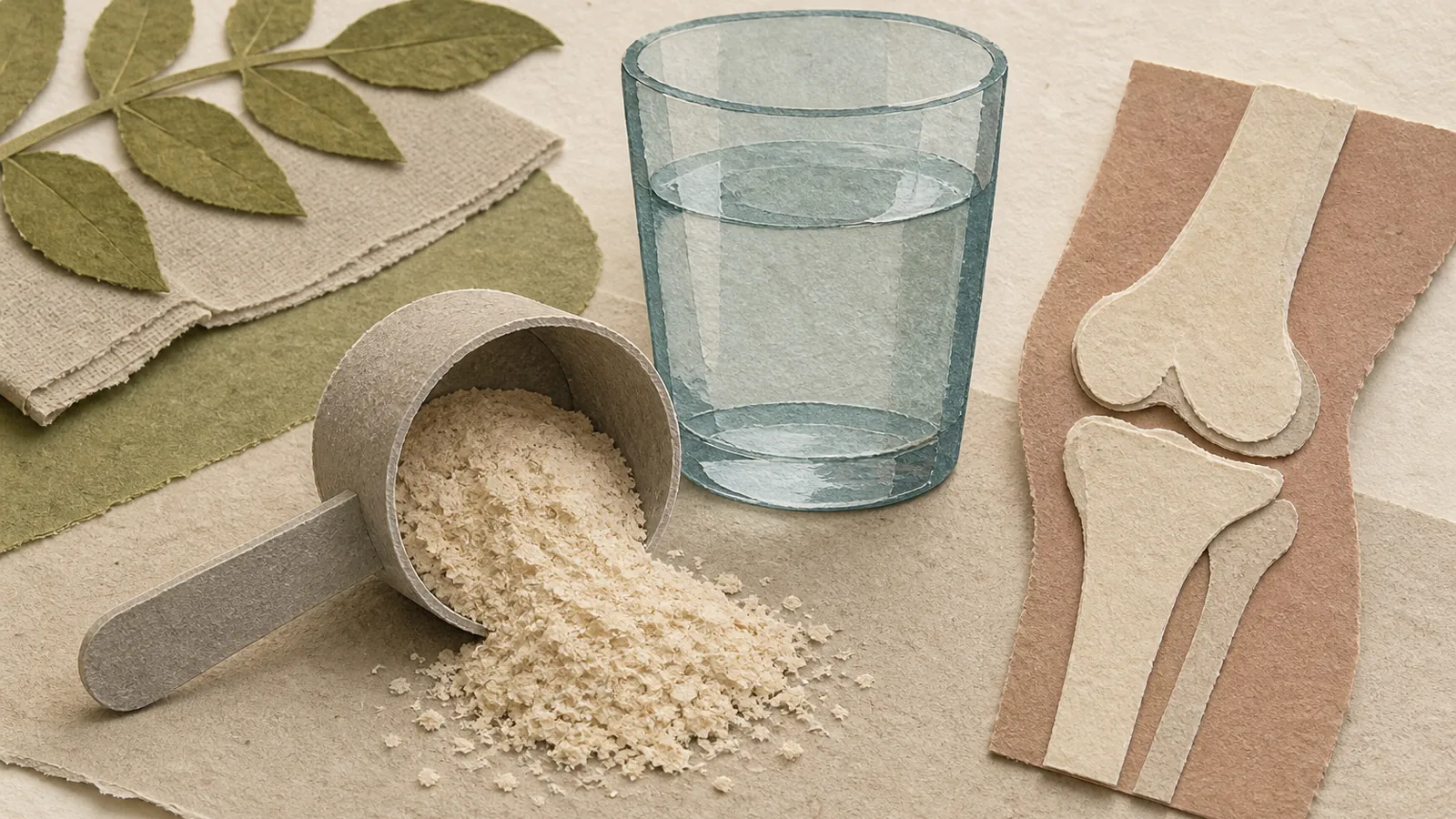
For years I have told people that fiber is for the gut and the heart, and I filed joint pain in a completely separate drawer of the body. Bones and cartilage over here, breakfast over there. So when a trial out of the University of Nottingham reported that a plain daily scoop of chicory-root fiber eased knee arthritis pain, my honest first reaction was to fold my arms. What does a swollen knee have to do with what you stir into your morning glass of water?
The answer runs straight through your gut, and it is more interesting than the “simple supplement cuts pain” headlines are letting on.
This is what happened. In the INSPIRE trial, published in Nutrients, a Nottingham team led by Dr. Afroditi Kouraki randomized 117 adults with knee osteoarthritis into four groups for six weeks. One group took 20 grams a day of inulin, the fermentable fiber found in chicory root and Jerusalem artichokes. One group did a digitally delivered, physiotherapy-supported exercise program. One did both. The last group got a maltodextrin placebo. These were not young joints: the average age was 67.5, the average BMI just under 30, and everyone started with real, daily knee pain.
Both the fiber and the exercise app beat placebo on pain, and I want to be straight with you about the gap between them, because it matters. On a 0-to-10 pain scale, inulin cut pain by about 1.1 points versus placebo (a mean difference of −1.11, just clearing statistical significance at p = 0.045). The exercise program did a bit better at −1.55, and doing both together landed at −1.67. Fiber alone was the weakest of the three active arms, and its confidence interval nearly brushed zero. If you only read the press release, you would think a spoon of fiber was a knockout. It was not. It was a modest, honest effect from something that costs about thirty cents a day.
But pain was not the surprise. Grip strength was. The inulin group gained roughly 4.6 kilograms of grip strength versus placebo, a solid effect (p = 0.002), while the exercise app did not move grip at all. A fiber you eat made people’s hands measurably stronger and an exercise program did not. That is the kind of result that makes me put my coffee down and go read the methods section twice.
So, wait: why would feeding a gut microbe do anything to a muscle in your hand? This is where the biology stops being a metaphor. Inulin is not absorbed; it pours into your colon intact, and the bacteria living there ferment it into short-chain fatty acids, chiefly butyrate. Those bugs did their job here, because butyrate rose significantly in the fiber groups. And butyrate is a known trigger for the specialized L-cells lining your gut to release GLP-1, the exact same hormone the blockbuster weight-loss drugs are engineered to mimic. In this trial the markers moved the way that pathway predicts: GLP-1 climbed in the inulin groups, and higher GLP-1 was positively associated with the stronger grip.
That association is the one that got me, because it reframes the whole thing. We have spent two years treating GLP-1 as something you inject to lose weight. Here it shows up as a signal your own gut produces when you feed it the right fiber, and it seems to reach all the way out to muscle. The gut was talking to the rest of the body the whole time; the fiber just turned up the volume.
Now the discipline, because enthusiasm is not evidence, and two caveats keep this story honest rather than magical. The butyrate that rose so nicely did not actually correlate with less pain, so the tidy fiber-to-butyrate-to-relief chain is not proven. And the GLP-1 analysis was exploratory, tacked on after the fact rather than pre-specified in the original protocol, which makes the gut-muscle link a strong hypothesis, not a demonstrated mechanism. This was also six weeks in 117 people, and the exercise arms shed participants fast enough that the researchers had to over-recruit and bend the allocation. Take the causal story as a lead worth chasing, not a settled pathway.
And yet that same dropout gap is quietly the most practical finding in the paper. Only about 3.6 percent of people in the fiber arms quit, against 21 percent in the exercise-app arms. An intervention that works on paper but that one in five people abandon by week six is a weaker intervention in the only setting that counts, which is real life. A spoonful of fiber, apparently, is easy to keep doing.
On the receipts, this was clean money. The trial was funded by the UK Medical Research Council, the charity Versus Arthritis, and UKRI, not by a supplement maker with a product to move. Two of the authors do disclose seats on the scientific advisory boards of nutrition companies (Chuckling Goat and OLIPOP), which is worth naming out loud even though those boards were unrelated to this study and the funders were public. Set against the industry-soaked trials that clutter the joint-supplement aisle, this one is refreshingly boring in its financing, and that makes me trust the modest result more, not less.
It also fits a pattern I keep watching build. For knee osteoarthritis, the cheap and unglamorous options keep holding their own: yoga rivaling strength training on pain and function, metformin throwing off a pain signal in a small trial, and even high-intensity strength training failing to beat lighter lifting. The assumption baked into so much osteoarthritis care, that relief has to come from a drug or a procedure, keeps getting contradicted by boring, accessible things.
Would I stir inulin into my water on the strength of this? I already do, for reasons that started with my gut and had nothing to do with my knees. It is cheap, the only real downside is some gas while your bacteria adjust, and the biology under this result is sound even where the trial is small. I would not treat it as a substitute for moving my body, and I would not wait for it to become an official guideline before feeding the bugs that, it turns out, may have been talking to my joints all along.
Sources
- Nutrients – Kouraki et al., INSPIRE prebiotic inulin randomized trial for knee osteoarthritis (2026, full text)
- ScienceDaily – A daily fiber supplement reduced knee arthritis pain and improved strength (2026)
- University of Nottingham via EurekAlert – gut health supplement relieves arthritis pain (2026)
- ClinicalTrials.gov – INSPIRE protocol and statistical analysis plan (NCT05670314)
- JAMA – Yoga rivals strength training for knee arthritis relief (2025)
- BMJ – Metformin may reduce knee arthritis pain, small study indicates (2025)
- JAMA – High-intensity strength training, knee pain, and joint compressive forces in knee osteoarthritis (2021)