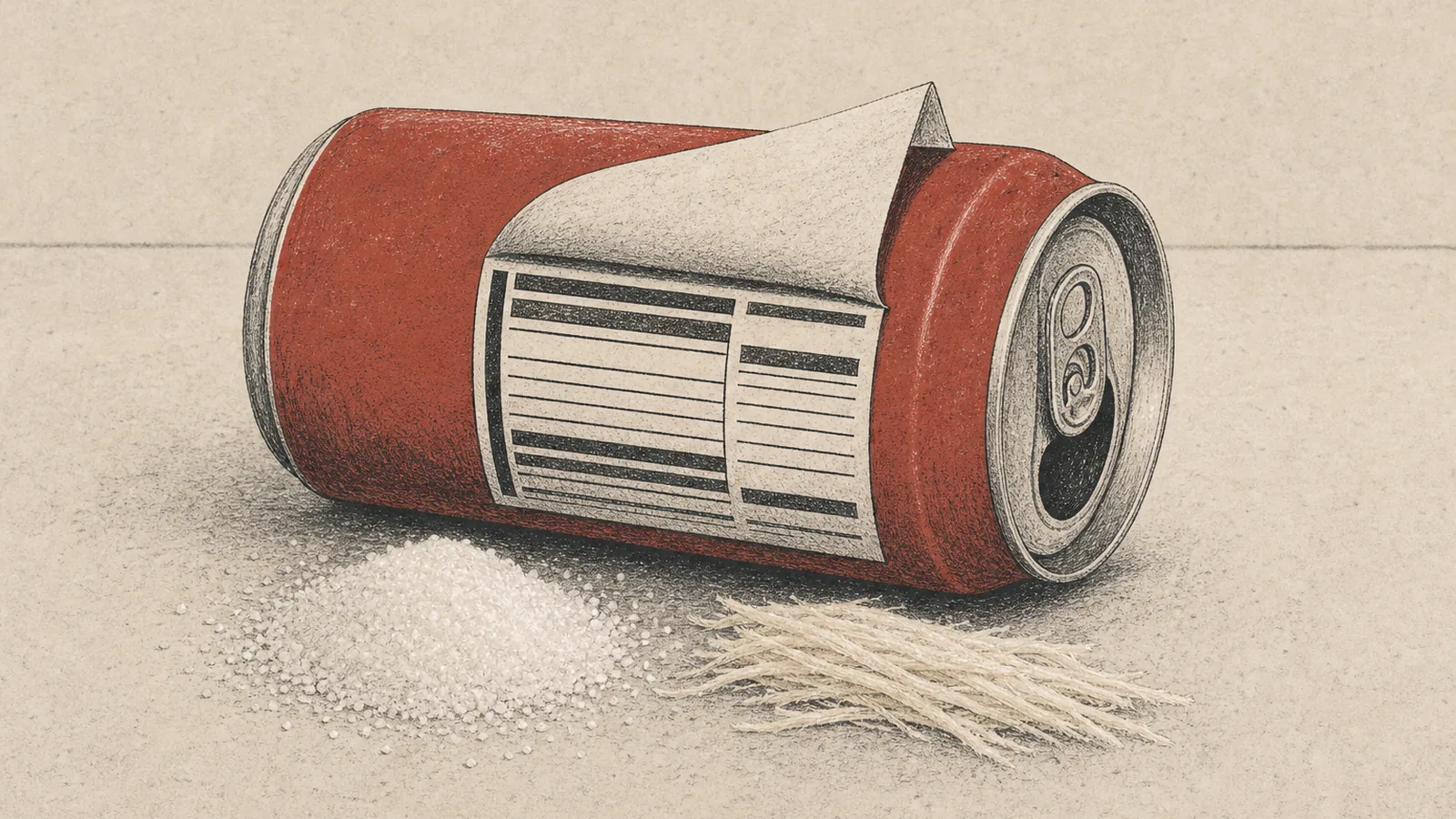
Carlos Soto Díaz did the unglamorous work. He and Lindsey Smith Taillie, both at the University of North Carolina at Chapel Hill, pulled the nutrition profiles of 108 prebiotic sodas launched in the United States between 2021 and 2025, lined them up against the regular sodas, diet sodas, fruit drinks, and sparkling waters sharing the shelf, and read the labels. No laboratory required. Almost everything that follows was printed on the can, in the small type the marketing was betting you would skip. They presented it this week at NUTRITION 2026, the American Society for Nutrition’s annual meeting in National Harbor, Maryland. It is a conference poster, not a peer-reviewed paper, and that is worth saying plainly. It also barely matters, because the central number is stamped on the packaging and nobody is arguing about it.
The average prebiotic soda, the pair found, carries roughly 35 calories, 5 grams of sugar, and 5 grams of fiber per twelve-ounce can. The product is sold on the fiber. It contains, on average, about as much sugar as fiber, and the fiber itself runs anywhere from 2 grams to 9, which means some of these cans deliver the prebiotic equivalent of a rounding error.
Then there is the sugar the front of the can would rather you not add up. The average is 5 grams, but some of the products stamped “no added sugar” carry around 10, because the sweetness rode in as fruit juice, and juice, conveniently, is not the added sugar that claim is denying. Soto Díaz has a phrase for the move. “Many products include nutrition and functional claims that may overstate their nutritional quality,” he said, the “no added sugar” label sitting on top of 10 grams of juice sugar being his own example. The effect is a “health halo,” the glow one virtuous phrase throws over an entire product until a can of sweetened soda reads as medicine. His advice to shoppers was the sort of thing that should not need saying and does: ignore the marketing, read the Nutrition Facts panel.
And there is the sweetener nobody prints on the front. Roughly 67 percent of the prebiotic sodas contained non-nutritive sweeteners, usually stevia. That is more than the 28 percent of fruit drinks, more than the 16 percent of flavored sparkling waters, and well past the 12 percent of regular sodas. It trails only diet soda, more than 90 percent of which carries the stuff, the one category prebiotic soda was supposedly invented to escape. The gut-health drink and the diet drink reach for the same jar.
Here is what no label can fix. In the U.S. market the word “prebiotic” is not tied to any required amount of fiber. No regulator sets a floor. As the UNC researchers point out, a company can print the word on a can holding 2 grams of chicory root, and a shopper has no way to tell from the claim alone whether there is meaningful fiber inside. The term polices itself, which is another way of saying it doesn’t.
Someone tested that. In May 2024, plaintiffs sued the maker of Poppi, the category’s breakout brand, arguing that a can carrying about 2 grams of prebiotic fiber could not deliver the gut benefits its “gut healthy” marketing promised. The complaint did the arithmetic: to get a real benefit you would have to drink more than four cans a day, and by then the sugar has canceled most of it back out. Poppi agreed to an $8.9 million settlement, granted preliminary approval in May 2025, without admitting it had done anything wrong. The money changed hands. The recipe did not have to.
The suit had barely been resolved before the price of Poppi went the other way. In March 2025, PepsiCo announced it was buying the brand for $1.95 billion, closing that May, a figure that makes the $8.9 million settlement look like a line item on the receipt. Coca-Cola had already launched its own prebiotic soda, Simply Pop, in February. Olipop, the category’s other darling, raised a round at a $1.85 billion valuation around the same time. And in July 2025, Pepsi did the thing that tells you the disruption is over: it put out a prebiotic cola of its own. The brands that spent five years positioning against Big Soda are, in the two biggest cases, now Big Soda.
To be fair to the category, the fiber is not doing nothing. A randomized trial posted last year found that a prebiotic soda blunted the blood-sugar spike after a meal compared with ordinary soda pop. The trial is worth taking seriously, and it is narrow: it measured glucose, not the microbiome, it pitted soda against soda rather than soda against water, and it is still a preprint. Trading a Coke for a Poppi may nudge one number in the right direction. It is not the thing on the front of the can.
The tidiest way to see the whole affair is to ask who ended up doing the regulating. The FDA never defined the word. The nutrition scientists got there this week, with a poster and a spreadsheet of labels anyone could have pulled up. The only party that extracted an actual change out of Poppi was a class-action lawyer in California, and by the time the check cleared, the brand he had sued belonged to PepsiCo.
Sources
- News-Medical – “Prebiotic sodas may contain less fiber and more sugar” (UNC analysis, NUTRITION 2026)
- Medical Xpress – “Prebiotic sodas typically contain as much sugar as fiber, raising questions about gut-health claims”
- ClassAction.org – “$8.9M Poppi Settlement Resolves Class Action Lawsuit Over ‘Gut Healthy’ Claims”
- PepsiCo – “PepsiCo to Acquire poppi” ($1.95 billion)
- CNBC – “Pepsi introduces prebiotic cola months after Poppi acquisition”
- CNBC – “Prebiotic soda brand Olipop valued at $1.85 billion in latest funding round”
- medRxiv – “Prebiotic soda lowers postprandial glucose compared to traditional soda pop: a randomized controlled trial” (2025 preprint)