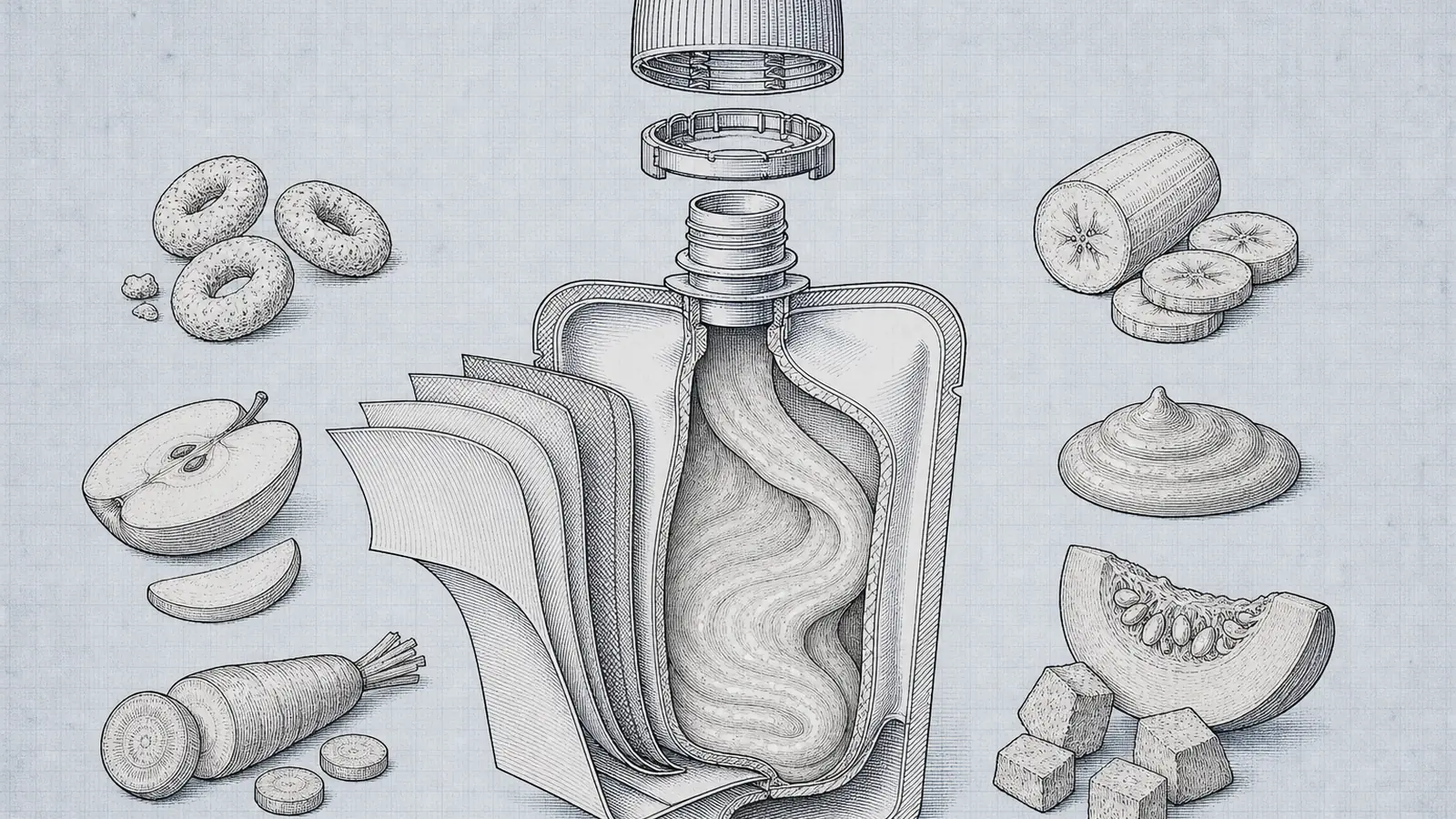
Here is an assumption I did not know I was carrying until a grocery audit knocked it over: that the little pouches and puffs on the baby aisle had to clear some kind of bar. Somebody official, I figured, had decided that food sold specifically for a 14-month-old was held to a stricter standard than the chips two aisles over. Why wouldn’t it be? These are babies.
It turns out no one decided that. There is no bar.
Researchers at the University of Texas at Austin walked into 21 grocery stores and read the label on every product marketed for children aged 6 to 36 months. Not formula, not juice, not the plain first-food purees, but the real toddler-aisle economy: the fruit pouches, the melty puffs, the shelf-stable mac and cheese. They ended up with 2,783 products. When they ran each one through the NOVA processing scale, 81 percent came back ultra-processed. Four in five. Then they checked those foods against a World Health Organization nutrient-profile benchmark for foods marketed to young children, and 49 percent failed at least one of its limits.
The work was presented in late July at NUTRITION 2026, the American Society for Nutrition’s annual meeting, so it is a conference abstract that has not cleared peer review, and I want to be straight about that. But this is mostly label arithmetic, not a fragile statistical model that could wobble in review: the researchers read the sugar, sodium, and calories printed on the boxes.
The grams are what made me put my own pouch down. 17 percent of the products blew past the WHO’s sugar ceiling, 25 percent exceeded the sodium limit, and 12 percent failed on energy density. The lead researcher, Erin Hudson, singled out fruit pouches for excess sugar, mac and cheese for sodium and fat, and peanut butter puffs for the trifecta of sodium, fat, and calories. The ultra-processed items, she found, were high in sugar “without additional nutritional benefits.” Sweetness with nothing riding along.
A toddler is not a small adult with a small appetite. Ages two and three are a wiring window: the gut microbiome is still assembling itself, and the palate is being trained in real time, deciding what “normal” tastes like for the next several decades. That is exactly why a Canadian team is running a controlled Mediterranean-diet trial in two- and three-year-olds right now, feeding them real food for three weeks and sampling their stool to watch the microbiome respond. They call toddlerhood “a critical window when the gut microbiome is still developing and eating habits are being established.” Wait, why would three weeks of diet in a two-year-old matter that much? I had to sit with that one. Because you are not just filling a stomach, you are setting a thermostat.
So think about what ultra-processing does inside that short window. Many of these snacks are built to be soft, sweet, shelf-stable, and easy to eat, which usually means the fruit’s structure has already been broken down before it reaches the child. A whole apple makes a toddler work, and its fiber slows the sugar to a trickle. A pouch labeled with the same fruit arrives pre-smoothed, the fiber matrix gone, the sweetness freed. Do that at snack after snack and the worry is what it trains: a reward system learning that food shows up sweet and effortless, a gut learning that fiber is optional. The label says “fruit.” What is in your hand is closer to candy wearing a health halo.
Which is exactly what the aisle is selling. Hudson’s own framing nails it: “Many parents may assume that products sold on the baby/toddler food aisles of their grocery stores have to meet certain nutrient standards.” They don’t. In the United States there is no rule requiring toddler food to meet any nutrient standard, and no requirement to warn a parent about a box that runs high in sugar, sodium, or calories. A company can put a cartoon and the word “toddler” on sweetened puffs, shelve them next to the purees, and let the aisle itself do the vouching. The parent supplies the trust; the regulator supplies nothing.
We have known for years that diets built on ultra-processed food track with worse health, with the literature tying them to cardiovascular disease and to cancer, and a 2024 Nature Medicine review pulling the harms together in one place. Adults at least get to make an informed bad choice. A toddler eats what is bought for them, and what is bought for them is shaped by an aisle no one has made answer to a standard that already exists on paper at the WHO.
The hopeful part is that none of this is fate. A multicenter randomized trial in Brazil tested whether you can simply keep the ultra-processed food out in the first place. Researchers gave 516 mothers UNICEF-based feeding guidance plus five monthly phone calls, and the intervention children ate roughly 33 grams less ultra-processed food a day by their first birthday and less added sugar, while nursing longer and getting less formula and toddler milk pushed on them. Counseling. Phone calls. No product required. The palate can be set toward whole food as easily as toward the pouch, if someone decides to set it.
I have fed a small child from that aisle, trusting it the way I described at the top. I won’t anymore. I would read the NOVA logic and the sugar grams before the front-of-package claims, treat “toddler” on a box as marketing rather than a credential, and reach for the whole apple, the plain yogurt, the actual peanut over the puff, precisely because the window is short and the wiring is still soft. And I would stop waiting for a warning label that, in this country, no one has yet been required to print.
Sources
- ScienceDaily – “4 in 5 toddler foods are ultra-processed” (audit summary, NUTRITION 2026), July 2026
- UT Austin College of Natural Sciences – Hudson & Burgermaster toddler-food audit, researcher quotes and WHO nutrient-profile comparison
- EurekAlert! – “80% of toddler foods on grocery shelves are ultra-processed,” per-nutrient breakdown and product examples
- Baratto et al., J Hum Nutr Diet (2025) – RCT preventing ultra-processed foods and added sugar in the first year of life
- ClinicalTrials.gov NCT07309536 – MUNCHIES Mediterranean-diet toddler microbiome trial
- Nature Reviews Cardiology (2024) – ultra-processed foods and cardiovascular disease
- The Lancet Regional Health – Europe (2024) – ultra-processed foods and cancer
- Nature Medicine (2024) – the harms of ultra-processed foods