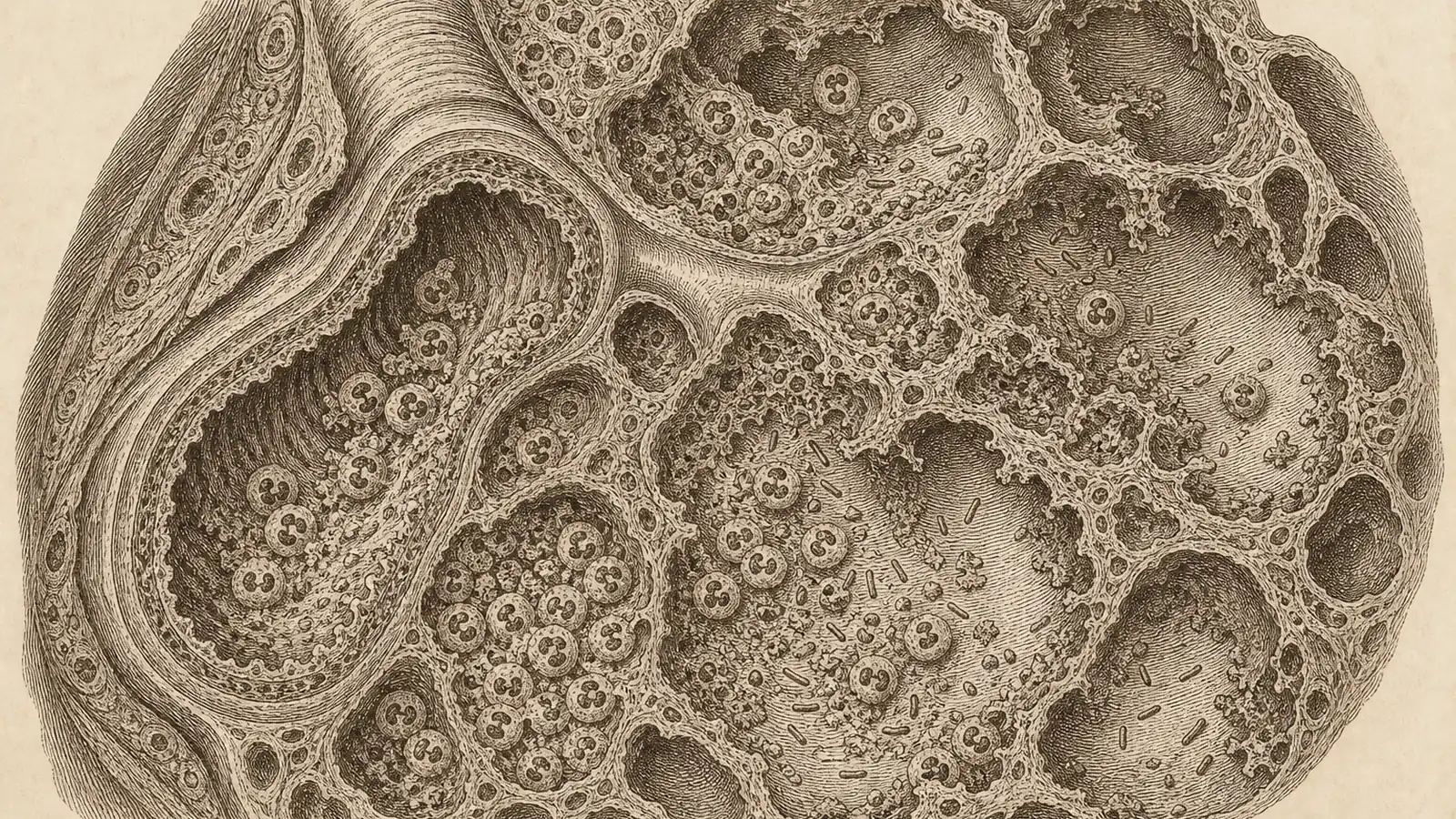
For as long as I have been reading tuberculosis immunology, I pictured the fight in the lung as a contest between two cells: the macrophage that swallows the bacterium whole, and the T cell that tells it when to strike. Everything else was crowd. So when a new Nature Immunology commentary landed with the title “the neutrophil is neutral in name alone,” my first reaction was to squint at it. Since when is the neutrophil a lead in this story?
The name is a hundred-year-old accident. Neutrophils got it because their granules take up neutral dyes, staining neither the pink of eosin nor the blue of the basic stains, and the label stuck: the immune system’s disposable first responder, the cell that floods in, dumps its chemicals, and dies within a day. In TB it was written off as a bystander, sometimes a nuisance, never the plot. The new work says that bystander may be the cell organizing the response that scars the lung, and that if we learned to read it early, we might spot who is about to fall sick before they cough once.
A team led by Will Branchett and Anne O’Garra at the Francis Crick Institute, working with clinicians in Leicester, told me I had the cast list wrong. The mechanism they found is uglier and more precise than “bystander,” and I have not been able to put it down.
The study nobody had done
Most TB immunology runs on blood, because blood is easy to draw. TB does not live in blood. It lives in the airway. So the Leicester team did the hard thing and went there, threading bronchoscopes into the lungs of people who had recently shared a home with someone sick with pulmonary TB, washing out the airway to see which immune cells were actually camped in it. They collected more than 200 bronchoscopy samples, the largest bronchoscopy study of TB contacts ever run in the UK, scanned the same people with PET-CT, and followed them for two years to see who stayed well and who did not.
That design is what makes it rare. This is low-incidence Britain, not a high-burden setting, so they caught people at the earliest edge, before symptoms, and watched the two roads split. Then they read the cells three ways, bulk RNA sequencing, single-cell sequencing, and flow cytometry, one cell at a time instead of averaging the crowd.
The fire that feeds itself
In the contacts whose infection took off, the airway was not a contest. It was a flood. Neutrophils poured in and took over the space, and about 50 percent of them had switched on a type I interferon gene program, the same interferon alarm O’Garra’s lab first flagged in the blood of TB patients fifteen years ago, back then already driven by neutrophils. Finding it now in the airway itself, in the very cells doing the flooding, closes a loop the field has been circling since.
And all of those neutrophils appeared to be pumping out high levels of CXCL8, a chemical flare whose only job is to call more neutrophils into the tissue. Sit with that. The cells drowning the lung were screaming for reinforcements, and the reinforcements arrived screaming the same thing. More neutrophils, more CXCL8, more neutrophils, a fire pouring on its own fuel while the bacterium sits in the middle of the blaze it lit.
And the T cells I had cast as the heroes? They were losing. The more neutrophils crowded in, the fewer T cells remained, and the ones still there looked, in Branchett’s words, like they had been pushed too hard: exhausted, dying, spent before the fight was settled.
The other road
Now the people who controlled the infection and never got sick. Their T cells were not charging the line. They sat in what the team called a regulated, “stem-like” state, a reserve that holds its shape over the long haul, not whipped into a frenzy and not burned out, just holding.
This is the finding that rearranged my mental model. I had always assumed protection from TB meant a harder punch, a more aggressive attack. The data say the reverse. Protection is restraint. The lung that wins is the one that never lets the neutrophil flood start, so the T cells never get shoved aside and drowned. “It’s about getting the balance right,” Branchett put it: control the bug without torching the tissue. The people who progressed did not fail to respond. They over-responded, in the wrong cell, in the wrong place.
The team saw the same pattern in non-human primates and in mice, which is what lifts it above a one-cohort curiosity, and it fits a thread other labs have pulled for years, that the way a cell dies inside a TB lesion can help the bacterium or hurt it, and that the neutrophil can clear the bug under the right antibody conditions and wreck the lung under the wrong ones. Neutral in name alone.
Why the wrong cell matters
Tuberculosis just reclaimed the title of deadliest infectious disease on earth from COVID, killing roughly 1.25 million people in 2023. About a quarter of humanity carries the bacterium silently, and only about one in ten will ever get sick. For a century our defense has been a single vaccine, BCG, older than antibiotics, and no reliable way to look at an infected person and say who is walking the dangerous road.
And we fund the fight like it belongs to someone else. In 2023 the world set a 22 billion dollar annual target for TB and put up 5.7 billion, roughly a quarter of what its own agencies say the disease needs, then those same agencies called the death toll a tragedy. The deadliest bug on the planet gets afterthought money.
So a marker would matter enormously. If a neutrophil signature and a CXCL8 loop flag the people about to progress, you could test for it before anyone coughs and treat the ones who light up. And the drug that suggests itself is not a new billion-dollar molecule. CXCR2 inhibitors, which block the very receptor CXCL8 uses to summon neutrophils, are already in trials for other lung conditions. Repurposing one to cool a TB airway is at least imaginable.
I will say the honest limit loudly: nobody has run that trial in TB. This is a mechanism and a hypothesis, not a therapy, and the jump from “we blocked the loop in a mouse” to “we saved a lung in a person” is exactly where a lot of beautiful biology goes to die. But the idea that you could treat TB by calming the immune response instead of only poisoning the bug, in a disease where the drugs take months and resistance keeps climbing, is the kind of turn I read this beat hoping to find.
If I were one of the two billion people carrying this bug quietly, I would not want the test that reads my skin and shrugs. I would want the one that reads my neutrophils, and I would want it before the fire starts feeding itself, not after my T cells are already spent.
Sources
- Nature Immunology – Branchett et al., “Airway immune signatures of protection and disease progression in recent human tuberculosis household contacts” (2026)
- Nature Immunology – News & Views, “In tuberculosis, the neutrophil is neutral in name alone” (2026)
- EurekAlert / Francis Crick Institute – “The early immune clues that determine who develops TB” (2026)
- University of Leicester – “A ‘balanced’ immune response in the lungs is key to protection from TB” (June 2026)
- bioRxiv – Branchett et al., preprint of the airway-signatures study (2026)
- Nature – Berry et al., “An interferon-inducible neutrophil-driven blood transcriptional signature in human tuberculosis” (2010)
- WHO – “Tuberculosis resurges as top infectious disease killer” (2024)
- Immunity – “Macrophage and neutrophil death programs differentially confer resistance to tuberculosis” (2021)
- Nature Microbiology – “Fc-engineered antibodies promote neutrophil-dependent control of Mycobacterium tuberculosis” (2024)