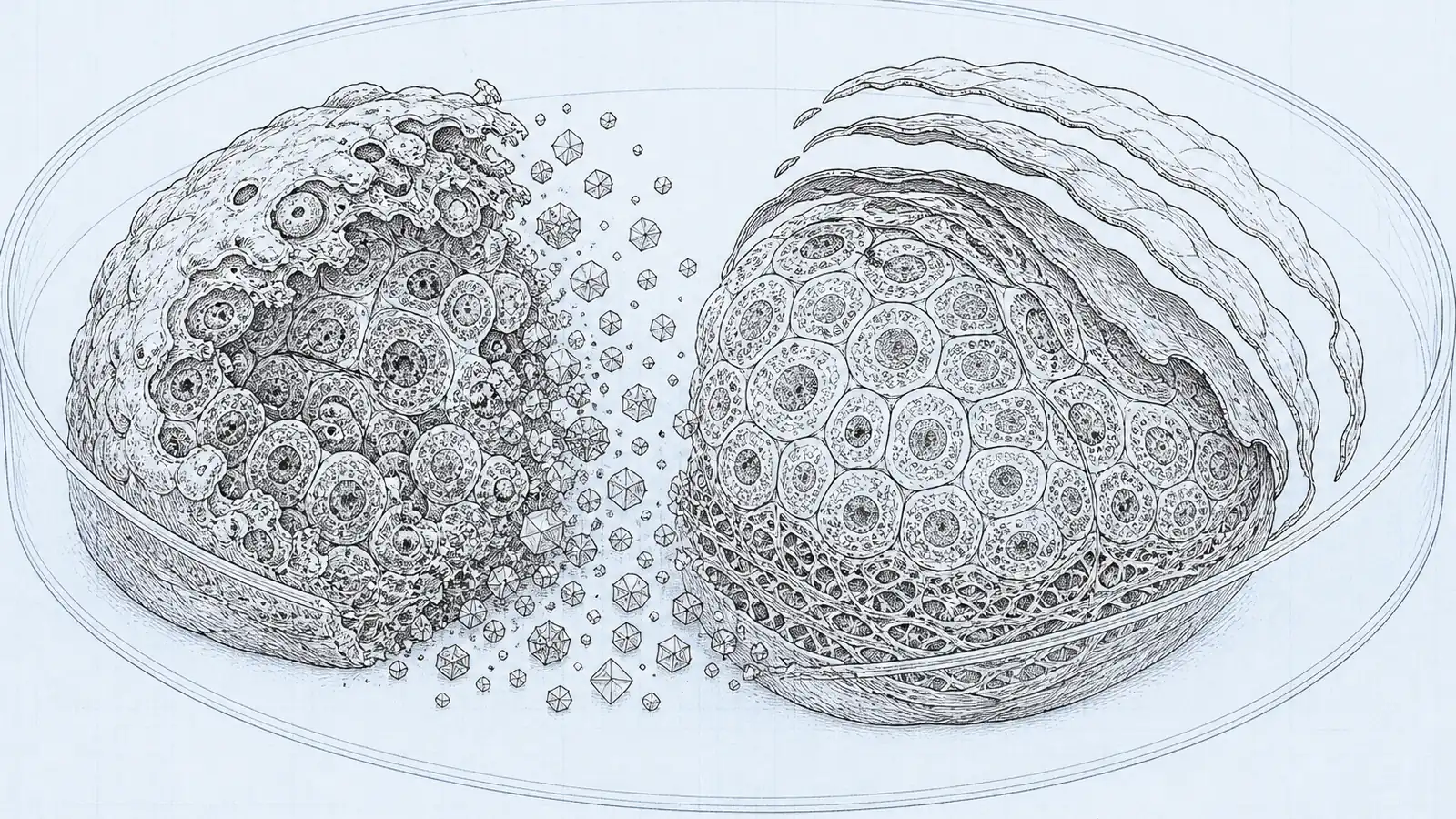
A woman finishes six rounds of platinum chemotherapy for ovarian cancer. The scans come back clean, the tumor marker drops, and for a stretch of months everyone in the room lets themselves believe it worked. Then, in most cases, it comes back. And when ovarian cancer comes back it rarely stays where it started: it seeds itself across the abdominal cavity, and that spread, not the original tumor, is what kills. Roughly 90 percent of the deaths from the disease trace to metastasis, not to the mass a surgeon first found.
The comfortable assumption about the cells left behind after chemotherapy is that they are the losers of the fight, damaged and dormant, sitting quietly until something wakes them. A team at The Wistar Institute, writing in Nature Aging, spent its effort on the more uncomfortable possibility: that the survivors are not asleep at all.
They are senescent, which is a specific thing. “Some cancer cells that survive chemotherapy aren’t dividing anymore, but they’re still biologically active,” said Aidan Cole, the postdoctoral fellow in Katherine Aird’s lab who is first author on the paper. Done dividing, in other words, but chemically loud, still leaking a stream of molecules into the neighborhood around them. What Cole and his colleagues report is that one of those molecules is a sugar. The chemo-surviving cells secrete fructose, and the fructose behaves like a set of instructions to the tumor cells nearby.
The instruction, stripped down, is to let go. Fructose suppresses cholesterol production in the cells that receive it, and cholesterol is part of what holds one tumor cell fast to another, the biological glue at the cell membrane. Starve the glue and the adhesion weakens. Cells that were anchored come loose, and cells that come loose are cells that can travel. Which makes this as much a story about cholesterol as about sugar. “As far as we know, this is the first time anyone has shown, in a preclinical model rather than just a dish, that it’s the molecules these cells release, not the cells themselves, that drive the cancer’s spread,” Cole said.
You do not need to have survived chemotherapy to bathe your cells in fructose. The Wistar group reports that high dietary fructose, the kind delivered by high-fructose corn syrup that runs 8 to 20 percent of daily calories in some Americans, produced a similar loosening effect on its own, no chemotherapy required. The sweetener the food industry has long defended as no worse than table sugar is, in this model, doing metabolic work on tumor tissue that nobody ordered.
And then the mechanism turns, and it turns toward the medicine cabinet. If lowering cholesterol is what helps these cells detach, then a drug whose entire job is lowering cholesterol becomes a fair question. Statins, taken by roughly 39 million Americans, do exactly that. In the Wistar work, lowering cholesterol decreased cellular adhesion, the same doorway fructose was using. To their credit, the researchers did not bury this. “We haven’t tested this effect in patients yet, but it raises questions about combining cholesterol-lowering drugs with chemotherapy, especially since ovarian cancer is most common in postmenopausal women who are often already on statins,” Aird said. That is precisely the population most likely to be on a statin and most likely to be sitting in an infusion chair at the same time.
The lab found that lowering cholesterol helped the cancer cells let go. The advice that immediately followed was to keep lowering it: no patient should stop a prescribed statin over a mouse study, the team stressed, and they are right to say so. But the gap between the finding and the reassurance is worth sitting in for a moment, because it is the gap where the next decade of trials should go, and if the pattern holds, it is exactly the kind of gap that stays unfunded when there is no new drug waiting at the end of the trial to pay for it.
The honest limits are worth stating plainly. This is cells and mice, not a single human patient followed from diagnosis to outcome. It says nothing yet about whether cutting fructose changes how any real woman’s cancer behaves, and Aird’s own team is first to say the fructose-restriction question is untested in people. What the work does is name a plausible, mechanically detailed route by which a common sugar and a common drug could each nudge a cancer toward the thing that actually does the killing. The people who found it were paid by the NIH, the American Cancer Society, and the Ovarian Cancer Research Alliance, not by anyone with a product riding on the answer, which is part of why the finding gets to be inconvenient in three directions at once.
Aird thinks the mechanism will not stay confined to the ovaries. Pancreatic, colon, and liver cancers all spread through the same crowded real estate of the torso, and she suspects they may read the same chemical signals. She will not call it universal, and she is careful not to. What she will say is that the cells everyone assumed were finished are still talking, and that what they are handing their neighbors is sugar.
Sources
- Nature Aging – Cole, Aird et al., “The chemotherapy-induced senescence-associated secretome promotes cell detachment and metastatic dissemination through metabolic reprogramming” (2026)
- The Wistar Institute – “Wistar Scientists Identify Fructose as a Surprise Driver of Cancer Spread” (press release, funding and quotes)
- EurekAlert – Wistar release, mechanism and preclinical-model detail
- MedicalXpress – “Scientists identify fructose as a driver of cancer spread,” dietary fructose figures
- Inside Precision Medicine – “Fructose Contributes to Metastasis in Aggressive Ovarian Cancer,” statin context
- ScienceDaily – “A common sugar may help cancer cells break free and spread”