Maureen Cox has a drug she likes, and you can hear it when she talks about her own results. “It looks really promising that we can use this drug, which is already on the market, to target BDNF,” the University of Oklahoma immunologist told her institution’s news office when her lab’s work appeared in Cell Death & Differentiation this month. Promising is the word that launches a thousand press releases. What is promising, and to whom, is the part worth slowing down on.
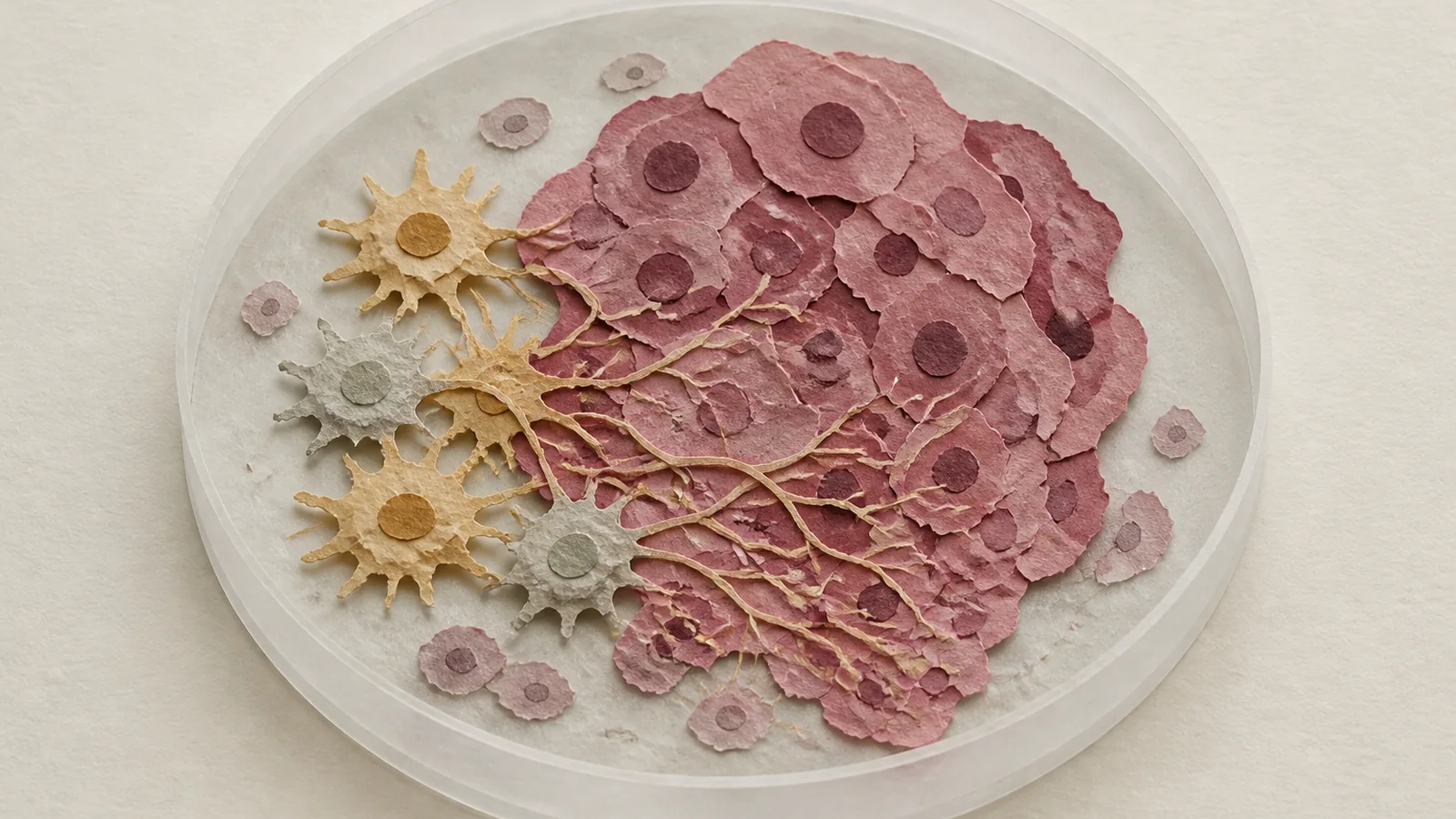
The finding underneath the enthusiasm is elegant, and it turns a familiar cell into a traitor. Macrophages are the body’s cleanup crew, the immune cells that turn up at wounds and infections to eat debris and run the repair. Cox and her colleagues, led by first author Jumana Abbadi, report that triple-negative breast tumors recruit these healers and put them to work on the tumor’s behalf, secreting a protein called brain-derived neurotrophic factor, BDNF, that acts as a beacon pulling nerve fibers into the tumor. New nerves, more growth. The repair cell becomes the tumor’s contractor, wiring the building for the tenant. “Macrophages are the critical source for drawing nerves into the tumor,” Cox said.
It is a breast-cancer drug candidate, in mice, with a plausible story and an empty trials column.
In mice, the causal chain holds. When the team hit the pathway with a drug that blocks BDNF signaling, the nerves stopped growing into the tumors and the growth slowed sharply. Cox’s reading goes a step further than the anatomy. She believes the tumor-infiltrating nerves are immunosuppressive, quieting the very immune response that might otherwise reject the cancer. “We believe that the nerves are immunosuppressive,” she said, “so if we can stop the nerves from growing in the first place, maybe we can boost the immune response to help fight the cancer.”
Maybe. The mice earned a mechanism. The patients got a correlation.
The human half of the study looks back at existing tumor samples and finds that triple-negative cancers carrying more macrophages and more BDNF tended to belong to patients who did worse. It points somewhere, and it is a thread you pull. It is also, by the authors’ own account, not proof that macrophage-derived BDNF causes the worse outcome. No one in that dataset was given the drug, and no one was randomized to anything. Tumors that do worse do worse for a hundred braided reasons, and this study can name one strand without proving it pulled the others.
Which returns us to the drug that is “already on the market,” the phrase doing the heaviest lifting in every writeup of this work. The appeal is obvious: a repurposed compound can skip some of the early safety work and reach patients faster than a molecule built from scratch. But read what the coverage concedes in the same breath. The drug is available clinically for another purpose entirely, and its safety and effectiveness against breast cancer remain unproven. A drug approved for one job is not a breast-cancer drug. It is a breast-cancer drug candidate, in mice, with a plausible story and an empty trials column. And which drug? The compound at the center of the good news goes unnamed in the coverage.
None of this shrinks the science. Tumor innervation, the idea that cancers cultivate their own nerve supply, has been one of oncology’s more interesting frontiers for a decade, and pinning the recruiting role on macrophages through a specific, druggable pathway is the kind of mechanistic work that moves a field. Public money paid for it: NIGMS grants and Oklahoma’s Tobacco Settlement Endowment Trust, settlement and taxpayer dollars doing the unglamorous work the market tends to skip until there is a product in view. That is the system doing what it is supposed to do, which is the strongest argument for not overselling what it bought.
The distance between “we blocked a protein and mouse tumors grew less” and “we can treat women with this” is measured in years, and in trials nobody has designed yet, let alone run. Triple-negative breast cancer, which lacks the three receptors most targeted therapies aim at, is the disease where a new mechanism would matter most, which is also why the pull to round the preclinical up to the clinical is strongest here. Cox has already moved on, to whether the same nerve-recruiting trick turns up in ovarian cancer. The drug she likes will still be on the shelf, approved for something else, when she gets back.
Sources
- Cell Death & Differentiation – Abbadi, Cox et al., “Macrophage-secreted brain-derived neurotrophic factor promotes tumor growth in triple-negative breast cancer by inducing axonogenesis” (2026)
- University of Oklahoma – “Researchers Discover How Tumors Enlist Nerves to Keep Growing” (press release, 2026)
- ScienceDaily – “Scientists uncover the hidden nerve network fueling breast cancer” (2026)
- News-Medical – “Breast cancer co-opts the immune system to attract nerves that fuel tumor growth” (2026)
- Bioengineer.org – “Study reveals how tumors recruit nerves to sustain their growth” (2026)