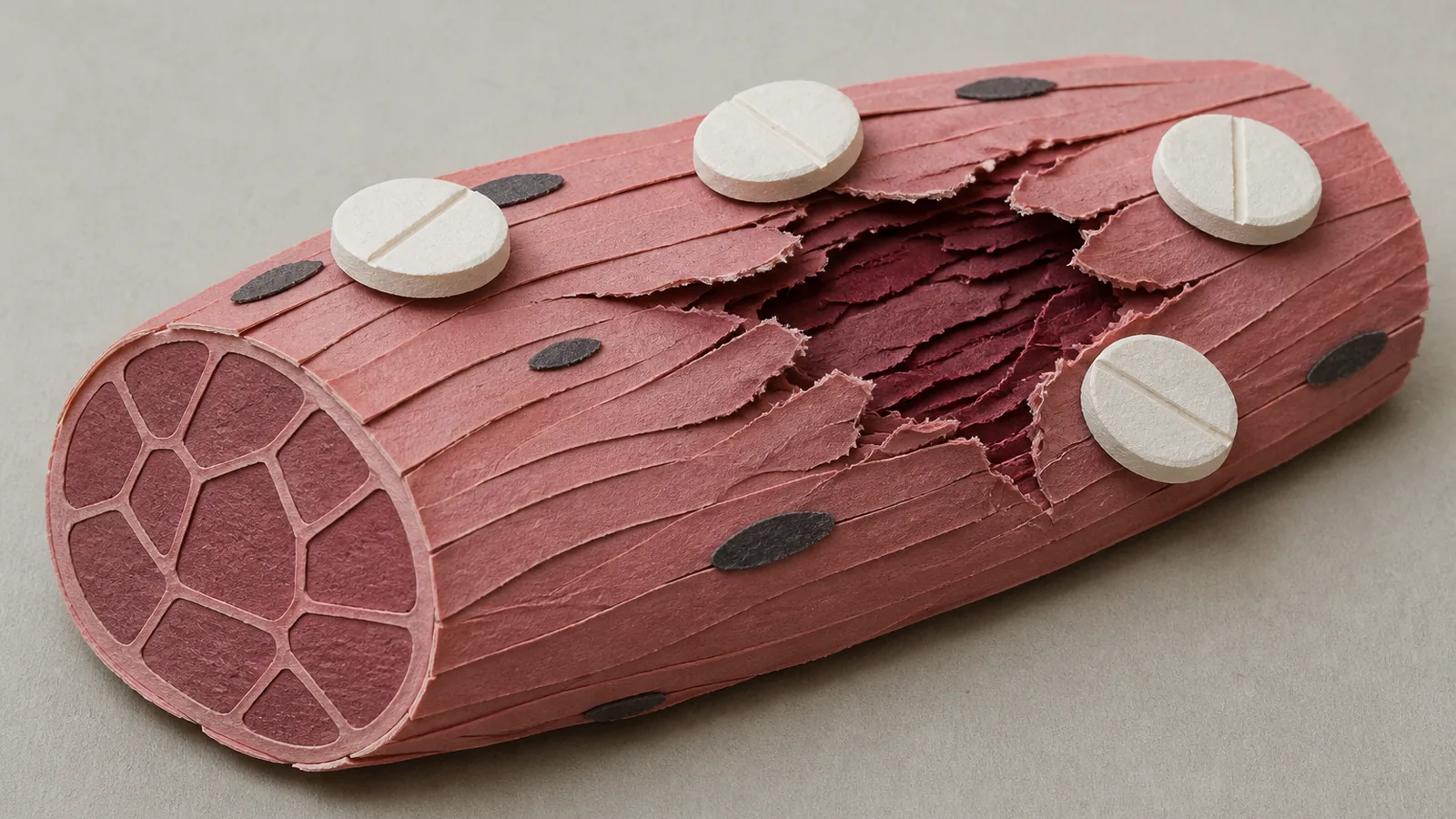
In 2020, a group of cardiologists at Imperial College London sat sixty patients down, handed them bottles that were sometimes a statin, sometimes a placebo, and sometimes empty, and asked them to rate their aches day by day. The patients hurt about the same whether the pill contained a drug or nothing at all. Something like ninety percent of the symptom burden people blamed on statins showed up on the placebo too, and the verdict traveled fast: the aches were mostly a nocebo effect, the physical residue of expecting to feel bad. The pain was real, the study allowed, generously. It just, in that trial, mostly wasn’t the drug’s chemistry.
That verdict did a great deal of work over the next five years. It reassured prescribers, it turned patient complaints into a teachable moment about the power of suggestion, and it fit neatly with a guideline expansion already underway. By 2024, updated criteria had made more than half of American adults between thirty and seventy-nine eligible for the drugs, widening the pool without anyone slowing down to ask why so many of the people already in it kept quitting. The ones who said their legs ached were, increasingly, told what the trial had told them: it’s the tablet, not the statin.
Then a lab in Hamilton, Ontario went and looked at the muscle cells.
The study came out of Jonathan Schertzer’s lab at McMaster University, published in Science Advances in June, with Nazli Robin and Nicole Barra as first authors. It is not a human trial, and it does not pretend to be one. What it is, is the first tidy account of a biological mechanism by which a statin can damage a muscle cell directly, through a route that has nothing to do with the cholesterol the drug is prescribed to lower.
Here is the chain the team assembled. Statins work by throttling an enzyme early in the cholesterol-manufacturing line. That same line also produces a family of molecules called isoprenoids, which cells use to tack tags onto proteins so those proteins know where to go. Choke off the line and you starve the cell of isoprenoids too. In the McMaster experiments, that shortfall dropped protein prenylation, disrupted a signaling protein called YAP, pushed a stress factor named FOXO into the cell nucleus, and lit up the NLRP3 inflammasome, the muscle’s own internal alarm system. The alarm, once tripped, drove the cell toward atrophy and death. The researchers watched it happen in mouse and human muscle cells and in live mice, using fluvastatin, atorvastatin, and cerivastatin, and they found that a dose of bacterial lipopolysaccharide, a standard way to mimic the low-grade inflammation that rides along with infection or metabolic disease, lowered the statin dose it took to start the damage.
The clean part is what they did next. They tried to rescue the cells two ways. Restoring the cell’s isoprenoids prevented the damage. Restoring its cholesterol did not. Blocking NLRP3 spared the muscle just as well. In Schertzer’s own summary, the mechanism causing the muscle trouble “appears to be separate from the mechanism that lowers cholesterol,” which is the scientist’s careful way of saying the side effect is not the price of the benefit. It is a second, avoidable thing the drug happens to do on the way.
None of this proves that the sixty patients in London were feeling their inflammasomes fire. Mouse muscle is not human muscle, a cell in a dish is not a leg on a staircase, and human studies have not begun. What it does destroy is the lazy assumption underneath five years of nocebo commentary, that there was no tissue injury worth looking for. The nocebo work measured what patients reported on a symptom scale. It never looked inside the muscle, because on the reigning theory there was nothing there to find. The estimated 7 to 29 percent of statin users who describe muscle symptoms were, in the establishment’s telling, a population of the suggestible. The McMaster work says at least some of them may have been describing a real injury the researchers weren’t set up to see.
reported prevalence
- Lower bound
- 7
- Upper bound
- 29
That distinction is not academic for the more than half of adults the guidelines now make eligible for these drugs. A patient told that her pain is a psychological artifact is a patient invited to push through it, or to feel foolish for stopping. A patient told her pain runs through a specific immune pathway is a candidate for a fix. The obvious commercial reading of the McMaster finding is an add-on drug, an NLRP3 blocker to sell alongside the statin. That is not what the paper proposes; it is just where the incentives point, because a pill to counter the side effect of a pill is exactly the kind of product this industry knows how to build. The less lucrative reading, that some people’s bodies simply should not be pushed to the maximal tolerated dose the guidelines prize, will get less attention.
The work was funded by Canada’s public science agency, the NSERC, not by a statin manufacturer. It is worth noting because it is the kind of study a manufacturer had little commercial reason to commission: there is no blockbuster in confirming that the aches your customers report are mechanically real, and every reason to prefer the version where the aches were in their heads.
Schertzer is not a statin skeptic. He calls the drugs “among the most effective medications we have,” and the caveat is sincere, not throat-clearing. But his lab has now done the one thing five years of nocebo commentary never got around to doing. It took the complaint seriously enough to go look for the injury, and it found a pathway waiting where the profession had insisted there was only imagination.
Sources
- Science Advances – Robin, Barra et al., “Statins promote muscle metabolic danger and NLRP3-mediated myopathy via lower protein-prenylation and YAP” (2026)
- Medical Xpress – McMaster reporting, prevalence and researcher quotes
- PubMed – abstract, PMID 42319925
- TCTMD – “Both Statins and Placebos Produce ‘Very Real’ Side Effects: SAMSON”
- JACC – “Side Effect Patterns in a Crossover Trial of Statin, Placebo, and No Treatment” (SAMSON data, 2021)
- Michigan Medicine – “More than half of U.S. adults now qualify for statins under new guidelines” (2024)
- ScienceDaily – “Scientists may have found a way to prevent statin muscle pain” (2026)