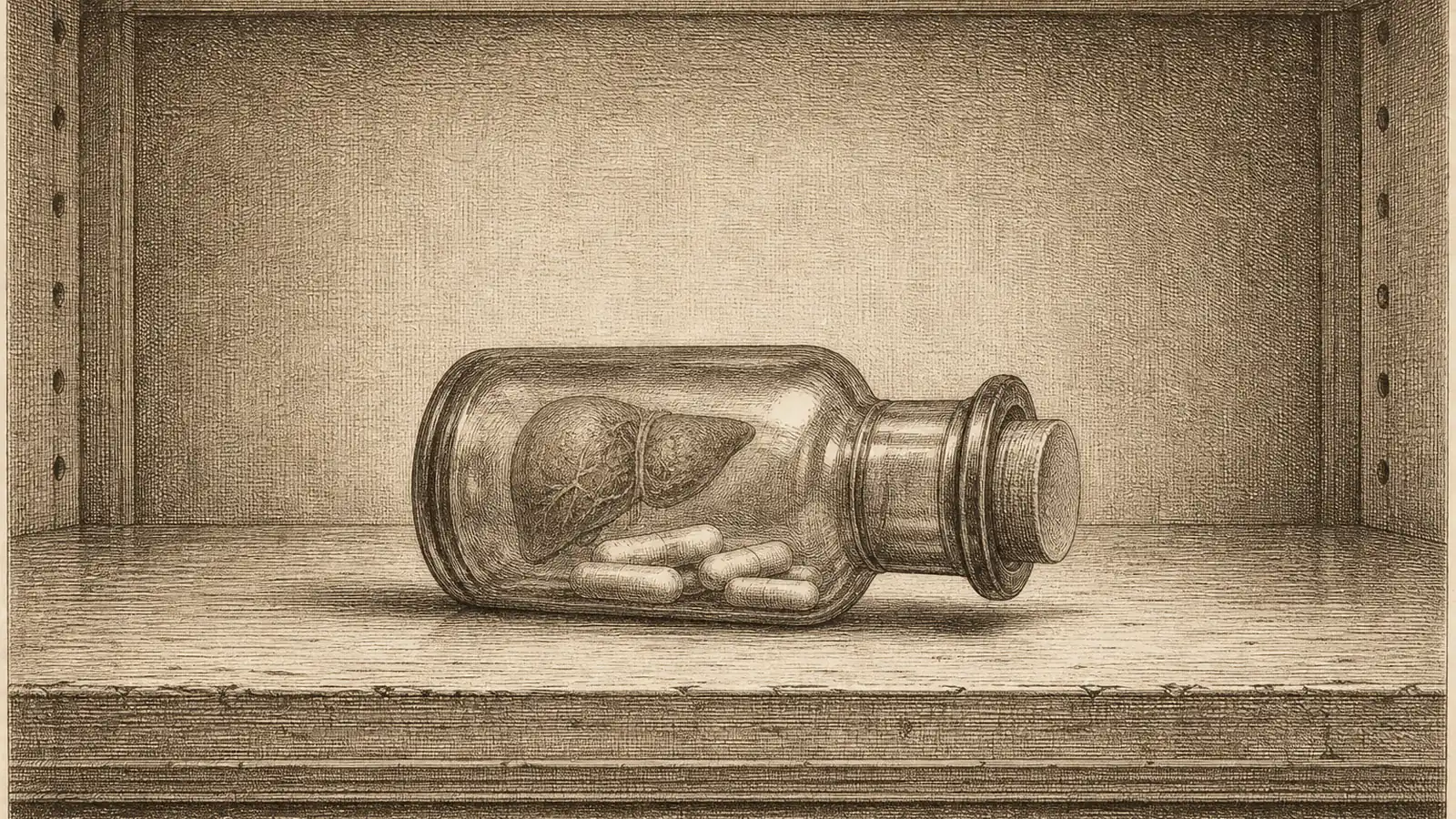
For years I filed narcolepsy under “too little wakefulness,” a stimulant problem, something you push through with coffee and grit. The thing that stopped me cold about this approval is that the framing is backwards. It is really a disease of a missing molecule, and the FDA just approved the first drug that puts that molecule’s signal back instead of flogging a tired brain into staying awake.
Here is what the approval headline skips, though. This is Takeda’s second run at the target. The first orexin pill it built, TAK-994, worked beautifully and then poisoned livers badly enough that the trial was pulled mid-stream. Oveporexton, sold as Orzeyful, is the redesign that survived. It cleared the liver problem, cleared the FDA on August 5, and you still cannot buy it. Takeda calls it the first medicine to treat the underlying cause of the disease. That sentence is true. It is also the exact line a sponsor reaches for right after a program nearly died.
The biology is worth slowing down for, because once it clicks the rest of the approval makes sense. Narcolepsy type 1 is not laziness and it is not a vague sleep complaint. It is widely understood as an immune attack on a small cluster of neurons deep in the hypothalamus, the cells that make a wake-promoting chemical called orexin (you will also see it called hypocretin). Orexin is what normally holds the wall between being awake and dropping into REM sleep. Take it away and the wall dissolves. You fall asleep mid-sentence, and the muscle paralysis of dream sleep leaks into waking life as cataplexy, where a laugh or a scare drops you to the floor.
Every treatment we have had until now worked around that hole. Stimulants and modafinil whip the rest of the brain into alertness; oxybate consolidates broken nighttime sleep. None of them touch the orexin gap. Oveporexton is a selective OX2R agonist, which means it walks up to the exact receptor those dead neurons used to signal through and switches it on directly. The neurons are gone, but the receptor is still sitting there intact, and this drug rings it. I kept turning that over while I read: why would a doorbell still work when the hand that used to press it is gone? Because the wiring downstream of the receptor never died. Only the cells sending the signal did.
Does it work? The Phase 2b trial is the cleanest look. On the maintenance of wakefulness test, scored 0 to 40 minutes with 20 counting as normal and untreated patients often lasting only a few, the dose arms improved average sleep latency by 12.5 to 25.4 minutes from baseline while placebo slipped 1.2. The stronger 2 mg arm gained 23.5 minutes and landed people back in the normal range. In the pivotal Phase 3 program, FirstLight randomized 168 adults and RadiantLight another 105; the wakefulness endpoint was met and weekly cataplexy attacks fell, with the sleepiness and cataplexy measures both at p below .001. Those are company-reported topline figures until the full papers land, but for a condition this disabling, they are not incremental.
dose arms improved average sleep latency from baseline
- Lower bound
- 12.5
- Upper bound
- 25.4
So why am I not writing a victory lap? Two reasons, and the first is a body count that is not in the approval press release. TAK-994 did not just nudge some lab values. Eight patients on it blew past liver-enzyme safety thresholds and 3 of them met Hy’s law criteria, the combination of transaminase and bilirubin elevation that flags the kind of drug-induced liver injury that can kill. The nerdy part that actually reassures me is the mechanism: it was not the orexin receptor doing the damage, because orexin receptors are not even expressed on liver cells. It was a toxic reactive metabolite of that one molecule. That is precisely why redesigning the molecule could keep the wakefulness and drop the poison, and why oveporexton did not reproduce the severe liver signal. Hold both facts at once anyway. The same company, chasing the same target, was injuring livers three years ago.
The second reason is almost funny. A drug whose entire job is wakefulness gives roughly 60 percent of patients on the higher dose insomnia, against 1 percent on placebo, per the pooled data. More than half get urinary frequency, some get urgency, and there is a fair amount of excess saliva. About 11 percent had a muscle-enzyme marker, CPK, spike above five times the upper limit versus 5 percent on placebo, and two of those cases came with elevated liver enzymes too and stopped the drug. None of that is disqualifying for a disease this severe. All of it is the honest cost of switching a receptor on around the clock, twice a day, likely for the rest of your life. This does not regrow the dead neurons and it does not call off the autoimmune attack. It is signal replacement, not a cure.
| Measure | Value |
|---|---|
| Oveporexton higher dose | 60 |
| Placebo | 1 |
Here is the part that genuinely irritates me. You cannot get it yet. The approval landed, but Orzeyful still has to clear DEA controlled-substance scheduling before it reaches specialty pharmacies, and Takeda has not named a price. A first-in-class drug with no competitor, routed through specialty-pharmacy channels, launching at a number the public does not get to see until it is real. That is exactly the setup where a genuine breakthrough curdles into an affordability problem, and the people who have spent their adult lives falling asleep at stoplights are the ones who will find out what the ringing doorbell costs.
If I had narcolepsy type 1, would I want this? Honestly, yes, I would ask for it, because a drug that addresses the actual defect beats a lifetime of stimulants stacked on a broken system. But I would not sign for it starry-eyed. Given the liver history of this exact molecular family, I would ask my doctor point blank about enzyme monitoring, I would treat that first year of bloodwork as non-negotiable for myself, and I would want the price in writing before I ever swallowed the first tablet.
Sources
- FDA – Approves First Drug to Treat the Full Range of Narcolepsy Type 1 Symptoms (2026-08-05)
- Takeda – ORZEYFUL (oveporexton) approval release, pooled Phase 3 safety data
- New England Journal of Medicine – Oveporexton, an Oral OX2R-Selective Agonist, in Narcolepsy Type 1 (Phase 2b)
- Takeda – Positive Results from Two Pivotal Phase 3 Studies of Oveporexton (FirstLight/RadiantLight)
- Drugs.com – FDA Approves Orzeyful (oveporexton), with pooled safety data
- Toxicological Sciences – TAK-994 mechanistic investigation into drug-induced liver injury
- NeurologyLive – Safety Concerns Halt Phase 2 Trial of TAK-994 in Narcolepsy Type 1
- New England Journal of Medicine – Oral Orexin Receptor 2 Agonist TAK-994 in Narcolepsy Type 1 (Phase 2, 2023)