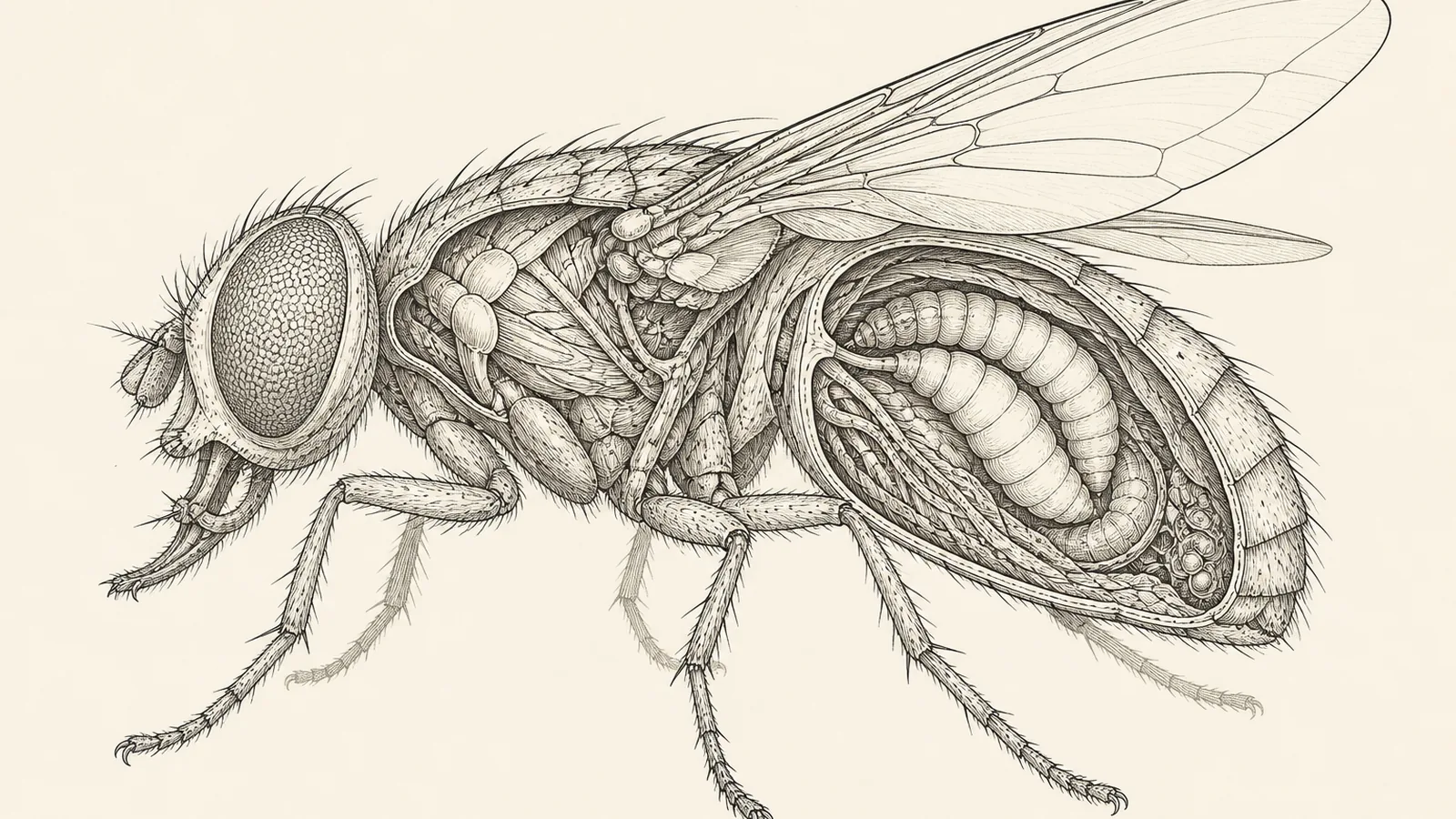
To understand why the screwworm is one of the few large-scale pests humanity has ever driven off an entire continent, start with the female fly’s sex life. She mates once. In the late 1930s an Agriculture Department entomologist named Edward Knipling noticed that quirk and built a theory around it: flood the wild population with sterilized males, let the females burn their single mating on a partner who can give them nothing, and the next generation simply fails to arrive. It took Knipling and his colleague Raymond Bushland the better part of two decades, plus a cobalt-60 source borrowed from Oak Ridge and a rearing diet of ground meat and beef blood, to turn that observation into a weapon. It worked. The sterile insect technique cleared the fly out of Florida after 1957, out of Texas after 1962, and by 1966 the New World screwworm was considered gone from the continental United States. It was later called one of the great returns on a federal research dollar in American history, and it earned its two scientists a posthumous Golden Goose Award.
- 1957cleared from Florida
- 1962cleared from Texas
- 1966gone from the continental US
- 2026the fly returns
Sixty years later the fly is climbing north again, and it has already crossed the line. On June 3, 2026, it turned up in the umbilical wound of a three-week-old calf in Zavala County, Texas, the first New World screwworm detection on US soil since eradication. Federal counts have since reached 45 confirmed infestations. And the government’s newest response is not the method that beat it the first time.
On August 7, the FDA issued an emergency use authorization for CLiK Extra, a wound spray meant to keep screwworm larvae from taking hold in sheep, cattle, goats, swine, camelids, and a list of captive and captured wildlife that runs from deer and elk to American bison, bighorn sheep, and the Sonoran pronghorn. The active ingredient is dicyclanil, an insect growth regulator that does not kill the maggots so much as sabotage their development, stalling them before they can burrow into living tissue. Ranchers are told to spray it on and around the wounds where a female fly likes to lay: the raw edges left by injury, by birth, and by the ordinary work of a ranch, from castration and dehorning to ear-tagging, tail-docking, and shearing. A chemical on a wound buys time. It has never been the thing that won this war.
CLiK Extra, in the FDA’s own words, is not approved or conditionally approved for any indication. This is not a drug that cleared the normal animal-drug review and is simply being deployed faster in a crisis. It has never cleared that review at all. It reached American pastures through the same emergency-authorization logic the public learned to recognize during COVID, and the legal bar for that logic sits far below what the word authorization suggests. The FDA did not have to find that CLiK Extra works. It had to find only a reason to believe the product may be effective, and that its likely benefits outweigh its risks, judged on the totality of scientific evidence available. Those are the agency’s criteria, and meeting them is not the same as showing the spray has prevented a single infestation in a single American animal. The authorization stays in force until the FDA revokes it or the health secretary ends the emergency declaration underneath it.
Dicyclanil is not a new molecule, which is where the scrutiny belongs. It has been sprayed on Australian sheep for decades under the CLiK brand to prevent flystrike, the local blowfly version of this same problem, so there is a safety record to read. Read it closely and it cuts both ways. When Australian regulators reviewed the chemical, and when an international residue panel weighed it for food safety, they found that dicyclanil raised the rate of liver tumors in female mice. The reviewers discounted the finding for stated reasons: the tumors showed up in one tissue, in one sex, of one species, at doses above the maximum an animal could tolerate, and the compound was not genotoxic. On that basis they judged it no meaningful cancer risk to people at expected exposures. That is a reasonable call on the evidence they had. It is also precisely the kind of question a full FDA new-animal-drug review exists to force into the open, on American food animals eaten by American families, and the emergency pathway did not require anyone to open it.
The fine print tells you the agency knows this is a chemical, not a wand. CLiK Extra carries an 86-day withdrawal before a treated animal can be slaughtered for food. It cannot be used on dairy animals at all, because no one established a safe milk-discard time. It prevents infestation and does nothing for an animal already struck. And it arrives with a corporate beneficiary: the product is sponsored by Elanco US Inc. of Indianapolis, which now holds a newly authorized commercial position in a fast-growing American market for a product it never had to carry through standard approval to sell here.
None of this means a rancher should turn down the spray. The danger is not hypothetical, and it arrived the way these things often do, up through the southern border. The fly worked its way north through Central America and Mexico, where more than 189,000 animal cases and over 2,000 human cases have been logged during this outbreak, before it reached that calf in Zavala County. Set against those numbers, the 45 infestations confirmed so far on the US side look like the leading edge of a wave, not the whole of it. Canada and Mexico have shut their borders to affected US livestock, and a rancher watching a fresh wound on a newborn calf is not wrong to want something to put on it today.
A wound spray is a stopgap, though, and it is worth saying plainly which tool actually did the job. What cleared the screwworm off the continent was not something anyone sprayed on a wound. It was the sterile fly, released by the hundreds of millions until the wild population collapsed under the weight of its own wasted matings. That capacity is what the country let wither after 1966, and it is what the USDA is now scrambling to rebuild, leaning on sterile-fly releases again while Texas moves to stand up a domestic production facility to replace the factory it closed. Watch two numbers in the coming weeks: the confirmed case count, and how far north of the border the next detection lands. If the fly keeps climbing while the factory is still under construction, the country will relearn what it already knew sixty years ago. The chemical buys time. The sterile fly wins the war.
Sources
- FDA – Emergency Use Authorization for CLiK Extra to prevent New World screwworm (2026-08-07)
- Elanco / PR Newswire – CLiK Extra receives FDA EUA (2026-08-07)
- Texas Public Radio – FDA authorizes wound spray for Texas livestock and wildlife (2026-08-08)
- CIDRAP – Mexico reports more human New World screwworm infections (2026)
- Texas Parks & Wildlife – New World screwworm confirmed in Zavala County calf (2026-06-03)
- APVMA – Public release summary on dicyclanil in CLiK Spray-on sheep blowfly treatment
- JECFA / INCHEM – Toxicological evaluation of dicyclanil residues
- Federal Register – Emergency use authorization for animal drugs against New World screwworm (2026-04-17)
- FAO – The sterile insect technique for New World screwworm eradication
- Golden Goose Award – The sex life of the screwworm fly
- Texas Tribune – How history is guiding a US attempt to beat screwworm again (2026-06-25)