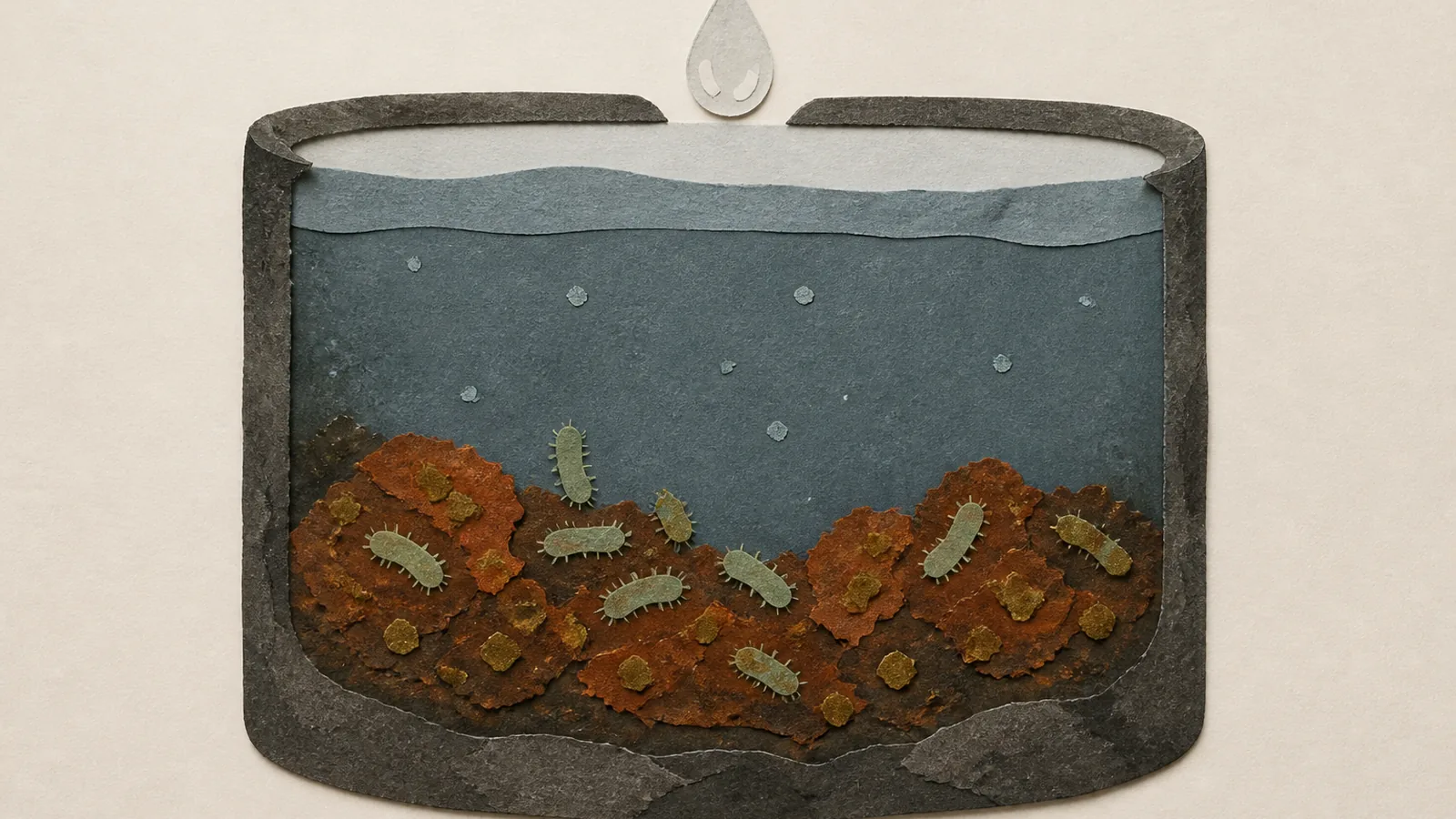
For most of my life I filed uranium in the water under problems you fix with an excavator: dig it up, seal it in a drum, haul it somewhere else, because I assumed nothing alive would want to go anywhere near the stuff. Then I read that ordinary bacteria pulled 95 percent of the dissolved uranium out of real mine water on a diet of nothing fancier than a splash of glycerol, and that when the researchers let oxygen back in, the uranium stayed put instead of washing back out. I read the abstract twice to be sure I hadn’t misunderstood the chemistry.
| Measure | Value |
|---|---|
| of dissolved uranium, in 130 days | 95% |
The study, published in Nature Communications in 2026, came out of the Helmholtz-Zentrum Dresden-Rossendorf, where a team led by Antonio Newman-Portela and Evelyn Krawczyk-Bärsch took water from a flooded uranium mine in Germany’s Ore Mountains, from a shaft roughly two kilometers down where oxygen barely reaches, and fed the microbes already living in it. After 130 days, only around 5 percent of the dissolved uranium remained. “Our study has revealed for the first time that bacteria supplied with glycerol as a carbon source can convert toxic uranium dissolved in water into a stable chemical compound,” Krawczyk-Bärsch said. Some bacteria, it turns out, can make a living off the poison.
The usual version of this cleanup carries a flaw that shows up the moment air comes back. The textbook move is to get bacteria to strip electrons off the soluble form of uranium, U-six, and knock it down to an insoluble mineral, U-four, which settles out of the water as a solid. That works right up until oxygen returns. It re-oxidizes the U-four, the uranium dissolves again, and what you thought you had buried washes back into the groundwater. Any cleanup that leans on that reduction step is fighting the same battle with the atmosphere.
So the question I kept circling was what these bacteria made that oxygen couldn’t undo. The answer is stranger than I expected. Instead of stopping at the usual insoluble form, the microbes routed the uranium into a pentavalent state, U-five, and locked it together with iron and oxygen into a compound written FeU(V)O4. Pentavalent uranium is the awkward middle child of uranium chemistry. “Pentavalent uranium does exist, but it is rare or only transient,” Newman-Portela said. It flickers into being and falls apart. Wait, why would the unstable in-between form be the one that holds? Because the iron does the holding. Wedged into that iron-oxygen lattice, the U-five sits down and stays. And when the team let oxygen back in, the amount of FeU(V)O4 went up, not down.
That is the reversal I keep turning over: the fragile oxidation state, glued to iron, outlasts the sturdy one. To gauge how long it lasts in the wild, the researchers pointed to the same compound sitting in Croatian soil contaminated by uranium ammunition, where it has stayed stable for more than 25 years under open sky. It is not the first time microbes have out-engineered our chemistry; a few years ago researchers watched bacteria in a Brazilian copper mine turn toxic copper ions into stable single atoms of metallic copper. Life has been handling metals far longer than we have, and it keeps finding tricks our engineers never thought to try.
Now the receipts on who ran this study, because they matter. One of the collaborators is Wismut GmbH, the German state company that operated those mines during the Cold War and is now charged with cleaning them up. It supplied the mine water. I don’t raise that to wave the finding away; the spectroscopy was run on real contaminated water, and the chemistry is the chemistry. But when the party holding a multi-decade cleanup bill co-authors the paper suggesting the job might be done with bacteria and a cheap sugar-alcohol feedstock, you read it with your eyes open.
The same poisoned ground is under Navajo wells
And this is where it stops being a German curiosity. America is sitting on the same problem at scale and has been looking away for two generations. The EPA counts 523 abandoned uranium mines on and around the Navajo Nation, dug to feed the U.S. weapons complex and then walked away from. Nearly 13 percent of the unregulated wells, springs, and tanks tested on the reservation run past the federal drinking-water limit for uranium, a metal that scars kidneys. The federal response has run to more than $1.7 billion in enforcement settlements and the slow, diesel-belching logic of dig-and-haul, with assessment funded at only 230 of those 523 sites. Communities that gave up their men to the mines and their aquifers to the tailings have spent decades being told the fix is coming. Scholars have a name for the arrangement: toxic colonialism.
I’ll keep my enthusiasm honest. This is one laboratory study on water from one German mine, run in sealed vessels, not a working well field. The team didn’t pin down which specific bacteria did the heavy lifting, and Krawczyk-Bärsch was plain that more work is needed before anyone can say bacteria will render uranium harmless at a real site. Aquifers are messier than a flask: competing microbes, shifting chemistry, uranium that moves. The distance between 95 percent gone in a jar and safe to drink from the tap is the whole ballgame, and nobody has crossed it yet.
But if my tap water came up through ground under one of those 523 mines, I know what I would want, and it is not another earthmoving contract with a ribbon-cutting a decade out. I would want a monitored pilot this year: a fenced test cell inside a contaminated plume, glycerol trickled in on a schedule, and a ring of sampling wells tracking uranium, its valence state, and the FeU(V)O4 signal going in and coming back out as the oxygen changes. Small, instrumented, falsifiable. I am not going to pretend a flask is a solution. I am going to watch whether anyone with the authority to fund that field trial actually does, because the biology has done its part, and every year of delay from here is a choice.
Sources
- Nature Communications – Newman-Portela et al., “Pentavalent and tetravalent uranium formation via glycerol-stimulated bacteria in mine water” (2026)
- EurekAlert – HZDR release with researcher quotes and the 130-day, 5% figures
- US EPA – Navajo Nation abandoned uranium mine cleanup overview
- US EPA – Navajo Nation water sampling results
- High Country News – EPA and the $1.7 billion uranium-waste cleanup on the Navajo Nation
- Science Advances – Wu et al., bacteria converting toxic copper ions into stable single-atom copper (2021)
- Critical Criminology – uranium mining as toxic colonialism against Native Americans (2023)